
Last updated on August 25th, 2026 at 12:25 pm
The engine control module (ECU) in your 1994 Toyota Supra manages fuel injection, ignition timing, and emissions systems. Failures may cause erratic idling, stalling, or a complete no-start condition.
If your 1994 Toyota Supra is experiencing intermittent stalling, rough idling, or a refusal to start, the engine control module (ECU) may be the culprit. This critical component governs fuel delivery, ignition timing, and emissions controls, ensuring smooth operation. Replacing it involves accessing a concealed location and following precise factory procedures. Understanding the steps—from removal to relearn—helps you assess repair options and avoid unnecessary delays. Whether you opt for a dealer visit or a pre-programmed replacement, knowing the process ensures a smoother resolution to drivability issues.
1994 Toyota Supra 3.0L:
OEM programmed replacements — plug & play, no dealer visit.
Find yours by year, make & model →
Free shipping · Lifetime warranty
In your 1994 Toyota Supra, the engine control module (ECU) acts as the brain of the fuel and ignition systems. It processes sensor inputs to adjust air-fuel ratios, spark timing, and idle speed, optimizing performance and emissions. A faulty ECU may disrupt these functions, leading to poor drivability or even a no-start condition. When replacement becomes necessary, replacement engine computers for the Supra are available to restore proper operation. Without a functioning module, the vehicle may struggle to maintain consistent power or fail to start altogether.
The ECU in your 1994 Toyota Supra is mounted behind the instrument panel, requiring dashboard disassembly for access. Factory labor estimates allocate 1.0 hour for removal and reinstallation. Before beginning work, the negative battery terminal must be disconnected, and you must wait 90 seconds from the time the ignition is turned to the ‘LOCK’ position. This precaution prevents electrical surges that could damage sensitive components. Once the module is replaced, an additional 0.5 hours is typically needed for relearn procedures to synchronize the new unit with the vehicle’s systems.
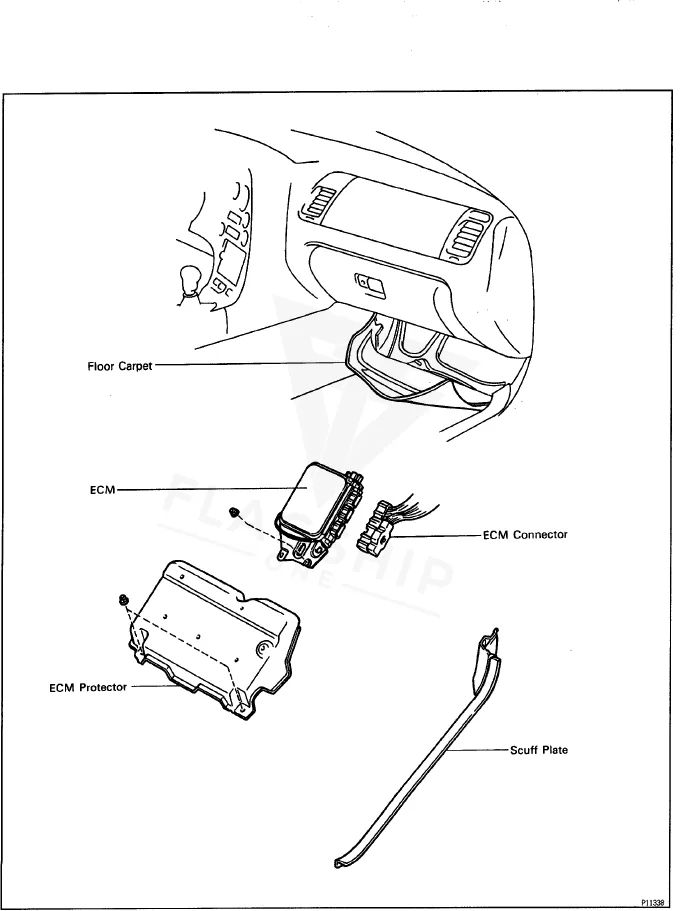
Work with the ignition off, and treat the module as static-sensitive: avoid touching the connector pins at any point.
| Operation | Configuration | Book Time |
|---|---|---|
| Engine Control Module Relearn | All configurations | 0.5 hr |
| Engine Control Module R&R | All configurations | 1.0 hr |
| Powertrain Control Module R&R | All configurations | 1.0 hr |
| Powertrain Control Module Relearn | All configurations | 0.5 hr |
After installing a new ECU in your 1994 Toyota Supra, the factory requires a relearn procedure, which typically takes 0.5 hours. This step ensures the module adapts to the vehicle’s specific calibration. However, a VIN-programmed replacement unit arrives pre-configured, eliminating the need for additional programming. This saves time and reduces the risk of incomplete synchronization, allowing your Supra to return to normal operation more quickly.
A failing ECU in your 1994 Toyota Supra may cause a range of drivability issues. Common signs include intermittent stalling, rough idling, or a complete no-start condition. You might also notice poor acceleration, misfires, or erratic shifting if the transmission is affected. In some cases, the vehicle may enter a limp mode, limiting power to prevent further damage. If scan tool communication fails entirely, the ECU could be the root cause. Symptoms like these often point to internal faults, such as memory corruption or voltage irregularities.
Common signs include stalling, rough idling, or a no-start condition. You may also experience poor acceleration or erratic transmission behavior. If scan tool communication fails, the ECU could be the issue. Diagnosing these symptoms early helps prevent further drivability problems.
Replacement is possible if you have mechanical experience and the right tools. The ECU is located behind the instrument panel, requiring dashboard disassembly. Factory procedures mandate a 90-second wait after battery disconnection before starting work. If unsure, consult a professional to avoid electrical damage.
The relearn procedure ensures the new ECU synchronizes with the vehicle’s sensors and systems. This step, typically taking 0.5 hours, helps prevent drivability issues like rough idling or poor acceleration. A VIN-programmed replacement unit eliminates this step, saving time and effort.
If your 1994 Toyota Supra is experiencing ECU-related issues, you have options. A dealer can perform a full replacement and relearn, but labor costs may add up. Alternatively, a pre-programmed replacement unit restores functionality without additional setup, reducing downtime. Assess your needs—whether prioritizing convenience or cost—to determine the best approach for your vehicle.
Flagship One stocks a refurbished, VIN-programmed PCM for the 1994 Toyota Supra with a lifetime warranty, free shipping and no core charge. The full Toyota Supra module lineup covers other engine configurations as well.
A failing ECU in your 1994 Toyota Supra can disrupt daily driving, but replacement is straightforward with the right knowledge. Whether you choose a dealer or a pre-programmed unit, understanding the process ensures a smoother repair. Addressing symptoms early helps maintain your Supra’s performance and reliability for years to come.