
Last updated on August 25th, 2026 at 12:31 pm
The Engine Control Module in your 1991 Pontiac 6000 governs fuel delivery, ignition timing, and emissions systems through a closed-loop strategy. When this processor fails, your vehicle loses its ability to fine-tune air-fuel ratios and spark advance based on sensor feedback, typically resulting in drivability complaints ranging from hard starting to poor fuel economy.
If your 1991 Pontiac 6000 with the 2.5L engine is running poorly, hesitating under load, or refusing to start, the Engine Control Module may be the culprit. This processor acts as the brain of your engine management system, continuously adjusting fuel and spark based on sensor inputs. On vehicles from this era, the ECM relies on a programmable read-only memory chip that contains calibration specific to your vehicle’s weight, transmission, and axle ratio. When the processor itself or the calibration data fails, the engine loses its adaptive capability and runs poorly or not at all. This guide explains what the module does, how replacement and programming work, and what your options are for getting your Pontiac back on the road.
1991 Pontiac 6000
OEM programmed ECM for your 1991 Pontiac 6000 — plug & play, no dealer visit.
Free shipping · Lifetime warranty
The Engine Control Module in your Pontiac 6000 serves as the central processor for engine management. It monitors intake air temperature, coolant temperature, throttle position, and oxygen sensor feedback to calculate real-time fuel injector pulse width and ignition timing. Without this closed-loop control, your 2.5L engine would rely on fixed, less efficient maps that cannot adapt to temperature changes, altitude variations, or component wear. The module also manages the transaxle shifting strategy on automatic versions and interfaces with various output drivers that control everything from the cooling fan to the evaporative emissions purge solenoid. Its importance to driveability cannot be overstated. When searching for replacement engine computers for the Pontiac 6000, you will encounter both rebuilt and new options that differ primarily in their programming status and warranty coverage.
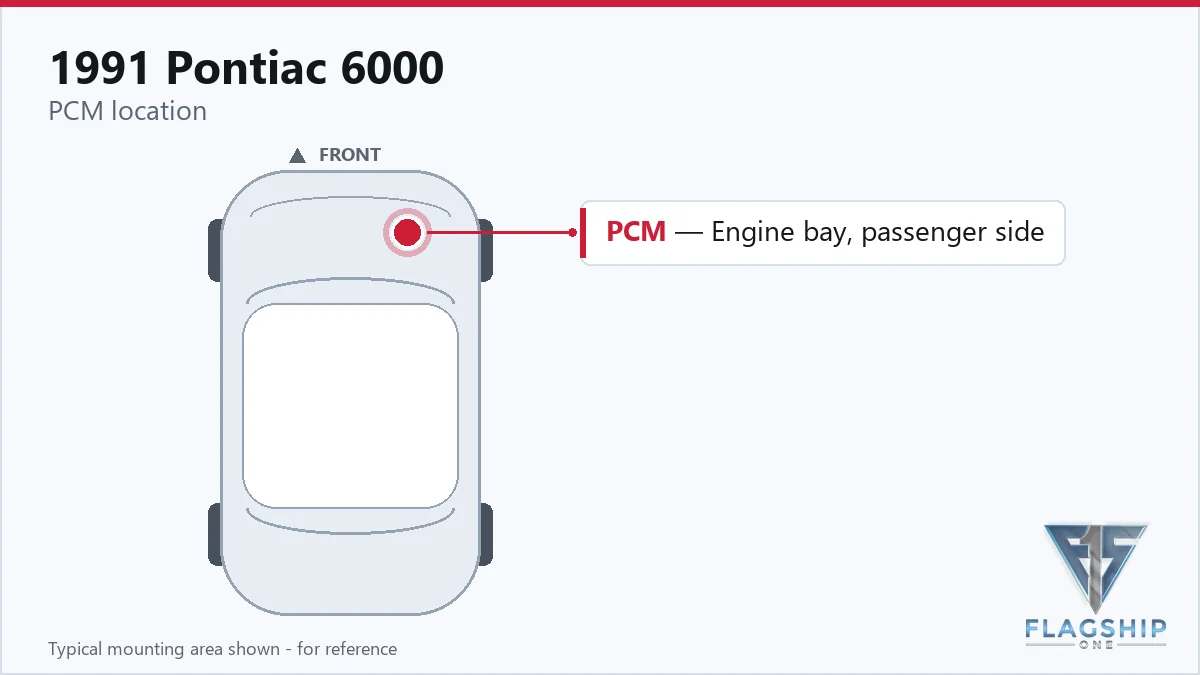
The ECM on your 1991 Pontiac 6000 is mounted inside the passenger compartment, typically behind the glove box or under the right side of the dash panel. Access requires interior trim removal and electrical connector disconnection before extracting the old unit. The replacement procedure follows the same reverse sequence. According to factory labor estimates, Powertrain Control Module removal and reinstallation requires approximately 1.3 hours of book time. After installing the new module, the vehicle enters a relearn mode for idle air control calibration and fuel mixture adjustment, a procedure that factory time estimates at 0.5 hours. Total combined labor approaches 2 hours when accounting for basic checks and verification steps. Working in an area with adequate lighting and having the correct connector pinout diagram helps avoid damaging harness wires during the swap.
| Operation | Configuration | Book Time |
|---|---|---|
| Engine Control Module R&R | All configurations | 1.3 hr |
| Powertrain Control Module Relearn | All configurations | 0.5 hr |
| Powertrain Control Module R&R | All configurations | 1.3 hr |
After physically installing a replacement ECM in your 1991 Pontiac 6000, the module requires configuration with your specific vehicle calibration data. The factory service procedure involves connecting a dealer-level scan tool or equivalent diagnostic equipment to perform an idle relearn and verify that adaptive fuel tables have reset to baseline values. Without this step, the engine may exhibit high idle speeds, stumbling during acceleration, or illuminated warning lamps. However, units sourced from Flagship One arrive preloaded with your VIN and vehicle-specific calibrations. This means the module is ready to install and run immediately after connection, eliminating the need for dealer programming appointments or separate equipment rental. You still need to allow the engine to complete its initial idle relearn cycle during the first few minutes of operation.
Every VIN-programmed replacement unit from Flagship One arrives with these steps already completed.
When the Engine Control Module fails on your Pontiac 6000, the engine typically exhibits multiple drivability problems simultaneously. A no-start condition is common when the processor stops driving the fuel injectors or fails to generate spark through the ignition coil circuit. Intermittent failures may cause the engine to stall at idle or during deceleration, only to restart normally after cooling. You might also notice a broad loss of power under acceleration, hesitation on throttle input, or rough running that feels like a misfire. On automatic transaxle models, shifting may become harsh or delayed because the ECM controls shift scheduling. A scan tool may show no communication with the module, or stored codes may indicate processor or memory faults.
The ECM must contain programming calibrated for your vehicle’s weight, engine, transaxle type, and axle ratio. Units that are not preprogrammed for your specific application will not operate correctly without dealer-level configuration using the correct software files.
Yes, a failed ECM commonly causes a no-start condition because it stops energizing the fuel injectors or fails to trigger the ignition system. However, you should verify fuel pressure and spark at the plug wires before replacing the module, as these represent more common failure points.
A salvage yard unit may physically fit and contain the correct PROM calibration, but it carries unknown history and may fail soon. Used modules also require verification that the calibration matches your vehicle exactly, and any stored fault history could complicate diagnosis.
When weighing repair versus replacement for your 1991 Pontiac 6000 ECM, consider that remanufactured units offer a middle ground between cheap used parts and expensive dealer new assemblies. Rebuilt modules typically undergo circuit board inspection and component-level repair, then receive fresh programming before shipment. New aftermarket units may arrive blank and require programming equipment you may not own or have access to. Evaluate whether your repair specialist has the tools and software to configure an unprogrammed unit, or choose a supplier who programs modules to your specific VIN before shipping.
Flagship One stocks a refurbished, VIN-programmed PCM for the 1991 Pontiac 6000 with a lifetime warranty, free shipping and no core charge. The full Pontiac 6000 module lineup covers other engine configurations as well.
The Engine Control Module in your 1991 Pontiac 6000 plays a critical role in engine operation and driveability. Whether your current module has failed completely or requires replacement as part of a broader diagnosis, understanding the programming requirements and labor involved helps you make informed repair decisions. Flagship One provides VIN-matched replacement modules for this Pontiac model, reducing your post-installation steps and getting your vehicle running sooner.