
Last updated on August 25th, 2026 at 12:22 pm
The Powertrain Control Module in a 2010 Dodge Viper controls engine timing, fuel delivery, and transmission shifts. When it fails, the engine may run rough, stall, or refuse to start, and diagnostic trouble codes such as P0601 can appear.
When a 2010 Dodge Viper exhibits odd engine behavior—such as hesitation, sudden loss of power, or a check‑engine light—there is a good chance the Powertrain Control Module (PCM) is involved. The PCM is the vehicle’s command center, coordinating fuel, ignition, and transmission actions. A failure in this module can manifest as a wide range of symptoms, from hard starts to erratic shifting. In this guide you will learn what the PCM does in the Viper, how to locate and replace it, and what steps the factory will already have handled when you install a Flagship One unit. Understanding the PCM’s role and the replacement workflow will help you make an informed decision about whether to repair or replace, ensuring your Viper stays on the road with confidence.
The Powertrain Control Module in the 2010 Dodge Viper is the main processor that manages engine timing, fuel metering, and transmission shift logic. It receives inputs from a network of sensors—such as crankshaft position, throttle position, and coolant temperature—and translates those signals into precise actuator commands. When the PCM is compromised, the engine may misfire, the transmission may shift poorly, or the engine may fail to start. replacement powertrain control module for the 2010 Dodge Viper The module’s health is critical because it integrates all real‑time data to maintain optimal performance and emissions.
2010 Dodge Viper
OEM programmed ECM for your 2010 Dodge Viper — plug & play, no dealer visit.
Free shipping · Lifetime warranty
The PCM is located beneath the hood on the left side of the engine bay, directly under the firewall. To replace it, the technician must first disconnect the battery, then remove a series of plastic covers that shield the module. The removal process requires a 0.5‑hour labor estimate. After the new unit is installed, the 0.5‑hour ECU relearn procedure is performed to recalibrate the engine and transmission parameters to the new module.
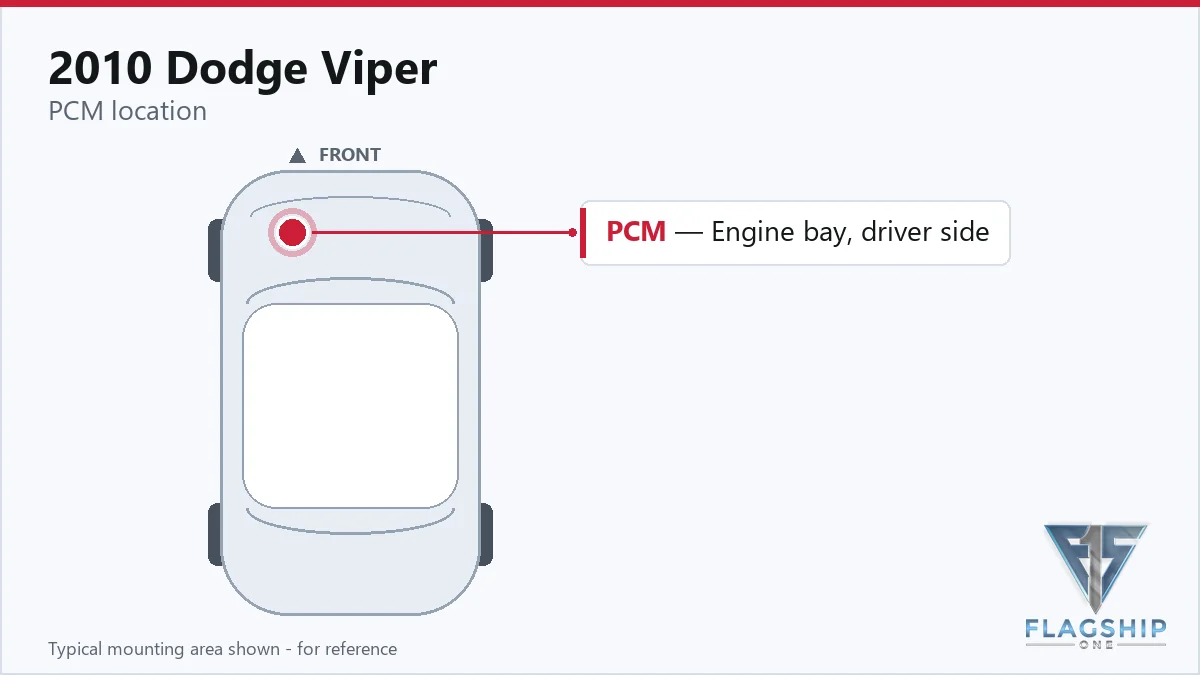
Work with the ignition off, and treat the module as static-sensitive: avoid touching the connector pins at any point.
| Operation | Configuration | Book Time |
|---|---|---|
| Powertrain Control Module R&R | All configurations | 0.5 hr |
| Engine Control Module Relearn | All configurations | 0.5 hr |
| Engine Control Module R&R | All configurations | 0.5 hr |
After the new PCM is installed, the factory’s post‑install routine requires a radio and clock reprogramming step. Flagship One units arrive already VIN‑programmed, so the technician does not need to perform this programming. The unit’s factory calibration is automatically applied during installation, saving time and eliminating the need for an external programming tool. VIN‑programmed replacement unit for the correct application.
Common signs that the 2010 Dodge Viper’s PCM is failing include a sluggish idle, abrupt stalling, and the appearance of misfire or engine control codes such as P0601. You may also notice irregular transmission shifts or a loss of power during acceleration. If the PCM is unable to communicate with other modules, the diagnostic scan tool may read dead or unresponsive data. Addressing these symptoms promptly can prevent further damage to the engine or transmission.
The codes below point to the PCM itself rather than to a sensor or circuit it monitors. Each one links through to its full diagnostic guide.
| Code | Meaning | Full Guide |
|---|---|---|
| P0601 | Internal memory checksum error | Full P0601 guide → |
| P0606 | Module processor failure | Full P0606 guide → |
Begin by scanning the vehicle for trouble codes. If codes such as P0601 or P0606 appear, confirm that they originate from the PCM. Check the battery voltage and ensure all related sensors are functioning. Only then should you proceed with the replacement.
The Flagship One PCM is factory‑programmed for the 2010 Dodge Viper, so no additional software update is required. The unit will automatically load the correct calibration data during installation.
Book time for removal and reinstall is 0.5 hours, and an additional 0.5 hours for the ECU relearn procedure. The total labor estimate is 1 hour.
After the ECU relearn is complete, the vehicle should be ready to drive. It is advisable to monitor the engine and transmission for a short period to confirm normal operation.
If the same symptoms recur, verify that the new PCM is properly seated and all connectors are clean. If problems persist, consult a qualified technician to rule out other electrical or sensor issues.
Whether you choose a professional repair or a refurbished replacement, the 2010 Dodge Viper benefits from a reliable PCM. A well‑installed module restores smooth engine performance and protects your investment. Consider evaluating your current system to decide the best path forward.
Flagship One stocks a refurbished, VIN-programmed PCM for the 2010 Dodge Viper with a lifetime warranty, free shipping and no core charge. The full Dodge Viper module lineup covers other engine configurations as well.
A 2010 Dodge Viper with a healthy PCM delivers consistent performance and confidence on the road. If you notice any of the symptoms described, act promptly to replace or repair the module and keep your Viper running at its best.