
Last updated on August 25th, 2026 at 12:46 pm
The Powertrain Control Module (PCM) in the 2009 Dodge Viper manages fuel injection, ignition timing, and transmission shifts. Failures may cause erratic engine behavior, poor performance, or stored trouble codes.
If your 2009 Dodge Viper is experiencing unexplained stalling, rough idling, or a check-engine light, the Powertrain Control Module (PCM) may be the culprit. This critical component oversees engine performance and transmission behavior, and when it fails, symptoms can range from subtle drivability issues to complete no-start conditions. Understanding the PCM’s role, location, and replacement process helps you make informed decisions about repairs. With the right approach, you can restore your Viper’s performance without unnecessary delays or complications.
In the 2009 Dodge Viper, the Powertrain Control Module (PCM) acts as the brain of the engine and transmission systems. It continuously monitors sensor inputs to adjust fuel delivery, ignition timing, and shift points for optimal performance. A faulty PCM may disrupt these functions, leading to poor throttle response, erratic shifting, or even a vehicle that won’t start. Since the PCM is integral to drivability, addressing issues promptly is key. When replacement becomes necessary, replacement engine computers for the Viper ensure compatibility and proper functionality for this high-performance model.
2009 Dodge Viper
OEM programmed ECM for your 2009 Dodge Viper — plug & play, no dealer visit.
Free shipping · Lifetime warranty
The PCM in the 2009 Dodge Viper is mounted under the hood on the left side of the engine compartment. Accessing it involves disconnecting the battery, removing the module’s electrical connectors, and unfastening the mounting hardware. Labor guides estimate 0.5 hours for Powertrain Control Module removal and replacement. After installation, the vehicle requires a relearn procedure, which also takes approximately 0.5 hours. Proper torque on mounting fasteners and secure connector seating are critical to avoid future electrical issues.
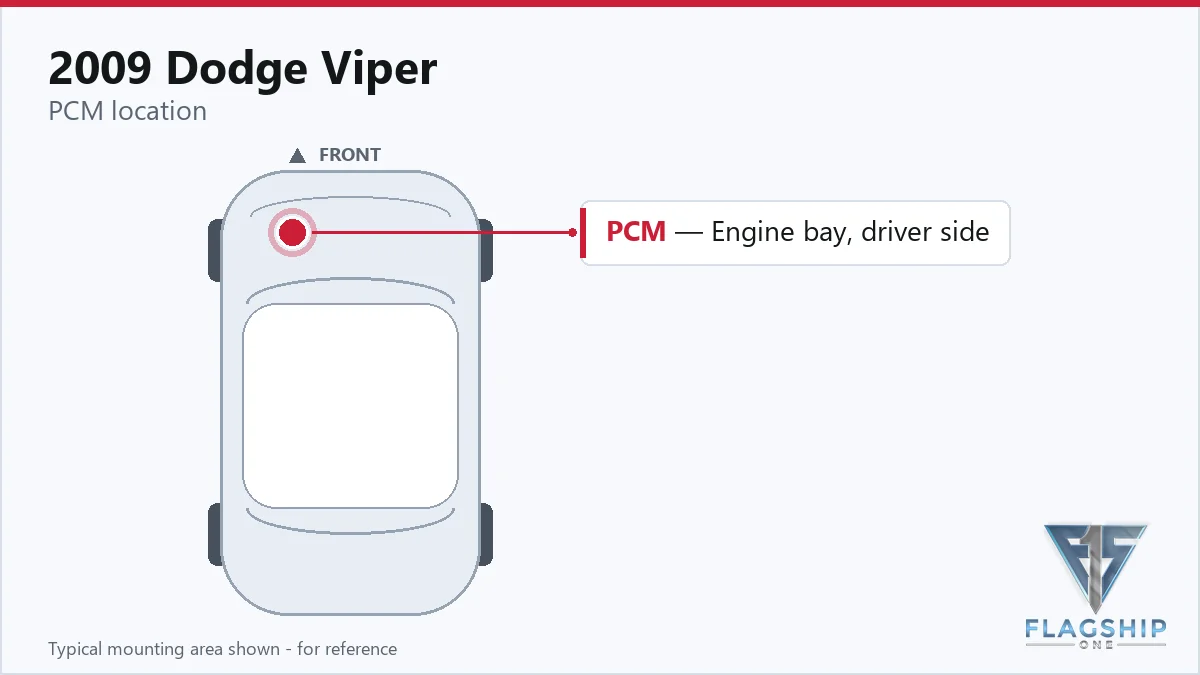
Work with the ignition off, and treat the module as static-sensitive: avoid touching the connector pins at any point.
| Operation | Configuration | Book Time |
|---|---|---|
| Powertrain Control Module R&R | All configurations | 0.5 hr |
| Engine Control Module Relearn | All configurations | 0.5 hr |
| Engine Control Module R&R | All configurations | 0.5 hr |
After replacing the PCM in a 2009 Dodge Viper, the factory procedure mandates a module relearn process, which typically takes 0.5 hours. Additionally, the radio and clock must be reprogrammed to restore their settings. However, a VIN-programmed replacement unit from Flagship One arrives pre-configured to your vehicle’s specifications, eliminating the need for these extra steps. This ensures your Viper is back on the road faster, with all systems functioning as intended.
A failing PCM in the 2009 Dodge Viper may cause a range of symptoms, including intermittent stalling, rough idling, or a no-start condition. Drivers might also notice poor throttle response, erratic transmission shifts, or a check-engine light with stored codes. Common module-internal faults, such as internal control module memory checksum error, often trigger these issues. If your scan tool fails to communicate with the PCM, the module itself may be the root cause.
The 2009 Dodge Viper’s PCM may store specific trouble codes when internal faults occur. These codes help diagnose issues related to the module’s performance and memory integrity.
| Code | Meaning | Full Guide |
|---|---|---|
| P0601 | Internal memory checksum error | Full P0601 guide → |
| P0606 | Module processor failure | Full P0606 guide → |
Common signs include stalling, rough idling, or a no-start condition. A check-engine light with module-related codes, such as P0601 or P0606, may also indicate PCM issues. If your scan tool can’t communicate with the module, the PCM itself could be faulty.
Replacement is straightforward if you’re comfortable with basic electrical work. The PCM is located under the hood, and labor guides estimate 0.5 hours for removal and installation. However, the vehicle requires a relearn procedure afterward, which may require professional tools.
The relearn process ensures the new PCM synchronizes with the vehicle’s sensors and systems. This step is necessary to restore proper engine performance, transmission shifting, and emissions compliance. Skipping it may result in drivability issues.
If your 2009 Dodge Viper is exhibiting PCM-related symptoms, you have options. A repair shop can diagnose and replace the module, but labor costs and relearn procedures add up. A VIN-programmed replacement unit simplifies the process, ensuring compatibility and eliminating extra programming steps. This approach gets your Viper back to peak performance with minimal downtime.
Flagship One stocks a refurbished, VIN-programmed PCM for the 2009 Dodge Viper with a lifetime warranty, free shipping and no core charge. The full Dodge Viper module lineup covers other engine configurations as well.
The 2009 Dodge Viper’s PCM plays a critical role in engine and transmission performance. If you’re experiencing drivability issues, addressing the module promptly can restore reliability. Whether you opt for a repair or a pre-programmed replacement, understanding the process helps you make the best choice for your vehicle.