
Last updated on August 25th, 2026 at 01:44 pm
The powertrain control module and engine control module in your 2017 Nissan Titan manage engine and transmission functions. Internal memory failures, voltage spikes, and heat damage commonly cause these modules to fail, triggering diagnostic trouble codes.
When your 2017 Nissan Titan exhibits drivability problems that resist conventional diagnosis, the control modules governing your 5.6-liter V8 engine often bear responsibility. The powertrain control module and engine control module serve as the electronic brains of your vehicle, processing data from dozens of sensors and commanding actuators accordingly. Unlike simple sensor faults that trigger clear component-specific codes, module-internal failures can produce vague symptoms spanning multiple systems.
Understanding these modules—their functions, failure patterns, and replacement requirements—empowers you to approach repair decisions with confidence. This guide covers specifically what goes wrong inside these units, how technicians identify the problem, what replacement entails, and why post-installation programming matters. Whether you are weighing repair against replacement options or seeking to understand an estimate you have received, the information here applies directly to your Nissan Titan with the 5.6L engine.
Your 2017 Nissan Titan relies on two distinct control modules that work in concert to manage engine operation and powertrain performance. The engine control module primarily monitors and adjusts fuel delivery, ignition timing, and emissions controls using data from the oxygen sensors, mass airflow meter, and throttle position sensor. The powertrain control module takes a broader role, coordinating transmission shifting, stability control interventions, and communication between the engine management system and other vehicle networks.
These modules execute millions of calculations per second, comparing actual operating conditions against programmed targets and making adjustments within milliseconds. The replacement engine computers for the Titan must maintain precise synchronization with your vehicle’s specific sensor suite and hardware configuration. When internal memory corruption occurs—whether from voltage transients, thermal cycling, or manufacturing defects—the module loses its ability to store critical calibration data and operating parameters.
The relationship between these two units means a failure in either one affects overall vehicle behavior. The powertrain control module often serves as the primary diagnostic gateway, logging codes from both its own internal checks and data received from the engine control module. This architecture explains why a single module-internal fault like P0605 can influence multiple vehicle systems simultaneously.
2017 Nissan Titan
OEM programmed ECM for your 2017 Nissan Titan — plug & play, no dealer visit.
Free shipping · Lifetime warranty
The powertrain control module on the 2017 Nissan Titan 5.6L typically mounts in the engine compartment, often secured to the firewall or inner fender structure where it remains accessible for service while protected from direct engine bay heat. Replacement involves disconnecting the battery negative terminal first, then removing the module from its mounting bracket after releasing any retaining bolts or clips.
The engine control module location varies but generally positions near the throttle body or intake manifold area where it can receive immediate sensor data. Service procedures call for careful handling of the electrical connector, inspecting pins for corrosion or damage before installing the replacement unit.
Factory labor allocations for the replacement engine computers for the Titan reflect these access requirements. The powertrain control module removal and installation operation requires 3.0 hours of book time. An additional 0.5 hours accounts for the relearn procedure that follows. The engine control module removal and installation also takes 3.0 hours, with separate operations of 0.3 hours for reset and 0.5 hours for relearn procedures.
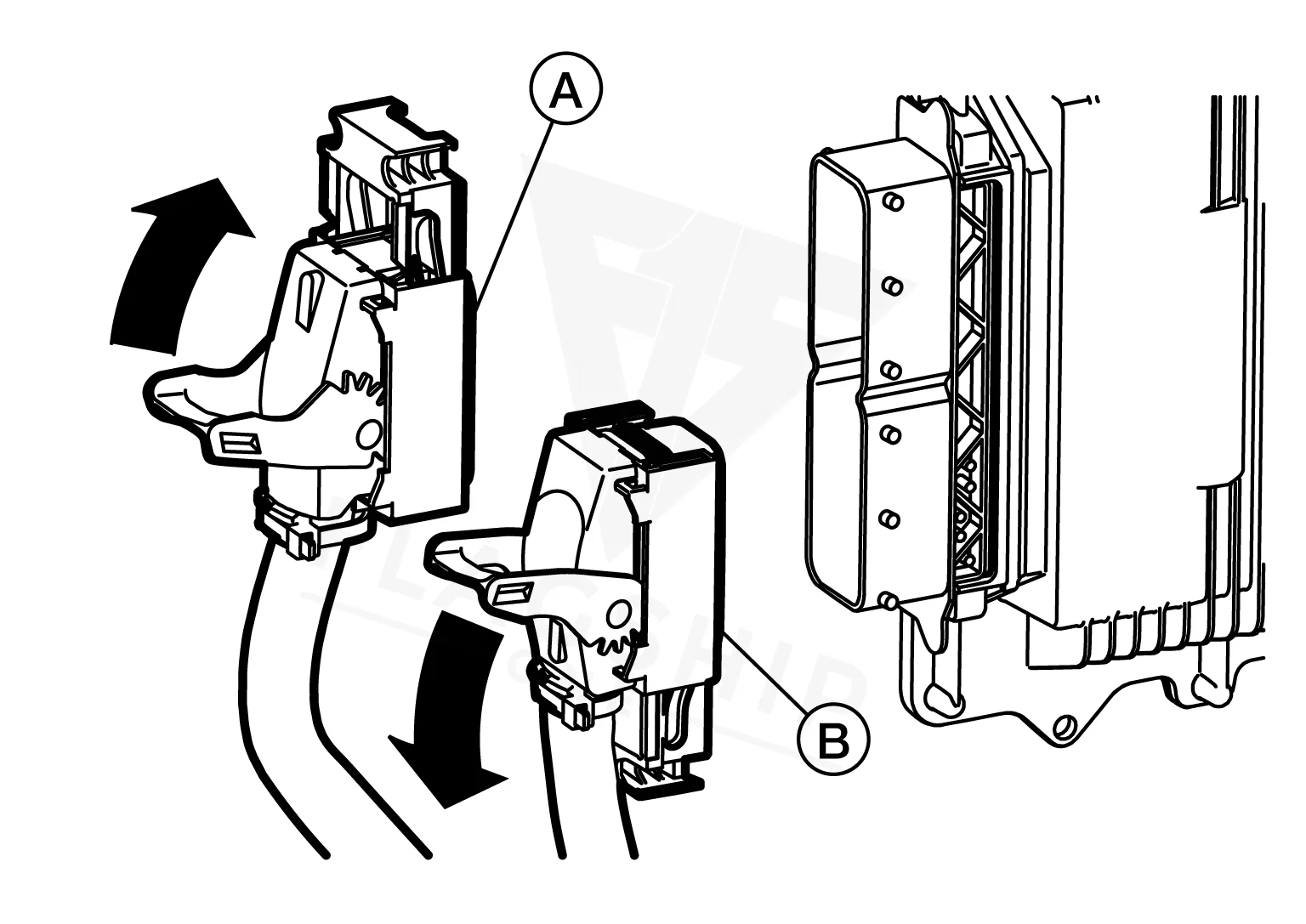
Work with the ignition off, and treat the module as static-sensitive: avoid touching the connector pins at any point.
| Operation | Configuration | Book Time |
|---|---|---|
| Powertrain Control Module R&R | All configurations | 3.0 hr |
| Powertrain Control Module Relearn | All configurations | 0.5 hr |
| Engine Control Module R&R | All configurations | 3.0 hr |
| Engine Control Module Reset | All configurations | 0.3 hr |
| Engine Control Module Relearn | All configurations | 0.5 hr |
After physically installing either control module in your 2017 Nissan Titan, the factory service procedure mandates a series of programming and relearn steps before the vehicle operates normally. These procedures synchronize the replacement module with your specific vehicle’s VIN, options content, and existing sensor configurations. Without proper programming, the module cannot communicate correctly with the transmission control unit, anti-lock braking system, or other networked controllers.
The relearn process allows the new module to adapt to your engine’s specific characteristics, learning idle airflow settings, fuel trim values, and transmission clutch apply points. Reset operations initialize the module’s memory structures and verify that all outputs function correctly.
Flagship One addresses this requirement by shipping a VIN-programmed replacement unit configured specifically for your Titan’s specifications. This means the critical programming steps that would otherwise require dealer equipment or specialized tools have already been completed. Your installer can proceed directly to the relearn procedures, reducing overall service time and eliminating the need for proprietary programming equipment at independent shops.
Control module failures in the 2017 Nissan Titan produce symptoms that often seem disconnected from any single component, which frequently delays correct diagnosis. Hard-starting or no-start conditions occur when the module fails to generate proper fuel injector pulses or ignition timing signals. The engine may crank normally but simply fail to ignite, or it may start and then stall immediately when the module loses communication with critical sensors.
Stalling and hesitation complaints frequently appear, especially under load or when the engine reaches operating temperature. The module may execute correct commands intermittently, causing inconsistent performance that varies with temperature, speed, or electrical system load. Limp-home mode activation represents the module protecting itself or detecting internal faults, severely limiting engine power and often locking the transmission in third gear.
Diagnostic trouble codes beyond P0605 commonly accompany module-internal failures. Misfire codes P0300 through P0308 frequently appear because the module cannot maintain proper ignition timing or fuel delivery. Transmission shifting complaints arise when the powertrain control module loses communication with the transmission control unit. In some cases, the scan tool itself may fail to communicate with the module, preventing code retrieval until the module partially recovers.
The internal memory fault indicates the module detected an error in its non-volatile memory storage, suggesting permanent damage to internal circuitry rather than a temporary electrical glitch.
The 2017 Nissan Titan 5.6L equipped with the documented trouble code requires attention to module-internal diagnostic information. These codes differ from conventional sensor and circuit codes because they point to problems within the control module itself rather than external components. The following table lists the specific code affecting this vehicle.
| Code | Meaning | Full Guide |
|---|---|---|
| P0605 | Internal ROM error | Full P0605 guide → |
No technical service bulletin information was provided in the available facts for the 2017 Nissan Titan 5.6L. This does not necessarily indicate an absence of factory communications regarding control module issues. Nissan may have published service guidelines addressing diagnostic procedures or replacement specifications that are not captured in the current documentation. A technician performing repairs on your vehicle may have access to additional bulletins or service information system updates not included here.
Control module replacement on your 2017 Nissan Titan presents a meaningful decision point. You may have received an estimate for factory repair through a dealer program, which returns your original module after refurbishment. Alternatively, purchasing a replacement engine computer from Flagship One delivers a pre-programmed unit ready for installation without waiting for your original to be processed. Each approach carries different cost structures, turnaround times, and warranty terms. Understanding that your 5.6L Titan’s specific VIN and configuration have been programmed into Flagship One’s replacement module helps clarify why these units command their price— eliminating a significant obstacle in the repair process.
Flagship One stocks a refurbished, VIN-programmed PCM for the 2017 Nissan Titan with a lifetime warranty, free shipping and no core charge. The full Nissan Titan module lineup covers other engine configurations as well.
The powertrain and engine control modules in your 2017 Nissan Titan represent sophisticated electronic systems that rarely fail without warning signs. Recognizing symptoms early and pursuing proper diagnosis prevents cascading damage and costly secondary repairs. Whether you ultimately choose refurbished repair or replacement with a pre-programmed unit, understanding the procedure and its requirements positions you to make informed decisions about your vehicle’s care.