
Last updated on August 25th, 2026 at 01:52 pm
In the 2010 Mitsubishi Endeavor the Powertrain Control Module and Engine Control Module manage engine timing, fuel delivery and emission controls. A failure typically disables the engine’s ability to start or run smoothly, and may trigger diagnostic trouble codes such as P0606.
When a 2010 Mitsubishi Endeavor begins to exhibit no‑start conditions, erratic idle or unexpected stalling, the electronic control modules are often the first place to investigate. The Powertrain Control Module (PCM) and Engine Control Module (ECM) work together to coordinate engine performance, emissions and transmission behavior. Understanding how these computers operate in this specific model helps you recognize when a replacement is warranted and what steps follow a swap. This guide walks you through the function of each module, where they reside, the labor involved, the programming requirements, and practical tips to keep them healthy, so you can make an informed decision about repair or replacement.
The PCM in the 2010 Mitsubishi Endeavor serves as the central command unit for the powertrain, processing sensor data to control fuel injection, ignition timing and transmission shift points. It also stores encryption keys that protect the vehicle’s anti‑theft system. The ECM, while often integrated with the PCM, focuses on engine‑specific parameters such as air‑fuel mixture and emissions controls. Together they ensure smooth acceleration and compliance with emissions standards. A malfunction in either unit may prevent the engine from starting or cause it to run poorly. For owners seeking a replacement, 2010 Mitsubishi Endeavor replacement modules are available that match the original specifications and fit within the vehicle’s electronic architecture.
2010 Mitsubishi Endeavor
OEM programmed replacements — plug & play, no dealer visit.
Find yours by year, make & model →
Free shipping · Lifetime warranty
Both the PCM and the ECM are mounted within the engine compartment of the 2010 Mitsubishi Endeavor, typically attached to the firewall near the intake manifold. Removal involves disconnecting the electrical harness, unbolting the unit and extracting it from its bracket. Reinstallation follows the reverse order, with torque specifications applied as per the service manual. The book time for a complete Powertrain Control Module removal and replacement is listed as 0.5 hours, while the Engine Control Module removal and replacement also requires 0.5 hours. After the hardware is secured, an Engine Control Module relearn procedure adds another 0.5 hour to the total labor estimate.
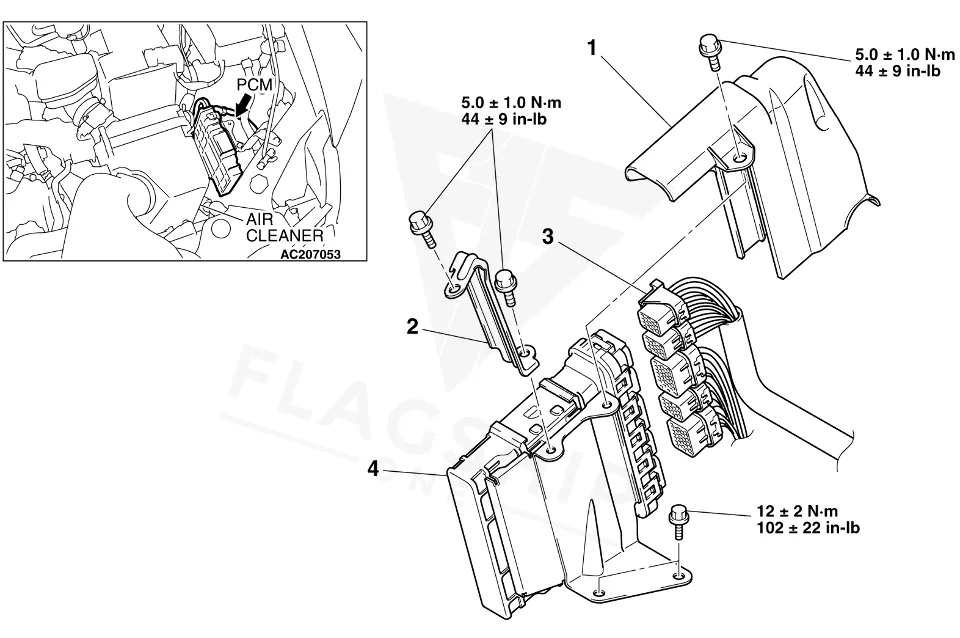
Work with the ignition off, and treat the module as static-sensitive: avoid touching the connector pins at any point.
| Operation | Configuration | Book Time |
|---|---|---|
| Powertrain Control Module R&R | All configurations | 0.5 hr |
| Engine Control Module Relearn | All configurations | 0.5 hr |
| Engine Control Module R&R | All configurations | 0.5 hr |
Once the PCM or ECM is physically installed, the factory service routine calls for a relearn of the Engine Control Module to synchronize sensor calibrations and adaptation values. This step normally occupies 0.5 hour of technician time. Flagship One provides a VIN‑programmed replacement unit that arrives already coded to match your vehicle’s unique identifiers, so the relearn process is completed at the factory and does not need to be performed on the shop floor.
A failing PCM or ECM in the 2010 Mitsubishi Endeavor may present as a complete lack of engine cranking, intermittent stalling at idle, rough acceleration, or the illumination of the check engine light. Drivers often notice a loss of power during acceleration or unexpected gear shifts if the transmission control signals are compromised. Diagnostic scans frequently reveal internal fault codes; for example, the presence of PCM internal memory error indicates a problem within the module’s internal circuitry. Communication loss between the scan tool and the vehicle’s computer network is another hallmark of a defective control unit.
The following internal diagnostic trouble codes have been recorded for the 2010 Mitsubishi Endeavor’s control modules:
| Code | Meaning | Full Guide |
|---|---|---|
| P0606 | Module processor failure | Full P0606 guide → |
Typical indicators include a no‑start condition, erratic idle, loss of power during acceleration, and the check engine light flashing with codes related to PCM internal errors.
Factory guidance advises against simultaneous replacement; you should replace one unit first and complete the encrypted code registration before addressing the other.
The labor estimate for a Powertrain Control Module removal and installation is approximately 0.5 hour, plus an additional 0.5 hour for the Engine Control Module relearn if required.
Flagship One units arrive VIN‑programmed, which means the factory‑required coding and relearn steps are already completed, eliminating on‑site programming.
Verify that the encrypted code registration was performed correctly and clear any remaining codes with a scan tool; if the light persists, further diagnosis may be needed.
When the PCM or ECM in your 2010 Mitsubishi Endeavor shows signs of failure, you can choose a factory‑repaired unit or a refurbished replacement from Flagship One. Both options restore vehicle functionality, but a refurbished unit offers a cost‑effective solution while still meeting original specifications. Evaluate your budget and service timeline to decide which path best fits your needs.
Flagship One stocks a refurbished, VIN-programmed PCM for the 2010 Mitsubishi Endeavor with a lifetime warranty, free shipping and no core charge. The full Mitsubishi Endeavor module lineup covers other engine configurations as well.
Understanding the role of the PCM and ECM in your 2010 Mitsubishi Endeavor helps you recognize symptoms early and choose the appropriate repair route. Whether you opt for a new or refurbished module, proper installation and programming are essential for reliable performance. Contact a qualified technician to assess your situation and ensure a safe, effective fix.