
Last updated on August 25th, 2026 at 01:53 pm
The powertrain control module (PCM) in your 2006 Mitsubishi Endeavor manages engine and transmission functions. Failures often trigger internal fault codes, leading to drivability issues like stalling or failure to start.
If your 2006 Mitsubishi Endeavor is experiencing intermittent stalling, a no-start condition, or persistent check-engine lights, the powertrain control module (PCM) may be at fault. This small but critical computer oversees everything from fuel delivery to transmission shifting, and when it fails, your vehicle’s performance can suffer dramatically. Replacing the PCM isn’t just about swapping a part—it involves careful handling, precise labor steps, and a mandatory relearn procedure to ensure the new unit communicates correctly with the rest of your Endeavor’s systems. Understanding the process upfront helps you avoid unnecessary delays or complications, whether you’re tackling the job yourself or working with a shop. With the right preparation, you can restore your vehicle’s reliability without the guesswork.
The powertrain control module (PCM) in your 2006 Mitsubishi Endeavor acts as the brain of the engine and transmission, continuously monitoring and adjusting critical functions like fuel injection, ignition timing, and shift points. Without a properly functioning PCM, your vehicle may struggle to start, idle roughly, or even refuse to run altogether. This module also interfaces with other onboard computers, such as the ETACS-ECU, to manage security features and encrypted communications. When the PCM fails, it often triggers specific trouble codes that pinpoint internal faults, such as processor errors or memory corruption. Replacing it requires not just mechanical skill but also adherence to factory procedures to ensure the new replacement engine computers for the Endeavor integrates seamlessly with your vehicle’s existing systems. A faulty PCM can lead to a cascade of issues, so addressing it promptly is key to maintaining your Endeavor’s performance and drivability.
2006 Mitsubishi Endeavor
OEM programmed replacements — plug & play, no dealer visit.
Find yours by year, make & model →
Free shipping · Lifetime warranty
In the 2006 Mitsubishi Endeavor, the PCM is located near the engine bay, typically mounted on the passenger side of the firewall or inside the cabin behind the glove box. Accessing it involves removing a few panels or covers, but the job is straightforward for a technician familiar with the layout. According to factory labor guides, replacing the PCM takes about 0.4 hours, which includes disconnecting the battery, unplugging the wiring harness, and removing the mounting bolts. Once the old unit is out, the new PCM is installed in reverse order, ensuring all connectors are securely fastened. Torque specifications for the mounting bolts are usually provided in the service manual, though the exact values aren’t always critical for this component. After installation, the battery must be reconnected, and a relearn procedure is required to sync the new PCM with the vehicle’s systems.
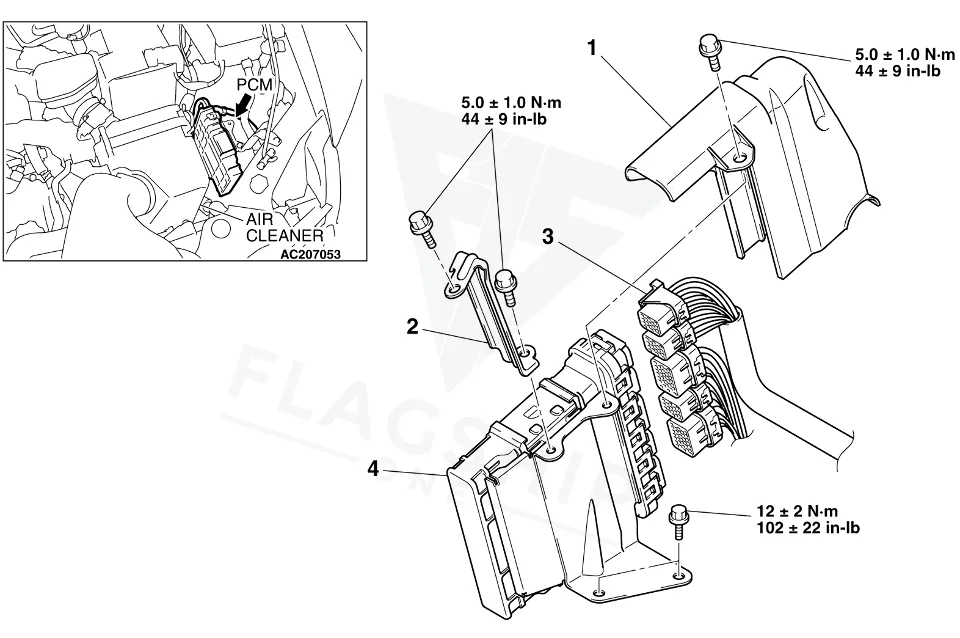
Work with the ignition off, and treat the module as static-sensitive: avoid touching the connector pins at any point.
| Operation | Configuration | Book Time |
|---|---|---|
| Powertrain Control Module R&R | All configurations | 0.4 hr |
| Powertrain Control Module Relearn | All configurations | 0.5 hr |
| Engine Control Module Relearn | All configurations | 0.5 hr |
| Engine Control Module R&R | All configurations | 0.4 hr |
After replacing the PCM in your 2006 Mitsubishi Endeavor, the factory requires a relearn procedure to register the new unit with the vehicle’s security system and ensure proper communication with other modules. This process typically takes 0.5 hours and involves using a scan tool to input the encrypted code, as outlined in the service manual’s GROUP 54A section. However, if you install a VIN-programmed replacement unit, these steps are already completed before the part arrives, saving you time and reducing the risk of errors during the relearn process. This pre-programming ensures the new PCM is ready to function immediately, allowing your Endeavor to start and run without additional coding. It’s a critical advantage, especially if you’re working without access to specialized diagnostic equipment or if you want to avoid the hassle of manual registration.
When the PCM in your 2006 Mitsubishi Endeavor begins to fail, you may notice a range of symptoms that can vary in severity. A common early sign is an intermittent no-start condition, where the engine cranks but refuses to fire, often due to incorrect fuel or spark signals from the PCM. Stalling at idle or during acceleration is another frequent issue, as the module struggles to maintain consistent engine control. You might also experience rough idling, poor fuel economy, or even transmission shifting problems, as the PCM’s failure disrupts communication with the transmission control system. In some cases, the check-engine light will illuminate, and a scan tool may reveal internal fault codes like an internal processor error, which directly points to a PCM malfunction. If your Endeavor exhibits any of these symptoms, it’s worth investigating the PCM as a potential culprit, especially if other common causes like fuel pump failure or ignition system issues have been ruled out.
The 2006 Mitsubishi Endeavor’s PCM is designed to log specific trouble codes when internal faults are detected. These codes help technicians pinpoint issues within the module itself, rather than broader engine or transmission problems. Below are the documented module-internal trouble codes for this vehicle.
| Code | Meaning | Full Guide |
|---|---|---|
| P0606 | Module processor failure | Full P0606 guide → |
Mitsubishi has issued specific cautions for replacing the PCM in the 2006 Endeavor, particularly regarding the encrypted code registration process. The factory advises against replacing the PCM and ETACS-ECU simultaneously, as this can lead to communication errors between the modules. Instead, you should replace one unit at a time and follow the registration steps outlined in GROUP 54A of the service manual. This ensures the new PCM or ETACS-ECU is properly synced with the vehicle’s security system, preventing issues like no-start conditions or loss of functionality in other systems. While no additional bulletins were provided, adhering to these guidelines is critical for a successful repair.
Stalling after a PCM replacement often occurs if the relearn procedure isn’t completed correctly. The new PCM must sync with the vehicle’s security system and other modules to function properly. If the encrypted code isn’t registered, the engine may start but stall shortly after. Using a VIN-programmed unit eliminates this step, reducing the risk of post-install issues.
Replacing the PCM is a straightforward job if you’re comfortable working with electrical components and have basic tools. However, the relearn procedure requires a scan tool and access to Mitsubishi’s encrypted code registration process. If you’re unsure about these steps, a shop can handle the job more efficiently, especially if you opt for a pre-programmed unit to skip the coding process.
In the 2006 Endeavor, the terms PCM (powertrain control module) and ECM (engine control module) are often used interchangeably, but the PCM typically refers to the combined unit that controls both engine and transmission functions. The ECM, if referenced separately, usually focuses solely on engine management. For this vehicle, the PCM is the primary module responsible for overall powertrain operation.
A failing PCM often triggers specific symptoms like no-start conditions, stalling, or internal fault codes such as P0606. However, these symptoms can also stem from other issues, like a faulty fuel pump, ignition system problems, or even a bad battery. A diagnostic scan is the best way to confirm a PCM issue, as it will reveal module-specific codes that point directly to the problem.
Skipping the relearn procedure can result in a variety of issues, including no-start conditions, stalling, or erratic engine behavior. The PCM must register its encrypted code with the vehicle’s security system to communicate with other modules. Without this step, the engine may run poorly or not at all, even if the physical installation is correct. Using a pre-programmed unit avoids this problem entirely.
If your 2006 Mitsubishi Endeavor is showing signs of PCM failure, you have a few options for moving forward. A repair shop can diagnose and replace the module, handling the relearn procedure for you, but this may involve additional labor costs and downtime. Alternatively, opting for a refurbished or new replacement unit that’s already VIN-programmed can simplify the process, ensuring your vehicle is back on the road faster. Given the critical role the PCM plays in your Endeavor’s operation, choosing the right replacement approach is key to avoiding further issues down the line.
Flagship One stocks a refurbished, VIN-programmed PCM for the 2006 Mitsubishi Endeavor with a lifetime warranty, free shipping and no core charge. The full Mitsubishi Endeavor module lineup covers other engine configurations as well.
The 2006 Mitsubishi Endeavor relies on its PCM to manage everything from fuel delivery to transmission shifting, so addressing any signs of failure promptly is essential. Whether you’re dealing with a no-start condition, stalling, or stored trouble codes, understanding the replacement and relearn process can help you make informed decisions. With the right preparation and a VIN-programmed unit, you can restore your vehicle’s reliability without unnecessary complications. If you’re ready to tackle the repair, consider your options carefully to ensure a smooth and successful outcome.