
Last updated on August 25th, 2026 at 12:20 pm
The Powertrain Control Module (PCM) in the 2019 Mazda CX-5 manages engine and transmission functions by processing sensor data. Failure may cause drivability issues, warning lights, or complete no-start conditions due to corrupted software or hardware faults.
If your 2019 Mazda CX-5 has developed unexplained stalling, rough idling, or warning lights that won’t clear, the Powertrain Control Module (PCM) may be the culprit. This critical component acts as the brain for both engine and transmission operations, interpreting signals from sensors to optimize performance. When it fails, symptoms can range from subtle drivability quirks to complete immobilization. Replacing the PCM isn’t as simple as swapping hardware—Mazda requires precise configuration and software updates to ensure the new unit communicates correctly with the vehicle’s systems. Without these steps, the CX-5 may not run at all or could exhibit erratic behavior. Understanding the role of the PCM, the replacement process, and the importance of proper programming helps you make informed decisions, whether you’re diagnosing an issue or planning a repair. This guide covers what the module does, how to recognize failure, and what to expect during replacement to restore your vehicle’s reliability.
In the 2019 Mazda CX-5, the Powertrain Control Module (PCM) serves as the central computer managing both engine performance and transmission behavior. It continuously monitors inputs from sensors—such as throttle position, oxygen levels, and crankshaft speed—to adjust fuel delivery, ignition timing, and shift points in real time. This coordination ensures optimal power, efficiency, and emissions compliance. When the PCM malfunctions, the CX-5 may experience misfires, poor acceleration, or transmission hesitation, as the module can no longer interpret sensor data accurately. The system also stores fault codes to help technicians diagnose issues, though some failures may not trigger a code at all. Replacing the PCM with replacement engine computers for the CX-5 requires careful attention to software configuration, as the module must match the vehicle’s exact specifications to avoid conflicts with other systems. Without proper setup, the new unit may not communicate with the transmission control module (TCM) or engine sensors, leading to persistent drivability problems.
2019 Mazda CX-5
OEM programmed ECM for your 2019 Mazda CX-5 — plug & play, no dealer visit.
Free shipping · Lifetime warranty
The PCM in the 2019 Mazda CX-5 is located in the engine bay, typically mounted near the firewall or on the passenger side of the vehicle. Accessing it involves removing the air intake duct and possibly other components to reach the module’s mounting bracket. According to factory labor guides, removing and replacing the PCM takes 0.9 hours, assuming no complications like corroded connectors or seized fasteners. After installation, a relearn procedure is required, which adds another 0.5 hours to the job. This step ensures the module synchronizes with the vehicle’s sensors and systems. If the wrong PCM is installed, it may interfere with engine control, causing erratic behavior or even preventing the vehicle from starting. Always verify the replacement unit’s compatibility with the CX-5’s VIN before installation to avoid mismatches that could lead to further issues.
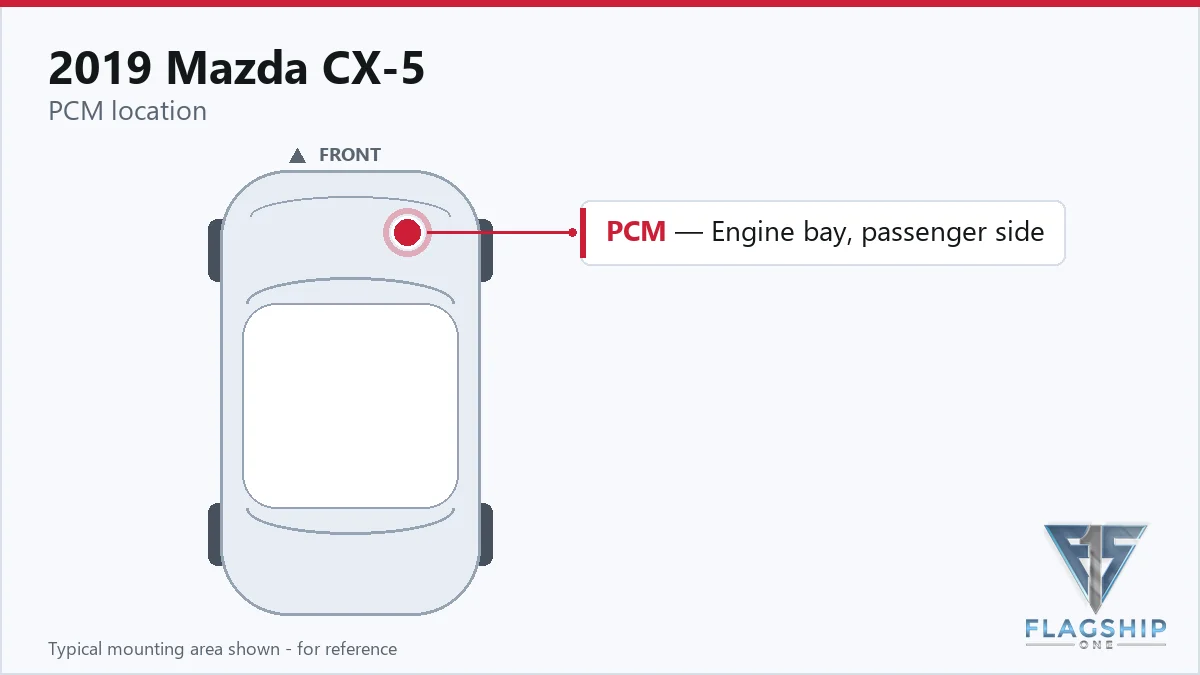
Work with the ignition off, and treat the module as static-sensitive: avoid touching the connector pins at any point.
| Operation | Configuration | Book Time |
|---|---|---|
| Powertrain Control Module R&R | All configurations | 0.9 hr |
| Powertrain Control Module Relearn | All configurations | 0.5 hr |
| Engine Control Module Reset | All configurations | 0.3 hr |
| Engine Control Module R&R | All configurations | 0.9 hr |
| Engine Control Module Relearn | All configurations | 0.5 hr |
Mazda’s factory procedure for PCM replacement in the 2019 CX-5 mandates configuration and reprogramming to ensure the new module operates correctly. Before removing the old PCM, technicians must read the vehicle’s specification data to transfer it to the replacement unit. If this step is skipped, the system may not recognize critical parameters like fuel trim values or transmission shift maps, leading to poor performance or warning lights. Additionally, if a newer software calibration is available, reprogramming the PCM is recommended to address known issues or improve functionality. These requirements can add complexity to the repair, as they often require specialized diagnostic tools and up-to-date software. However, when you install a VIN-programmed replacement unit, these steps are already completed, eliminating the need for manual configuration. This ensures the PCM arrives ready to communicate with the CX-5’s systems, reducing the risk of post-installation errors and saving time during the repair process.
A failing PCM in the 2019 Mazda CX-5 can manifest in several ways, often mimicking other issues like sensor failures or mechanical problems. Common symptoms include intermittent stalling, especially at idle or during deceleration, as the module struggles to maintain stable engine operation. Drivers may also notice rough idling, hesitation during acceleration, or a lack of power, as the PCM can no longer optimize fuel and ignition timing. In some cases, the vehicle may fail to start at all, with no crank or no spark due to the module’s inability to send signals to the ignition system. Transmission-related issues, such as delayed shifts or harsh engagements, may also occur if the PCM isn’t communicating properly with the TCM. Warning lights, like the check engine or transmission warning, often illuminate, and a scan tool may reveal codes such as internal control module memory checksum error. However, not all failures trigger a code, so persistent drivability issues without stored faults should still prompt a PCM inspection. If the module’s communication network is compromised, the scan tool may also fail to connect, leaving you with limited diagnostic options until the issue is resolved.
The 2019 Mazda CX-5 may store specific trouble codes when the PCM experiences internal faults. These codes help narrow down the issue, though they don’t always pinpoint the module itself as the root cause.
| Code | Meaning | Full Guide |
|---|---|---|
| P0601 | Internal memory checksum error | Full P0601 guide → |
Mazda has issued a technical service bulletin addressing warning lights and transmission-related fault codes in the 2019 CX-5. Bulletin 05-004/19 covers instances where the check engine light and automatic transmission (A/T) warning light illuminate, accompanied by one or more diagnostic trouble codes such as P0842, P0847, P0872, P0877, P0780, or P1738 stored in the TCM. These codes typically indicate pressure sensor or shift-related issues, but the bulletin suggests the PCM’s interaction with the TCM may contribute to the problem. Following the recommended diagnostic steps can help determine whether the PCM or another component is at fault, ensuring the correct repair is performed to resolve the symptoms.
| Bulletin | Subject | What It Addresses |
|---|---|---|
| — | Technical Service Bulletin > Transmission/Transaxle > On-Board Diagnostics > 05-004/19 – Check | — |
A weak or improperly installed battery can cause voltage fluctuations that disrupt the PCM’s operation. The module relies on stable power to maintain sensor readings and engine control. If the battery voltage drops too low, the PCM may reset or lose critical data, leading to stalling. Ensuring the battery is fully charged and properly connected can help prevent this issue.
While the vehicle may still run with a P0601 code, it indicates an internal memory error in the PCM, which can lead to unpredictable behavior. The module may not adjust fuel or ignition timing correctly, potentially causing poor performance or even stalling. It’s best to address the code promptly to avoid further complications.
A used PCM that hasn’t been reprogrammed to match your CX-5’s VIN and specifications may not communicate properly with the vehicle’s systems. This can result in warning lights, poor drivability, or even a no-start condition. Mazda’s factory procedure requires configuration and software updates to ensure compatibility, so skipping these steps can lead to persistent issues.
PCM failures often produce multiple symptoms, such as stalling, rough idling, and warning lights, while sensor issues typically trigger specific fault codes. If the scan tool can’t communicate with the PCM at all, the module itself may be at fault. However, a thorough diagnostic check is needed to rule out wiring or connector problems before replacing the PCM.
Yes, Mazda specifies a relearn procedure after PCM replacement to synchronize the module with the vehicle’s sensors and systems. This step takes about 0.5 hours and ensures the new PCM operates correctly. Skipping the relearn may result in poor performance or warning lights, as the module won’t have the necessary data to control the engine and transmission properly.
When the PCM in your 2019 Mazda CX-5 fails, you have options for replacement. A new unit from the dealer ensures compatibility but may come with a higher cost and longer wait times. Refurbished or remanufactured units offer a more affordable alternative, provided they’re properly programmed to your vehicle’s VIN. Flagship One units arrive ready to install, eliminating the need for manual configuration and reducing the risk of post-installation issues. Whether you’re addressing a no-start condition or persistent warning lights, choosing the right replacement can save time and ensure your CX-5 runs reliably again.
Flagship One stocks a refurbished, VIN-programmed PCM for the 2019 Mazda CX-5 with a lifetime warranty, free shipping and no core charge. The full Mazda CX-5 module lineup covers other engine configurations as well.
The Powertrain Control Module plays a critical role in your 2019 Mazda CX-5’s performance, managing everything from fuel delivery to transmission shifts. When it fails, symptoms can range from subtle drivability issues to complete immobilization, making timely replacement essential. Proper installation and programming are key to restoring your vehicle’s reliability, as the module must match the CX-5’s exact specifications. Whether you opt for a new or refurbished unit, ensuring it’s correctly configured will help you avoid further complications and get back on the road with confidence.