
Last updated on August 25th, 2026 at 02:31 pm
The Powertrain Control Module (PCM) in your 1995 Chevrolet Cavalier manages engine and transmission functions. Failures may cause erratic shifting, stalling, or diagnostic trouble codes related to internal memory or communication errors.
If your 1995 Chevrolet Cavalier is experiencing unexplained stalling, rough idling, or transmission shifting problems, the Powertrain Control Module (PCM) may be at fault. This critical component oversees engine performance and transmission behavior, and its failure can lead to a range of drivability issues. Understanding its role, location, and replacement process helps you make informed decisions about repairs. You’ll gain clarity on what the PCM does, how to recognize its failure, and what steps are involved in addressing it—whether through reprogramming or replacement.
The PCM in your 1995 Chevrolet Cavalier acts as the brain for both engine and transmission systems. It processes sensor data to optimize fuel delivery, ignition timing, and shift points, ensuring smooth operation. When it malfunctions, you may notice poor performance, erratic shifting, or even a no-start condition. Since the PCM integrates multiple functions, its reliability directly impacts your vehicle’s drivability. If replacement becomes necessary, you’ll need a compatible replacement engine computers for the Cavalier to restore proper operation without extensive reprogramming.
1995 Chevrolet Cavalier
OEM programmed ECM for your 1995 Chevrolet Cavalier — plug & play, no dealer visit.
Free shipping · Lifetime warranty
The PCM in your 1995 Chevrolet Cavalier is mounted behind the right front fender, near the EVAP canister. Accessing it requires removing the right-hand engine splash shield to reach the module. Factory labor estimates for PCM removal and replacement are 1.3 hours. Before disconnecting the PCM, ensure the ignition is off to prevent internal damage. Cleaning the PCM housing of debris is also critical to avoid contaminating the circuitry when servicing the Knock Sensor (KS) module cover.
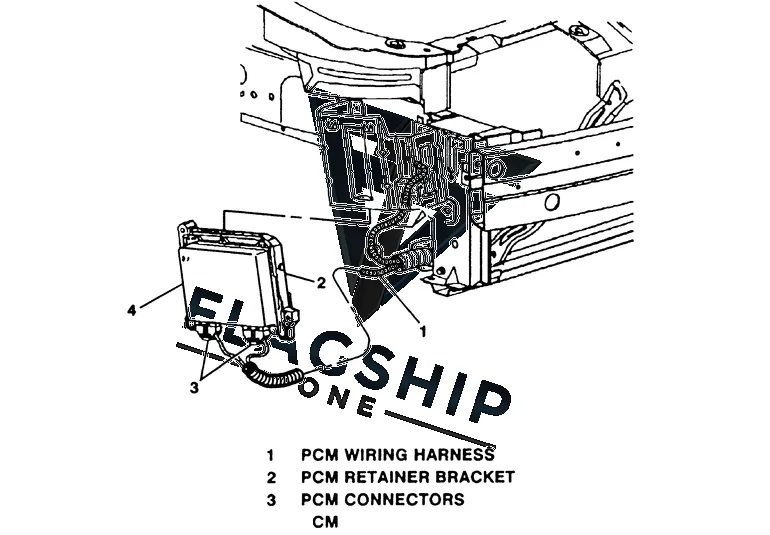
Work with the ignition off, and treat the module as static-sensitive: avoid touching the connector pins at any point.
| Operation | Configuration | Book Time |
|---|---|---|
| Engine Control Module R&R | All configurations | 1.3 hr |
| Powertrain Control Module R&R | All configurations | 1.3 hr |
After installing a new PCM in your 1995 Chevrolet Cavalier, the factory procedure typically requires reprogramming to match your vehicle’s VIN and calibration. However, a VIN-programmed replacement unit from Flagship One arrives pre-configured, eliminating the need for additional programming steps. This ensures immediate compatibility and reduces the risk of post-installation issues related to incorrect calibration.
A failing PCM in your 1995 Chevrolet Cavalier may cause a variety of symptoms, including stalling, rough idling, or a no-start condition. You might also experience transmission shifting problems, such as delayed or harsh shifts, or the vehicle may fail to upshift from first to second gear. Diagnostic trouble codes like internal control module memory checksum error may appear, indicating a fault within the PCM’s memory or processing functions. If your scan tool fails to communicate with the PCM, that’s another sign of potential failure.
The 1995 Chevrolet Cavalier’s PCM may log specific internal trouble codes when malfunctioning. These codes help diagnose issues related to the module’s memory, communication, or processing functions.
| Code | Meaning | Full Guide |
|---|---|---|
| P0600 | Module-internal fault | Full P0600 guide → |
| P0601 | Internal memory checksum error | Full P0601 guide → |
| P0602 | Control module programming error | Full P0602 guide → |
Factory service bulletins for the 1995 Chevrolet Cavalier address PCM-related issues. Bulletin #03-07-30-021 (updated in #03-07-30-021A) describes symptoms like neutral flare, RPM flare in drive, or a no 1-2 upshift, often accompanied by Diagnostic Trouble Codes (DTCs) P1810 or P1815. The recommended solution involves reprogramming the PCM. Another bulletin, #98078, covers rough engine operation and illuminated check engine lights, advising inspection, cleaning, or replacement of the PCM, along with installing a protective shield.
| Bulletin | Subject | What It Addresses |
|---|---|---|
| 03-07-30-021 | Neutral Flare and/or RPM Flare While In Drive, No 1-2 Upshift, Service Engine Soon (SES) Light | Some customers may comment on a neutral flare and/or RPM increase while in drive or no 1–2 upshift and/or the Service Engine Soon (SES) telltale may be… |
| — | CHECK ENGINE Light ON, Engine Runs Rough (Inspect, Clean/Replace and Seal PCM, and Install Prot | — |
Common signs include stalling, rough idling, no-start conditions, or transmission shifting issues. Diagnostic trouble codes like P0600, P0601, or P0602 may also appear. If your scan tool fails to communicate with the PCM, that’s another indication of potential failure.
Driving with a failing PCM may lead to further drivability issues, including stalling or transmission problems. While the vehicle might still run, it’s risky and could leave you stranded. Addressing the issue promptly is recommended.
Replacement involves removing the right-hand engine splash shield, disconnecting the PCM with the ignition off, and installing the new unit. Factory labor estimates are 1.3 hours. After installation, reprogramming is typically required unless using a pre-programmed replacement.
If your 1995 Chevrolet Cavalier’s PCM is failing, you have options. Reprogramming may resolve some issues, but if replacement is necessary, a new or refurbished unit can restore proper function. Given the labor involved, choosing a pre-programmed module can save time and reduce the risk of post-installation calibration problems.
Flagship One stocks a refurbished, VIN-programmed PCM for the 1995 Chevrolet Cavalier with a lifetime warranty, free shipping and no core charge. The full Chevrolet Cavalier module lineup covers other engine configurations as well.
The PCM in your 1995 Chevrolet Cavalier plays a critical role in engine and transmission performance. Recognizing failure symptoms early and understanding the replacement process helps you address issues efficiently. Whether you opt for reprogramming or replacement, ensuring compatibility and proper installation keeps your vehicle running smoothly.