
Last updated on August 25th, 2026 at 11:55 am
The engine control module in the 2019 Toyota C-HR manages fuel delivery, ignition timing, and emissions functions for the 2.0L engine. When internal processor faults occur, the vehicle may stall, refuse to start, or trigger module-internal codes that prevent normal operation.
Diagnosing a failing engine control module in your 2019 Toyota C-HR can feel overwhelming, especially when the vehicle stalls unexpectedly or refuses to start. The ECM serves as the central processor for your 2.0L engine, coordinating fuel injection, ignition timing, and emissions controls. When this module develops internal faults, it often sets specific diagnostic codes and may leave you stranded. Understanding how the ECM fits into your vehicle, where it is located, and what the replacement process involves helps you make informed repair decisions. This guide walks through the factory removal procedure, the necessary post-installation calibration steps, and common symptoms that point to a failing module. Whether you are comparing a dealership repair to a pre-programmed replacement, the information here clarifies what to expect so you can approach the repair with confidence.
In the 2019 Toyota C-HR, the engine control module acts as the on-board computer responsible for managing the 2.0L powertrain. It continuously reads input from sensors monitoring airflow, coolant temperature, throttle position, and oxygen levels, then adjusts fuel injector pulse width and ignition timing to maintain efficient combustion. The module also oversees evaporative emissions controls and communicates with other vehicle systems over the data network. When the ECM functions properly, your C-HR delivers smooth acceleration, steady idle, and acceptable fuel economy. Internal processor failures can disrupt these calculations, leading to drivability problems or a complete no-start condition. If you are exploring replacement engine computers for the C-HR, understanding the role of this component helps you choose the right path. The ECM does not simply plug in and work; it requires calibration to match your specific vehicle configuration, including transmission parameters and immobilizer data. A module that has suffered electrical damage from voltage spikes or water intrusion may appear functional initially but fail intermittently, making diagnosis challenging without proper scan-tool data.
2019 Toyota C-HR
OEM programmed ECM for your 2019 Toyota C-HR — plug & play, no dealer visit.
Free shipping · Lifetime warranty
The ECM in your 2019 Toyota C-HR is positioned alongside the air cleaner assembly. Reaching it requires removing several components in sequence. The factory procedure begins by separating the negative battery cable from its terminal, though a waiting period after switching the ignition off is required before doing so. From there, the technician removes the No. 2 cylinder head cover, the air cleaner cap together with the air cleaner hose, and the radiator cover. Next comes the No. 1 air cleaner inlet and finally the air cleaner case sub-assembly. Factory book time for the ECM removal and replacement is 1.1 hours. Once the new module is installed, additional labor is needed for calibration. The relearn procedure accounts for 0.5 hours, while a reset operation requires 0.3 hours. These figures reflect the manufacturer’s published time estimates and may vary depending on shop conditions and technician experience. Proper reassembly of all air cleaner components is essential to maintain correct airflow readings after the module is back in place.
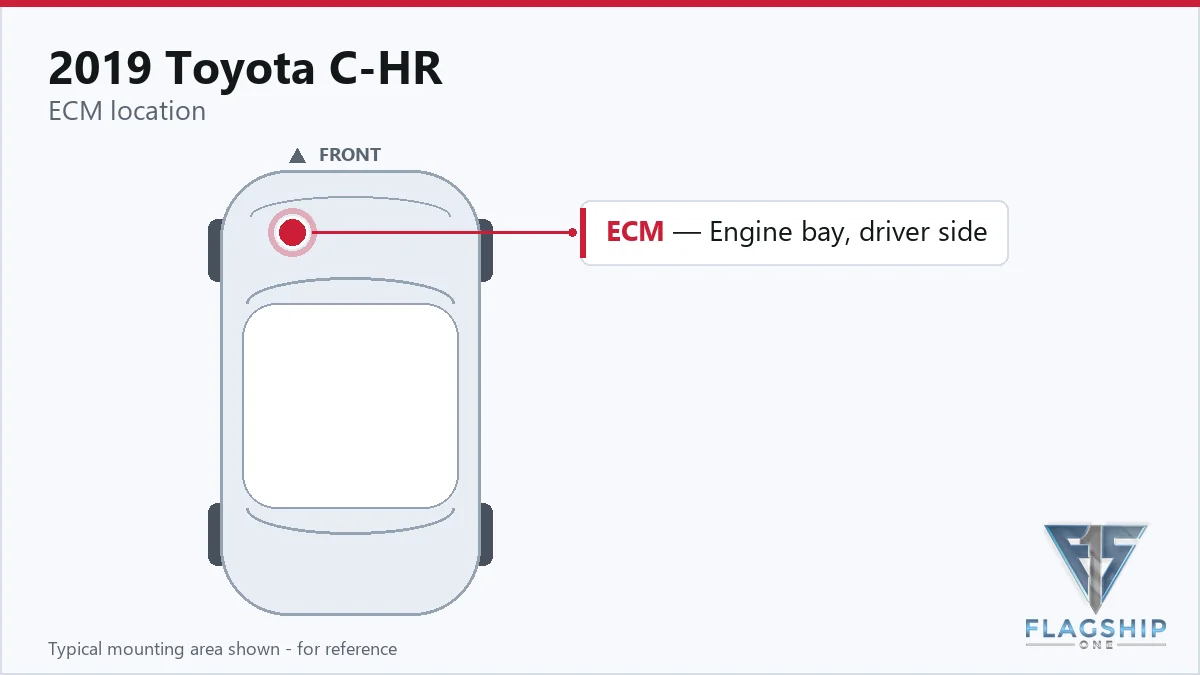
Work with the ignition off, and treat the module as static-sensitive: avoid touching the connector pins at any point.
| Operation | Configuration | Book Time |
|---|---|---|
| Powertrain Control Module R&R | All configurations | 1.1 hr |
| Powertrain Control Module Relearn | All configurations | 0.5 hr |
| Engine Control Module Relearn | All configurations | 0.5 hr |
| Engine Control Module R&R | All configurations | 1.1 hr |
| Engine Control Module Reset | All configurations | 0.3 hr |
After the ECM is removed and installed in the 2019 Toyota C-HR, the factory specifies that adjustment, calibration, initialization, or registration procedures must be performed. These steps ensure the new module communicates correctly with the immobilizer, transmission, and other vehicle systems. The relearn procedure requires 0.5 hours, and a reset operation requires 0.3 hours of additional labor time. Choosing a VIN-programmed replacement unit means these calibration steps are already completed at the factory before the part ships. Your vehicle’s specific identification number is used to configure the module, so it arrives ready to install without additional programming equipment. This eliminates the need for a dealership visit or specialized scan tools to perform the initialization. Once the pre-programmed module is physically installed and the battery is reconnected, the ECM should recognize your C-HR’s configuration and allow normal starting and operation.
A failing ECM in the 2019 Toyota C-HR may produce a range of drivability symptoms that can mimic other mechanical or electrical problems. One of the most common signs is a no-start condition where the engine cranks but fails to fire, or the starter does not engage at all. Intermittent stalling at idle or while driving may also occur, often without setting immediate codes. Some owners report rough running, misfire codes, or erratic shifting behavior when the module loses communication with the transmission controller. A scan tool may show no communication with the ECM, making diagnosis difficult. When internal processor faults develop, an internal P0606 processor fault may be stored, indicating the module itself has failed rather than a sensor or actuator. The check engine light typically illuminates, and in some cases the vehicle enters a reduced-power mode. Because these symptoms overlap with fuel pump, ignition, and sensor failures, proper diagnosis with a capable scan tool is essential before replacing the module.
The 2019 Toyota C-HR may store module-internal diagnostic codes when the ECM experiences processor or memory failures. These codes differ from sensor or circuit codes because they point to a problem within the control module itself rather than an external component. The following codes have been documented for this vehicle and typically indicate the ECM requires replacement.
| Code | Meaning | Full Guide |
|---|---|---|
| P0604 | Internal RAM error | Full P0604 guide → |
| P0606 | Module processor failure | Full P0606 guide → |
The factory book time for removing and replacing the ECM is 1.1 hours. Additional calibration work, including relearn and reset procedures, requires 0.5 hours and 0.3 hours respectively. Total labor may vary depending on shop conditions and whether any surrounding components need attention.
The ECM is positioned next to the air cleaner assembly. Accessing it requires removing the negative battery cable, cylinder head cover, air cleaner components, and radiator cover. The factory procedure specifies a waiting period after turning the ignition off before disconnecting the battery.
Yes, the factory requires adjustment, calibration, initialization, or registration after ECM removal and installation. A VIN-programmed unit from Flagship One arrives with these steps already completed, so the module is ready to operate once physically installed and the battery is reconnected.
When your 2019 Toyota C-HR needs an ECM, you have options. A dealership replacement typically involves purchasing the module, paying for installation labor, and covering additional programming time. A pre-programmed unit from Flagship One consolidates those steps by shipping the module already configured to your vehicle identification number. This approach may reduce total downtime and eliminate the need for a separate dealership programming visit. Comparing the two paths helps you decide which fits your budget and timeline.
Flagship One stocks a refurbished, VIN-programmed PCM for the 2019 Toyota C-HR with a lifetime warranty, free shipping and no core charge. The full Toyota C-HR module lineup covers other engine configurations as well.
The 2019 Toyota C-HR relies on a properly functioning engine control module to keep the 2.0L engine running smoothly. When internal faults trigger codes like P0604 or P0606, a replacement module is often the most reliable solution. Flagship One offers VIN-programmed units that arrive ready to install, saving you the additional calibration steps the factory requires. Explore the available options for your C-HR to get back on the road.