
Last updated on August 25th, 2026 at 11:56 am
The powertrain control module in the 2018 Toyota Sienna integrates engine and transmission management; internal circuit damage may cause communication loss, erratic shifting, or a no-start condition, often triggering a stored fault code that requires diagnosis by a qualified technician.
When a 2018 Toyota Sienna develops a sudden no-start, stalling, or transmission shifting irregularity, the powertrain control module often becomes a focus of diagnosis. This module governs both engine and transmission functions, so a failure can mimic several other issues. Understanding the replacement process, required programming, and common symptoms helps you plan a repair with confidence. The following sections outline the module’s role, its location, the labor involved, and the factory steps that must be completed after installation. You will also learn how a pre-programmed replacement can simplify the job and what warning signs suggest the module may be at fault.
2018 Toyota Sienna
OEM programmed ECM for your 2018 Toyota Sienna — plug & play, no dealer visit.
Free shipping · Lifetime warranty
In the 2018 Toyota Sienna the powertrain control module combines engine and transmission management into a single unit, coordinating fuel delivery, ignition timing, shift points, and emissions controls. Because it handles both systems, an internal fault can produce a wide range of drivability symptoms, from rough idle to complete communication loss with a scan tool. The module monitors its own processor and memory, and a detected anomaly will set a fault code that helps pinpoint the problem. When replacement becomes necessary, sourcing replacement engine computers for the Sienna ensures the correct hardware and software match for your vehicle’s specific calibration.
The factory removal procedure reaches the control module next to the air cleaner assembly. To access it, you must remove the windshield wiper motor and link assembly, the front outer cowl top panel sub-assembly, the air cleaner inlet cover assembly seal, and the air cleaner and hose. Book time for the powertrain control module removal and installation is 1.3 hours, while the engine control module removal and installation also calls for 1.3 hours. Additional procedures include a powertrain control module relearn at 0.5 hours, an engine control module relearn at 0.5 hours, and an engine control module reset at 0.3 hours. These times reflect the labor required for each distinct operation.
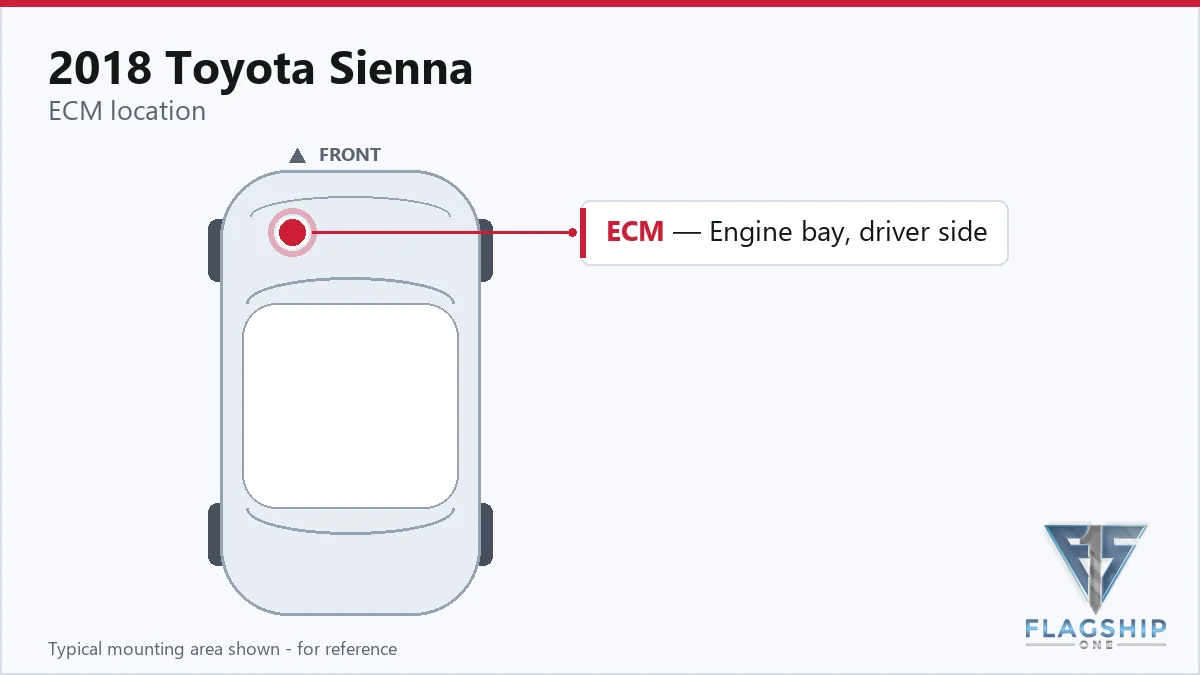
Work with the ignition off, and treat the module as static-sensitive: avoid touching the connector pins at any point.
| Operation | Configuration | Book Time |
|---|---|---|
| Powertrain Control Module R&R | All configurations | 1.3 hr |
| Powertrain Control Module Relearn | All configurations | 0.5 hr |
| Engine Control Module Relearn | All configurations | 0.5 hr |
| Engine Control Module R&R | All configurations | 1.3 hr |
| Engine Control Module Reset | All configurations | 0.3 hr |
After installing a new engine control module, the factory procedure requires performing Vehicle Identification Number registration to link the module to the specific vehicle. The service information also cautions that if the ECM has been struck or dropped, it should be replaced rather than reused. Flagship One units ship as a VIN-programmed replacement unit so the registration step is already completed, allowing the technician to proceed directly to verification and any required relearn routines.
Common signs of a failing powertrain control module in this vehicle include a no-start condition despite cranking, intermittent stalling, erratic or harsh shifting, and a scan tool that cannot communicate with the module. The check engine light may illuminate with codes related to processor performance, such as internal processor fault P0606, which indicates the module’s self-test detected an internal error. Other symptoms can involve loss of throttle response, inaccurate sensor readings, or unexplained transmission behavior that does not correspond to mechanical faults.
The following module-internal trouble code has been documented for the 2018 Toyota Sienna. This code points to an internal processor issue rather than an external sensor or wiring fault.
| Code | Meaning | Full Guide |
|---|---|---|
| P0606 | Module processor failure | Full P0606 guide → |
Yes, the factory procedure mandates VIN registration whenever the engine control module is replaced. This step links the module to the vehicle’s specific configuration and immobilizer system.
The labor guide lists 1.3 hours for powertrain control module removal and installation, with additional time for relearn or reset procedures as needed.
The service information advises replacing the ECM if it has been struck or dropped, even if no visible damage is present, because internal components may be compromised.
Deciding between repairing a faulty module and installing a refurbished replacement depends on the nature of the failure and the availability of proper programming equipment. For the 2018 Toyota Sienna, a pre-programmed unit can eliminate the VIN registration step and reduce overall labor time, while a repair may be viable for certain external circuit issues. Evaluating the specific symptoms and diagnostic results will guide the most efficient path.
Flagship One stocks a refurbished, VIN-programmed PCM for the 2018 Toyota Sienna with a lifetime warranty, free shipping and no core charge. The full Toyota Sienna module lineup covers other engine configurations as well.
The 2018 Toyota Sienna relies on a robust powertrain control module to manage both engine and transmission functions. When that module fails, understanding the replacement process, required programming, and typical symptoms helps you make an informed repair decision. A properly matched, pre-programmed replacement can streamline the job and restore reliable operation.