
Last updated on August 25th, 2026 at 11:56 am
The engine control module in the 2017 Toyota Sienna manages fuel delivery and ignition timing. When this computer fails, it often causes stalling, no-start conditions, or erratic shifting. Internal processor faults may trigger diagnostic trouble codes, requiring module replacement to restore normal vehicle operation.
When your 2017 Toyota Sienna experiences engine management issues, diagnosing the powertrain control module quickly becomes a necessary step. The engine computer directs critical functions like fuel metering, ignition timing, and emissions monitoring for your vehicle. Understanding how this component operates, where it is situated in the engine bay, and what happens when it fails helps you make informed repair decisions. Replacing this module involves specific steps, including programming and relearn procedures that are vital for proper vehicle operation. By learning about the replacement process, access requirements, and common failure symptoms, you gain the knowledge needed to address drivability concerns effectively. This detailed information ensures you can approach the repair with confidence and get your vehicle running smoothly once again.
The engine control module in your 2017 Toyota Sienna acts as the primary brain for the entire powertrain system. It continuously processes data from various sensors throughout the vehicle to adjust fuel injector pulse width, ignition timing, and variable valve timing. This constant adjustment ensures optimal engine performance and fuel efficiency while minimizing harmful emissions. When this module functions correctly, your vehicle operates smoothly under various driving conditions and loads. However, internal processor failures can disrupt these critical calculations, leading to poor drivability, erratic shifting, or a complete inability to start the engine. If you encounter such frustrating issues, sourcing 2017 Toyota Sienna replacement engine computers is often the most reliable way to restore proper communication between the engine sensors and actuators. Replacing a faulty unit resolves these operational disruptions and returns your vehicle to its intended running condition, preventing further damage to related components.
2017 Toyota Sienna 3.5L
OEM programmed ECM for your 2017 Toyota Sienna 3.5L — plug & play, no dealer visit.
Free shipping · Lifetime warranty
In the 2017 Toyota Sienna, the control module is situated beside the air cleaner assembly. Reaching this unit requires removing several components first. The factory procedure dictates taking off the link assembly and the windshield wiper motor, followed by the top panel sub-assembly for the front outer cowl. You must also remove the seal for the air cleaner inlet cover, along with the hose and air cleaner unit. Regarding labor times, removing and replacing the powertrain control module takes 1.3 hours, while the powertrain control module relearn procedure adds 0.5 hours. Similarly, the engine control module R&R requires 1.3 hours, with an additional 0.5 hours for the engine control module relearn and 0.3 hours for the engine control module reset. These times reflect the standard guidelines for servicing the unit.
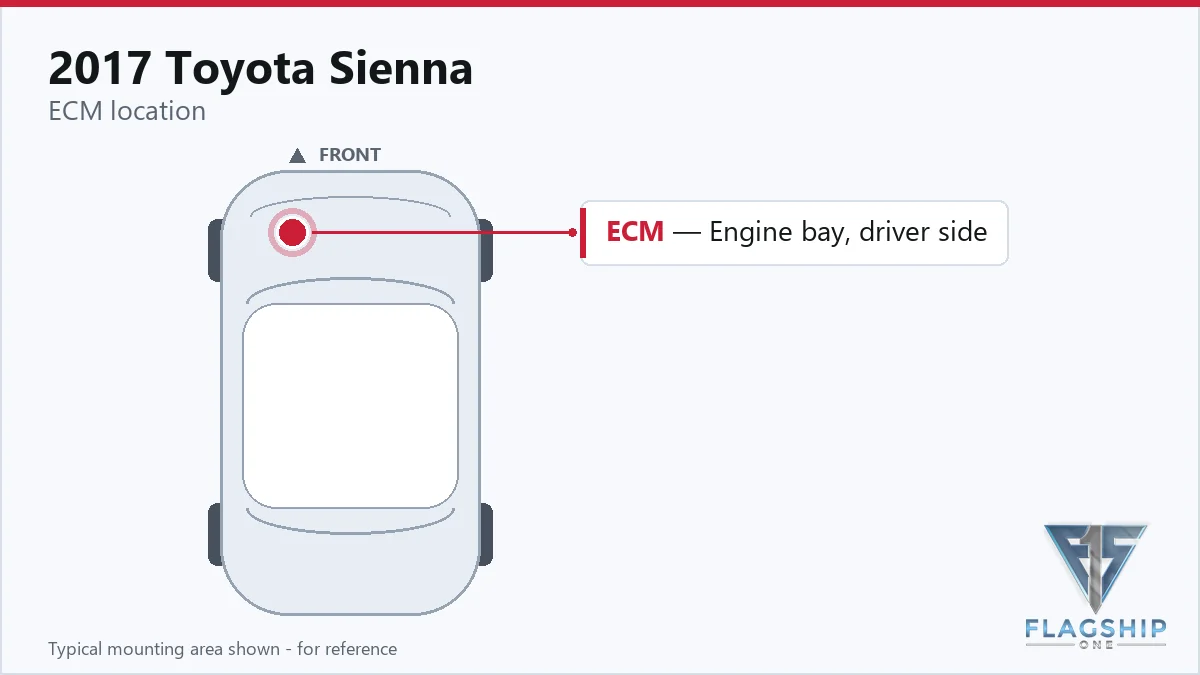
Work with the ignition off, and treat the module as static-sensitive: avoid touching the connector pins at any point.
| Operation | Configuration | Book Time |
|---|---|---|
| Powertrain Control Module R&R | All configurations | 1.3 hr |
| Powertrain Control Module Relearn | All configurations | 0.5 hr |
| Engine Control Module Relearn | All configurations | 0.5 hr |
| Engine Control Module R&R | All configurations | 1.3 hr |
| Engine Control Module Reset | All configurations | 0.3 hr |
Following the installation of a new engine computer, the factory procedure mandates completing a vehicle identification number registration. This step is crucial for the vehicle to accept the new module. Additionally, if the original module has been struck or dropped, it must be replaced rather than reinstalled. Bypassing these programming requirements is possible by choosing a VIN-programmed replacement unit from Flagship One, which arrives with the necessary identification already entered. This eliminates the need for the dealership registration step, allowing you to complete the installation and get your 2017 Toyota Sienna back on the road quickly. Proper programming ensures the engine management system functions correctly from the moment you turn the key.
A failing engine computer in your 2017 Toyota Sienna often manifests through several noticeable drivability issues. You may experience a no-start condition where the engine cranks but refuses to fire, or intermittent stalling while driving. Misfire codes and erratic shifting from the transmission are also common indicators of internal processor faults. Sometimes, your scan tool may fail to communicate with the module entirely, confirming an electronic failure. These symptoms occur because the module can no longer process sensor data accurately. When internal processing errors arise, they frequently trigger specific diagnostic trouble codes. For instance, you might encounter an internal processor fault P0606 that points directly to a calculation error within the computer itself. Addressing these symptoms promptly by replacing the faulty module prevents you from being stranded and restores reliable engine performance.
Diagnostic trouble codes pointing to internal module failures help pinpoint engine computer issues in your 2017 Toyota Sienna. The following list outlines the specific fault codes documented for this vehicle that indicate the control module itself requires replacement rather than a simple sensor repair.
| Code | Meaning | Full Guide |
|---|---|---|
| P0606 | Module processor failure | Full P0606 guide → |
Yes, the factory procedure requires completing vehicle identification number registration whenever the engine computer is replaced. This registration ensures the new module is recognized by the vehicle security system and can communicate properly with other modules.
The module is positioned beside the air cleaner assembly under the hood. Accessing it requires removing the wiper motor, the top cowl panel, and the air intake components.
The factory notice explicitly states that if the engine control module has been struck or dropped, it must be replaced. Internal damage from impact may not be visible but can cause intermittent failures or complete malfunction.
Deciding between repairing or replacing the engine computer in your 2017 Toyota Sienna depends on the extent of the internal damage. While some specialty shops offer rebuilding services, choosing a pre-programmed replacement often saves significant time and eliminates the need for complex dealership programming procedures. Flagship One provides ready-to-install options tailored to your specific vehicle configuration, ensuring a straightforward swap that gets your minivan back on the road reliably.
Flagship One stocks a refurbished, VIN-programmed PCM for the 2017 Toyota Sienna with a lifetime warranty, free shipping and no core charge. The full Toyota Sienna module lineup covers other engine configurations as well.
Addressing engine computer issues in your 2017 Toyota Sienna promptly restores reliable drivability and prevents further complications down the road. Understanding the replacement process, programming requirements, and common failure symptoms empowers you to handle the repair confidently. When you are ready to resolve those frustrating drivability concerns, explore the available replacement options to find the correct solution for your specific vehicle.