
Last updated on August 25th, 2026 at 11:56 am
The engine control module in your 2017 Toyota Highlander manages fuel delivery, ignition timing, and emissions functions for the 2.7L powertrain. When this computer fails, it may trigger diagnostic codes, cause rough running, or prevent starting. A damaged unit often requires VIN registration after installation to restore proper communication with the vehicle’s immobilizer and powertrain systems.
When your 2017 Toyota Highlander begins showing signs of engine computer trouble, understanding what is happening under the hood can save you time and money. The engine control module is the brain behind your 2.7L engine, coordinating fuel injection, ignition timing, and emissions monitoring. If this component fails, your vehicle may refuse to start, run poorly, or display warning codes that leave you searching for answers.
This guide walks through what the module does, where it lives in your Highlander, what the factory replacement procedure involves, and which symptoms typically point to ECM failure. You will also find the documented internal trouble code for this vehicle, practical prevention tips, and answers to common questions. Whether you are diagnosing a problem or planning a replacement, the information here helps you approach the repair with confidence and make informed decisions about new versus refurbished options.
The engine control module in your 2017 Toyota Highlander serves as the central processor for the 2.7L powertrain. It continuously reads input from sensors monitoring throttle position, coolant temperature, oxygen levels, and crankshaft rotation, then adjusts fuel injector pulse width and ignition timing to keep the engine running efficiently. The module also communicates with the transmission control system and manages emissions components to maintain compliance.
When the ECM begins to fail, it may store internal fault codes, illuminate the check engine light, or cause drivability problems ranging from hesitation to complete no-start conditions. Because the module integrates with the vehicle’s immobilizer and security system, a replacement replacement ECM for the Highlander must be registered to the chassis before the engine will run properly. This is why careful diagnosis matters before swapping parts, as sensor or wiring failures can mimic a bad computer. Understanding the module’s role helps you distinguish between a genuine ECM failure and other powertrain issues that produce similar symptoms.
2017 Toyota Highlander
OEM programmed ECM for your 2017 Toyota Highlander — plug & play, no dealer visit.
Free shipping · Lifetime warranty
The ECM in your 2017 Toyota Highlander is positioned alongside the air cleaner assembly. Reaching it requires removing several components in sequence. The factory procedure begins by disconnecting the negative battery cable, after which you remove the left-hand radiator side deflector seal and the right-hand radiator side seal. Next comes the seal on the cool air intake duct, followed by the inlet air cleaner assembly and the air cleaner assembly with its hose.
According to the published labor guide, removing and reinstalling the engine control module takes 0.7 hours. An additional 0.5 hours covers the relearn procedure that the module requires after installation. The factory also notes that after switching the ignition off, a waiting period may be necessary before disconnecting the battery cable, so plan accordingly.
If the module sustains an impact or is dropped during removal, the manufacturer recommends replacing it rather than attempting to reuse the damaged unit.
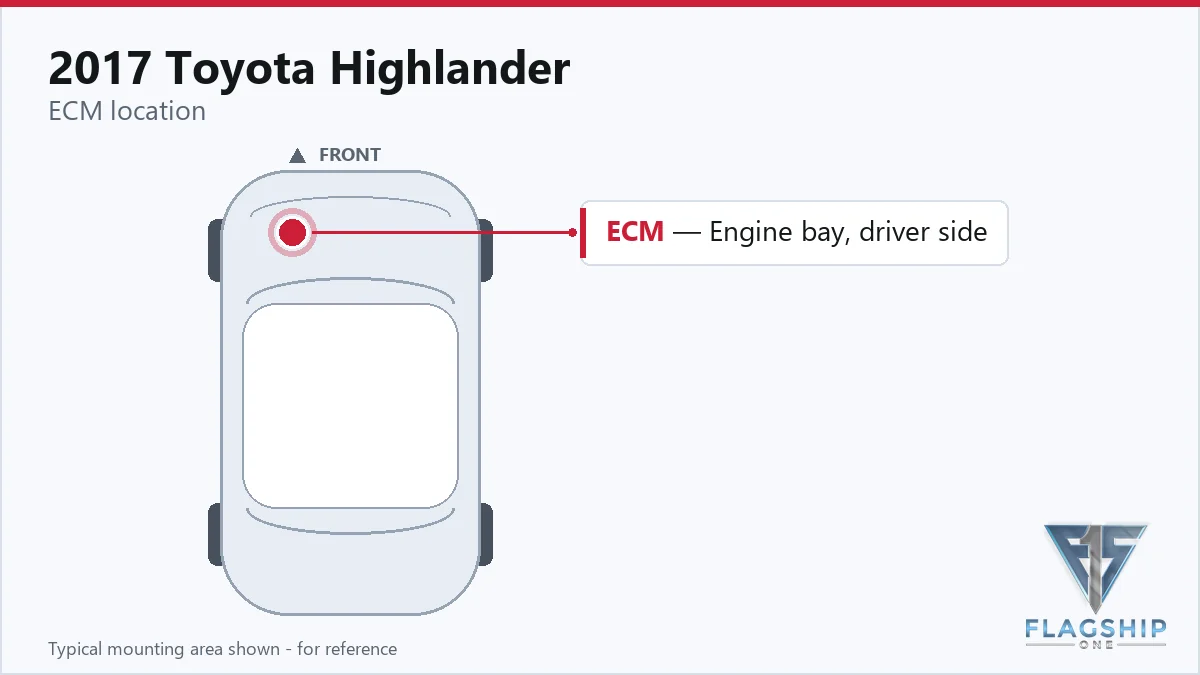
Work with the ignition off, and treat the module as static-sensitive: avoid touching the connector pins at any point.
| Operation | Configuration | Book Time |
|---|---|---|
| Powertrain Control Module R&R | All configurations | 0.7 hr |
| Engine Control Module Relearn | All configurations | 0.5 hr |
| Engine Control Module R&R | All configurations | 0.7 hr |
The factory service procedure requires Vehicle Identification Number registration whenever the ECM is replaced on your 2017 Toyota Highlander. The manufacturer also directs technicians to refer to the Registration section before proceeding with the module swap. Without completing this step, the engine computer will not communicate properly with the immobilizer, and the vehicle may not start.
Flagship One eliminates this concern by shipping a VIN-programmed replacement unit that already has your vehicle’s identification number loaded. This means the registration step the factory calls for is already completed before the part arrives, saving you the relearn time and getting your Highlander back on the road sooner. You still need to handle the physical installation, but the programming work is done.
A failing engine control module in your 2017 Toyota Highlander can produce a range of drivability symptoms. You may experience difficulty starting the vehicle, intermittent stalling at idle, or hesitation under acceleration. Some owners report rough running or misfire-like behavior even when the spark plugs and coils test fine. In more advanced cases, the engine may crank but refuse to start altogether.
Scan tool communication is another indicator. If your diagnostic tool cannot establish a link with the ECM, the module itself may be the problem. The factory has documented internal processor fault P0606 for this vehicle, and when the computer logs an internal ECM processor fault it typically points to a problem within the module rather than an external sensor or wiring issue. Shift quality may also suffer if the ECM loses its ability to coordinate with the transmission. Because these symptoms overlap with fuel pump, ignition, and sensor failures, confirming the diagnosis with proper testing before replacing the computer is always worthwhile.
The following table lists the module-internal trouble code that Toyota has documented for the 2017 Highlander with the 2.7L engine. This code relates specifically to the engine control module’s internal processor rather than an external sensor or circuit, which helps distinguish a computer fault from other drivability issues.
| Code | Meaning | Full Guide |
|---|---|---|
| P0606 | Module processor failure | Full P0606 guide → |
The engine control module manages fuel injection, ignition timing, emissions monitoring, and communication with the transmission system. It reads data from multiple sensors and adjusts engine operation in real time to maintain efficiency and compliance.
The published labor time for removing and reinstalling the module is 0.7 hours. The relearn procedure adds another 0.5 hours. Actual time may vary depending on shop conditions and whether any surrounding components require attention.
Yes, the factory requires Vehicle Identification Number registration after installing a new ECM. Flagship One ships units with the VIN already programmed, so this registration step is completed before the part arrives at your door.
If your 2017 Toyota Highlander is showing signs of ECM failure, you have options. A brand-new module from the dealership comes with a premium price tag, while a refurbished unit may carry uncertainty about its internal condition. Flagship One offers a middle path: quality replacement engine computers programmed to your vehicle’s specifications and ready to install. Choosing the right part depends on your budget, timeline, and how confident you want to feel about the repair lasting for the long haul.
Flagship One stocks a refurbished, VIN-programmed PCM for the 2017 Toyota Highlander with a lifetime warranty, free shipping and no core charge. The full Toyota Highlander module lineup covers other engine configurations as well.
Your 2017 Toyota Highlander relies on a healthy engine control module to keep the 2.7L powertrain running smoothly. Understanding the symptoms, location, and factory requirements for replacement helps you make the right call when trouble arises. Flagship One provides programmed replacement ECMs that take the guesswork out of the installation process, so you can get back on the road with confidence.