
Last updated on August 25th, 2026 at 11:57 am
The Engine Control Module in your 2016 Toyota Highlander 2.7L manages fuel delivery, ignition timing, and emissions functions. When this computer fails, your vehicle may experience starting difficulties, rough idle, or complete inability to run. Internal processor faults can also prevent communication with diagnostic equipment, making troubleshooting challenging without proper tools.
When your 2016 Toyota Highlander 2.7L develops drivability issues that point to the engine computer, understanding what is involved helps you make informed repair decisions. The Engine Control Module coordinates critical engine functions, and when it fails, the symptoms can mimic other problems. Replacing this component involves specific access steps, factory-mandated programming, and careful handling precautions. Your Highlander’s ECM is not a simple plug-and-play part; it requires registration procedures that link the new module to your vehicle’s identification number. Knowing the labor times, access path, and post-install requirements gives you a clear picture of what a proper replacement entails. Whether you are diagnosing a no-start condition or addressing an internal processor code, having accurate information about the module’s location, removal procedure, and programming needs helps you avoid unnecessary delays and repeat repairs. This guide walks through the documented facts so you can approach the repair with confidence.
The Engine Control Module in your 2016 Toyota Highlander 2.7L serves as the central processor for engine management. It continuously reads input from sensors monitoring throttle position, coolant temperature, oxygen levels, and mass airflow, then adjusts fuel injection and ignition timing accordingly. This module also oversees evaporative emissions controls and communicates with other onboard computers through the vehicle’s network. When the ECM functions correctly, your Highlander delivers smooth power, proper fuel economy, and passes emissions testing. When internal circuits degrade, the module may generate erroneous sensor readings, trigger false codes, or lose communication with the scan tool entirely. A failing ECM can cause intermittent stalling, hard starting, or prevent the engine from running at all. Because this computer controls multiple interconnected systems, symptoms often overlap with bad sensors or wiring faults, making diagnosis critical before replacement. Sourcing replacement ECMs for the Highlander that arrive properly programmed can save significant labor time compared to installing a blank module and performing factory registration steps at a shop.
2016 Toyota Highlander 2.7L
OEM programmed ECM for your 2016 Toyota Highlander 2.7L — plug & play, no dealer visit.
Free shipping · Lifetime warranty
The ECM in your 2016 Toyota Highlander 2.7L is positioned adjacent to the air cleaner assembly. Reaching it requires a sequence of removals that starts with disconnecting the cable from the negative battery terminal. From there, the radiator side deflector seal on the left side and the radiator side seal on the right side come off, followed by the cool air intake duct seal. The inlet air cleaner assembly is then removed, and finally the air cleaner assembly with its attached air cleaner hose is taken out to expose the module. Factory book time for removing and reinstalling the ECM is 0.7 hours. An additional 0.5 hours covers the engine control module relearn procedure. The factory notes that after turning the ignition switch off, a waiting period may be necessary before disconnecting the negative battery cable, so plan accordingly. If the ECM has been struck or dropped during handling, the manufacturer recommends replacing it rather than attempting reuse.
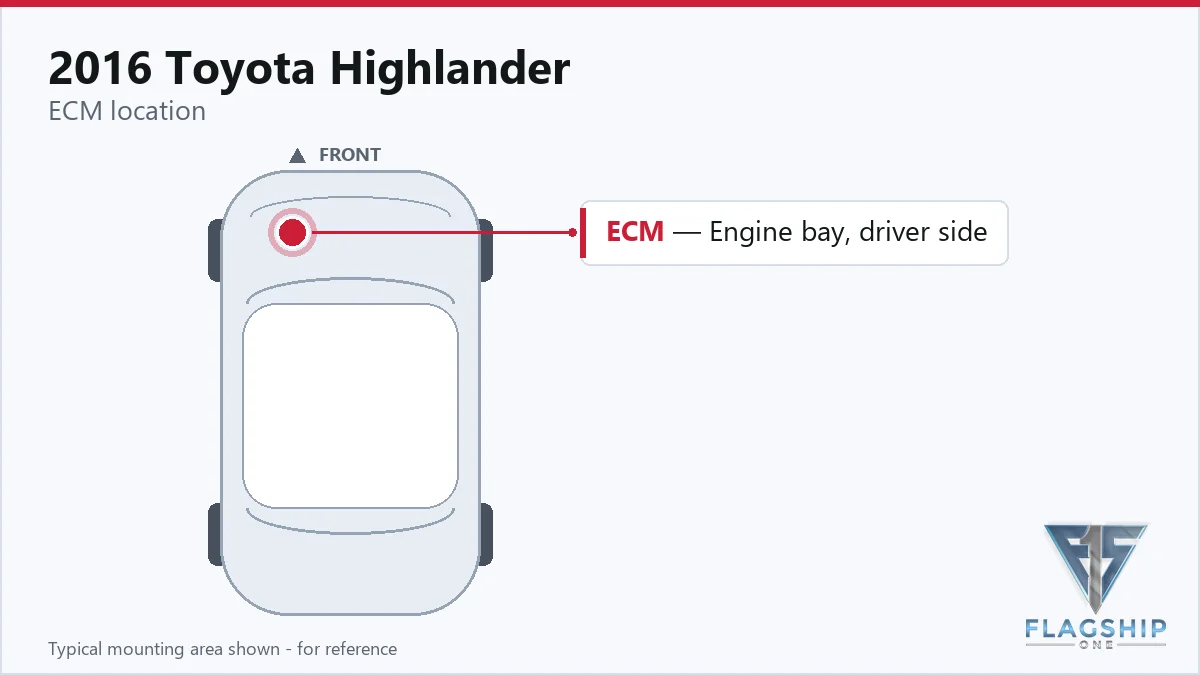
Work with the ignition off, and treat the module as static-sensitive: avoid touching the connector pins at any point.
| Operation | Configuration | Book Time |
|---|---|---|
| Powertrain Control Module R&R | All configurations | 0.7 hr |
| Engine Control Module Relearn | All configurations | 0.5 hr |
| Engine Control Module R&R | All configurations | 0.7 hr |
Whenever the ECM is replaced on your 2016 Toyota Highlander 2.7L, the factory requires Vehicle Identification Number registration to link the new module to your specific vehicle. The manufacturer also directs technicians to refer to registration procedures before replacing the ECM. These steps typically involve a compatible scan tool and a stable battery voltage to complete the process correctly. Choosing a VIN-programmed replacement unit means the VIN registration and relearn procedures are already completed at the factory level, so your installer can focus on the physical swap without needing specialized programming equipment. This can reduce shop time and eliminate the risk of incomplete registration that could cause drivability issues after installation. The 0.5 hours of book time allocated for the relearn procedure may be avoidable when the module arrives already configured.
When the ECM in your 2016 Toyota Highlander 2.7L begins to fail, several symptoms may appear. A no-start condition is common, where the engine cranks but does not fire because the module is not commanding fuel or spark. Intermittent stalling can occur if the internal processor loses communication momentarily while driving. You may notice rough running or misfire-like behavior even when traditional ignition components are in good shape. Sometimes the check engine light illuminates and the vehicle enters a reduced-power mode. In other cases, a scan tool cannot establish communication with the engine computer at all, which strongly suggests an internal module failure rather than a sensor or wiring issue. The documented trouble code an internal processor fault P0606 indicates the module’s own diagnostics have detected a problem within its circuitry. When this specific code appears alongside running issues, replacing the ECM is often the recommended path, though confirming wiring integrity first remains good practice.
The 2016 Toyota Highlander 2.7L has one documented module-internal trouble code associated with ECM faults. This code relates to the processor itself rather than external sensors or actuators. When this code is stored, it typically points to a problem within the engine computer’s internal circuitry rather than a fixable wiring or component issue elsewhere in the vehicle.
| Code | Meaning | Full Guide |
|---|---|---|
| P0606 | Module processor failure | Full P0606 guide → |
The ECM is located adjacent to the air cleaner assembly and requires removing several intake components for access. Factory book time is 0.7 hours for removal and reinstallation, plus 0.5 hours for the relearn procedure. VIN registration is required after the new module is installed.
Driving with a P0606 code is not recommended. This code indicates an internal processor fault within the ECM itself, which may cause unpredictable drivability issues including stalling or a no-start condition. Have the vehicle diagnosed promptly to confirm whether the module needs replacement.
Yes, the factory requires Vehicle Identification Number registration whenever the ECM is replaced. A VIN-programmed replacement unit arrives with this step already completed, which can save shop time and eliminate the need for specialized programming equipment during installation.
If your 2016 Toyota Highlander 2.7L is showing signs of ECM failure, you have two main paths: repair the existing module if the fault is external, or install a replacement unit when internal processor damage is confirmed. A VIN-programmed replacement eliminates the factory registration steps, reducing installation time. Consider having a qualified technician confirm the diagnosis before purchasing, as sensor and wiring issues can mimic module failure. Flagship One offers programmed ECMs tailored to your specific vehicle identification number.
Flagship One stocks a refurbished, VIN-programmed PCM for the 2016 Toyota Highlander with a lifetime warranty, free shipping and no core charge. The full Toyota Highlander module lineup covers other engine configurations as well.
The 2016 Toyota Highlander 2.7L relies on a properly functioning ECM for fuel management, emissions control, and overall drivability. When internal faults like P0606 appear, replacement is often the most reliable solution. Understanding the access path, labor times, and programming requirements helps you plan the repair with confidence. Explore VIN-programmed options from Flagship One to simplify the installation and get your Highlander back on the road.