
Last updated on August 25th, 2026 at 02:10 pm
The Engine Control Module (ECM) is the primary computer governing fuel delivery, ignition timing, and emissions systems in your Sedona. Internal failure may occur from voltage spikes, thermal stress, or corrupted memory, resulting in drivability issues.
If your 2017 Kia Sedona has developed drivability problems or stores fault codes related to the Engine Control Module, you are likely facing a repair decision that involves specialized programming equipment. This guide explains what the ECM does in your vehicle, where it is located, what the replacement procedure entails, and why proper programming is critical for getting back on the road. Whether you are a DIY mechanic evaluating options or a shop technician seeking procedural reference, the information here helps you understand the scope of work and what to expect from a proper repair.
The Engine Control Module serves as the central nervous system for your Sedona’s powertrain. It processes inputs from dozens of sensors throughout the engine and transmission, then controls fuel injectors, ignition coils, variable valve timing actuators, and the automatic transmission shift points. The module maintains closed-loop fuel control for emissions compliance and stores adaptive learned values that optimize engine behavior over time. When internal memory corrupts or processor functions fail, the ECM may default to limp-home mode or fail entirely, leaving you with a no-start condition. Replacement requires a matching unit programmed with your vehicle’s VIN, as the original module contains vehicle-specific security and calibration data. For owners of this model year, replacement engine computers for the Sedona must be sourced from suppliers capable of providing correctly programmed units.
2017 Kia Sedona
OEM programmed ECM for your 2017 Kia Sedona — plug & play, no dealer visit.
Free shipping · Lifetime warranty
The ECM on your Sedona is located in the engine compartment, accessible by working through the air cleaner assembly housing during removal. This positioning means the air ductwork and intake hose must be disconnected to gain adequate clearance for module extraction. The factory procedure specifies mounting nuts tightened to 8.8 to 11.8 newton-meters and mounting bolts torqued to 9.8 to 11.8 newton-meters. Book time for the removal and replacement operation alone is 0.8 hours, though the relearn procedure that follows typically requires an additional 0.5 to 0.8 hours depending on system initialization needs. The ECM reset procedure may add another 0.3 hours if the scan tool requires a separate reset routine after the new module is installed and communicating.
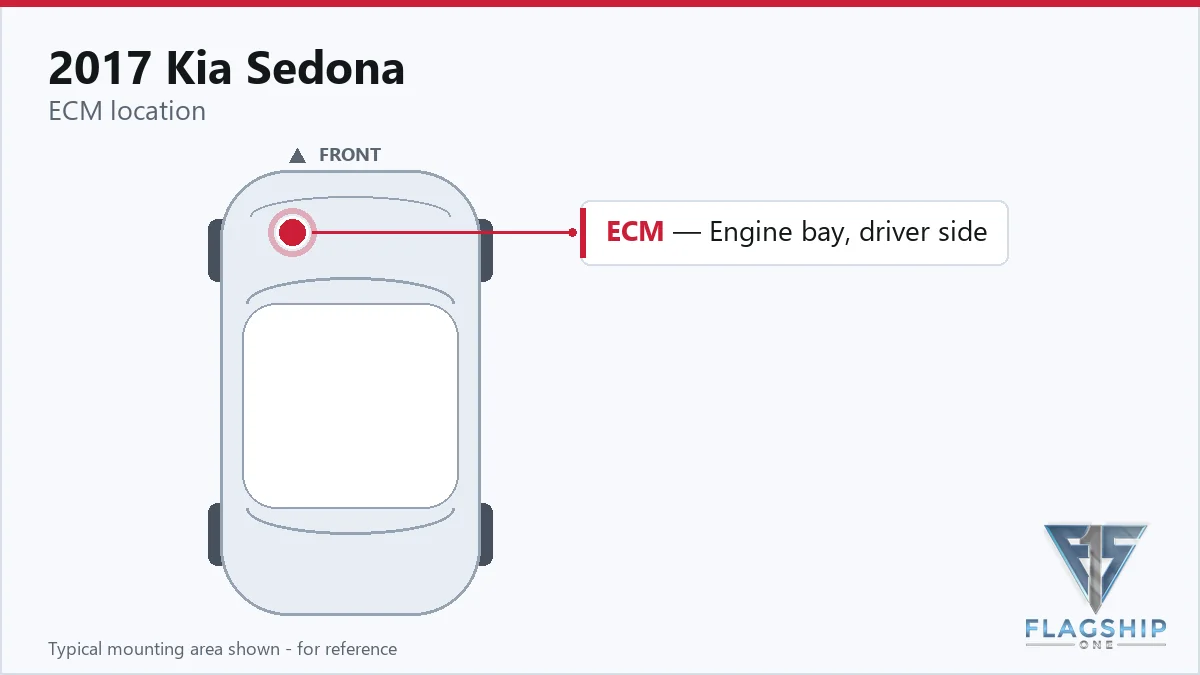
Work with the ignition off, and treat the module as static-sensitive: avoid touching the connector pins at any point.
| Operation | Configuration | Book Time |
|---|---|---|
| Powertrain Control Module R&R | All configurations | 0.8 hr |
| Powertrain Control Module Relearn | All configurations | 0.5 hr |
| Engine Control Module Reset | All configurations | 0.3 hr |
| Engine Control Module R&R | All configurations | 0.8 hr |
| Engine Control Module Relearn | All configurations | 0.5 hr |
Factory procedure for your 2017 Sedona requires that the replacement ECM have the vehicle identification number programmed into its memory before the engine will run. This security programming step uses the Kia Diagnostic System (KDS) or equivalent factory-grade scan tool to write the VIN to the module’s permanent storage. Additionally, the technician must perform a relearn procedure so the new ECM can build its adaptive tables based on your specific engine’s characteristics. Flagship One units ship with the VIN already programmed, which means the technician can proceed directly to the relearn and verification steps rather than performing the initial VIN programming procedure.
Every VIN-programmed replacement unit from Flagship One arrives with these steps already completed.
When the ECM experiences internal failure, common presentations include a no-start condition where the engine cranks but will not run, intermittent stalling especially during idle or low-speed maneuvering, and illumination of the check engine light. The scan tool may show no communication with the ECM or display multiple sensor-related codes that do not correlate with actual sensor failure. You may also notice harsh shifting from the automatic transmission or reduced power output as the module enters fail-safe mode. On this vehicle, the presence of internal memory fault often indicates that the ECM’s internal processor or memory has failed and the module requires replacement rather than repair.
This vehicle may store module-internal trouble codes that point specifically to ECM hardware failure rather than external sensor or wiring faults. These codes indicate the control module has detected an internal problem that prevents proper operation.
| Code | Meaning | Full Guide |
|---|---|---|
| P0605 | Internal ROM error | Full P0605 guide → |
Kia has published service bulletins relevant to electrical diagnostics and module replacement procedures. Bulletin ELE106 covers instrument cluster replacement, software updates, and mileage calibration procedures that may be referenced during related electrical work. Bulletin SST037r1, titled Standard KDS Reflash Procedure, provides the factory-approved methodology for programming and initializing control modules using the Kia Diagnostic System. These documents establish the standardized approach that authorized technicians follow when replacing and programming the ECM on your vehicle.
| Bulletin | Subject | What It Addresses |
|---|---|---|
| — | TSB • Body Electrical System • [ELE106] Instrument Cluster Replacement, Software Upgrade and Mi | — |
| — | TSB • General Information • [SST037r1] Standard KDS Reflash Procedure (SST037) (Rev 1) | — |
No. The ECM must be matched to your specific vehicle and programmed with your VIN to function. Modules from other vehicles will not communicate with your Sedona’s systems.
Driving with a compromised ECM may result in no-start conditions, stalling, or being stranded. If the module has entered fail-safe mode, performance will be severely limited and further damage may occur.
Any facility with the proper Kia factory scan tool or equivalent can program the ECM. Independent shops specializing in European and Asian module programming often offer this service at competitive rates.
When your 2017 Kia Sedona requires ECM replacement, you have two primary paths: a new or refurbished unit from an authorized dealer, or a quality replacement module from a specialist supplier. The key difference lies in programming—Flagship One provides VIN-programmed units that arrive ready for installation, eliminating the need for initial programming steps at your repair facility. Consider your budget, timeline, and whether your shop has access to factory-level diagnostic equipment when making your decision.
Flagship One stocks a refurbished, VIN-programmed PCM for the 2017 Kia Sedona with a lifetime warranty, free shipping and no core charge. The full Kia Sedona module lineup covers other engine configurations as well.
The 2017 Kia Sedona’s Engine Control Module is a critical component that governs essential engine and transmission functions. If diagnostic evidence points to internal ECM failure, replacement with a properly programmed unit restores full functionality. By understanding the labor involved, the programming requirements, and the importance of using a correctly configured replacement module, you can make an informed repair decision that gets your Sedona back to reliable operation.