
Last updated on August 25th, 2026 at 02:11 pm
In the 2015 Kia Sedona the Engine Control Module (ECM) manages fuel injection, ignition timing, emissions and diagnostic communication. A malfunction typically stems from internal circuitry loss, voltage spikes or corrupted software, leading to loss of engine control and diagnostic link loss.
When a 2015 Kia Sedona begins to exhibit no‑start conditions, rough idle, or intermittent power‑train warnings, the Engine Control Module is a common suspect. Understanding how the ECM functions, where it lives, and what the factory expects after a swap can help you decide whether a repair or a refurbished replacement makes sense. This guide walks you through the module’s role, typical failure signs, removal steps, programming requirements and best‑practice tips to keep the unit healthy. By the end, you’ll know what to look for, how long the job should take, and which precautions protect your investment.
The Engine Control Module in the 2015 Kia Sedona acts as the brain of the power‑train, interpreting sensor data and commanding fuel delivery, spark timing and emission controls. It also maintains communication with the vehicle’s diagnostic scanner, reporting fault codes and system status. Because the ECM coordinates critical engine functions, any internal fault can cause the engine to stall, refuse to start, or trigger warning lights. Maintaining accurate voltage and a clean grounding path helps prevent premature failure. When the module is replaced, the new unit must match the vehicle’s VIN to ensure calibration data aligns with the engine’s specifications. The 2015 Kia Sedona ECMs are designed to integrate seamlessly with the vehicle’s existing wiring harness and control strategies, but only when installed and programmed correctly.
2015 Kia Sedona
OEM programmed ECM for your 2015 Kia Sedona — plug & play, no dealer visit.
Free shipping · Lifetime warranty
Factory documentation places the ECM directly beside the air‑cleaner assembly, making it reachable once the intake cover is removed. The removal process typically involves disconnecting the electrical connector, undoing the mounting nuts (torqued between 8.8 and 11.8 N·m) and bolts (torqued between 9.8 and 11.8 N·m), and extracting the module. Reinstallation mirrors the removal steps, with the added requirement to tighten fasteners to the specified torque range to avoid stress on the housing. Labor time for a complete remove‑and‑replace operation is listed as 0.8 hours, while the subsequent relearn procedures add another 0.5 hours. The factory also calls for a control‑module reset of 0.3 hours and an ECM relearn of 0.5 hours if the original unit is reinstalled.
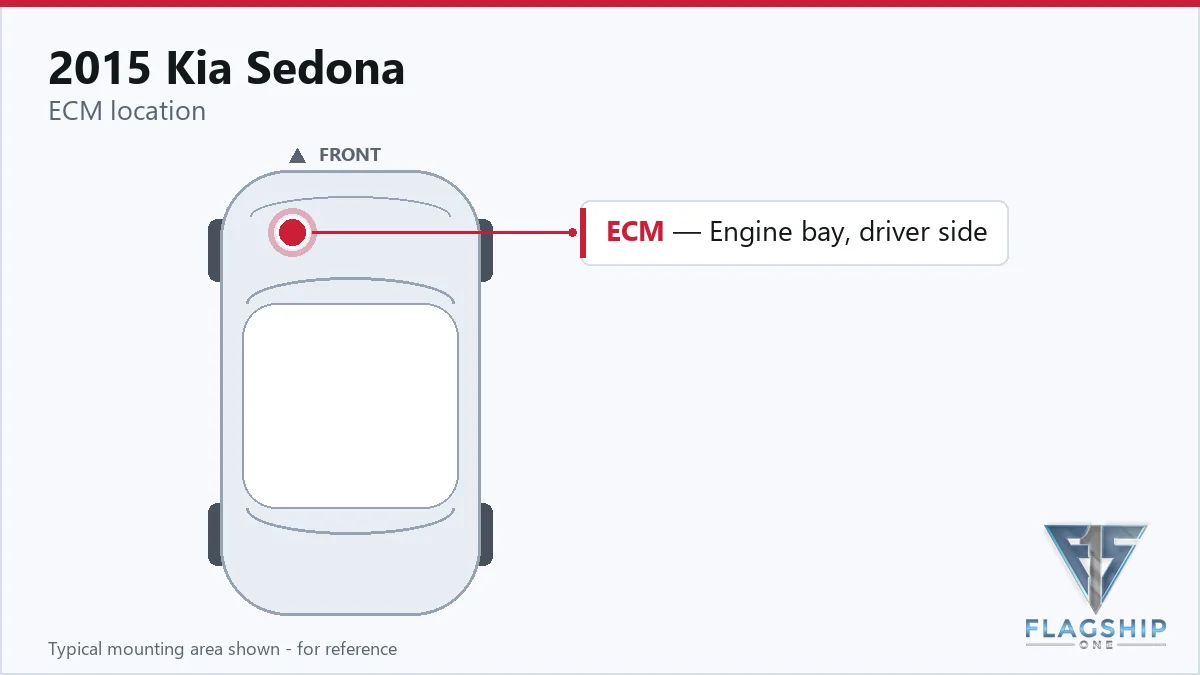
Work with the ignition off, and treat the module as static-sensitive: avoid touching the connector pins at any point.
| Operation | Configuration | Book Time |
|---|---|---|
| Powertrain Control Module R&R | All configurations | 0.8 hr |
| Powertrain Control Module Relearn | All configurations | 0.5 hr |
| Engine Control Module Reset | All configurations | 0.3 hr |
| Engine Control Module R&R | All configurations | 0.8 hr |
| Engine Control Module Relearn | All configurations | 0.5 hr |
After the physical swap, the factory procedure mandates that the vehicle identification number be entered into the new ECM so that calibration tables and emissions settings correspond to the specific car. Flagship One units arrive already VIN‑programmed, which eliminates the need for field programming and reduces the chance of human error. The required post‑install steps therefore consist of verifying connector engagement, performing the ECM relearn (0.5 hours) and confirming that no residual codes remain. Using a a VIN-programmed replacement unit ensures the vehicle’s computer is ready for immediate operation without additional coding.
Owners of a 2015 Kia Sedona may notice a range of symptoms when the ECM begins to fail. Common signs include the engine refusing to start, rough idle, unexpected stalling, or a loss of power during acceleration. Diagnostic scans often reveal a stored P0605 communication fault indicating internal module communication loss. In addition, the check‑engine light may flash, and transmission shift patterns can become erratic because the ECM also relays torque‑request data to the transmission control unit. These manifestations typically worsen under load or after repeated short trips that stress the electrical system.
The following internal diagnostic trouble codes have been recorded for the 2015 Kia Sedona’s Engine Control Module:
| Code | Meaning | Full Guide |
|---|---|---|
| P0605 | Internal ROM error | Full P0605 guide → |
A factory service campaign identified as SC109 Revision 1 calls for Body Control Module logic reprogramming on affected Sedona vehicles. While this bulletin targets the BCM, it highlights the importance of keeping all control modules up‑to‑date, especially when ECM replacement is performed.
| Bulletin | Subject | What It Addresses |
|---|---|---|
| — | CAMPAIGN • Body (Interior and Exterior) • [SC109r1] Service Campaign: Sedona (YP) – BCM Logic R | 1.Open the glove box and locate the Owner’sManual and the Features and FunctionsGuide (FFG).NOTICEDiscard the original FFG andreplace it with a new one… |
The factory book lists 0.8 hours for removal and installation, plus an additional 0.5 hours for the relearn procedure. A separate 0.3‑hour reset may be required if the original module is reused.
A torque wrench capable of measuring in the 8.8 to 11.8 N·m range is recommended to achieve the specified values for both nuts and bolts.
While the VIN can be programmed with a dealer‑level scan tool, Flagship One modules are shipped already programmed, eliminating the need for field programming.
P0605 points to an internal communication fault within the ECM, often resulting from corrupted software or a hardware failure that prevents the module from talking to other vehicle systems.
Improper torque or rough handling of connectors can stress the module. Following the specified torque values and using care when disconnecting the harness helps minimize risk.
When the ECM in your 2015 Kia Sedona shows signs of failure, you can choose to repair the original unit or install a refurbished replacement. Both options require the same removal steps and post‑install verification, but a refurbished module from Flagship One arrives VIN‑programmed, saving you the programming step. Consider the condition of the existing hardware, warranty coverage and your budget when deciding which route best fits your needs.
Flagship One stocks a refurbished, VIN-programmed PCM for the 2015 Kia Sedona with a lifetime warranty, free shipping and no core charge. The full Kia Sedona module lineup covers other engine configurations as well.
The Engine Control Module is central to the operation of your 2015 Kia Sedona. Proper removal, correct torque, and VIN programming are essential to restore reliable performance. Whether you repair the original unit or opt for a Flagship One replacement, following the outlined procedures will help you get back on the road with confidence.