
Last updated on August 25th, 2026 at 02:10 pm
In the 2020 Kia Sedona, the Powertrain Control Module and Engine Control Module manage engine timing, fuel delivery, and transmission shift strategy. A malfunction may cause loss of power, erratic shifting, or a complete no‑start condition, often flagged by diagnostic trouble codes.
When a 2020 Kia Sedona experiences intermittent power loss, rough shifting, or a complete failure to start, the electronic brains—specifically the Powertrain Control Module (PCM) and Engine Control Module (ECM)—are frequent suspects. Understanding how these modules operate, where they sit, and what the factory expects after a swap can save you time and unnecessary diagnostics. This guide walks you through the essential facts about locating, removing, and reinstalling the PCM and ECM in your Sedona, outlines the programming steps required by Kia, and highlights common symptoms that point to a failing unit. Armed with this knowledge, you can assess whether a repair or a replacement is the most efficient path forward.
2020 Kia Sedona
OEM programmed replacements — plug & play, no dealer visit.
Find yours by year, make & model →
Free shipping · Lifetime warranty
The Powertrain Control Module in the 2020 Kia Sedona acts as the central command unit for engine and transmission coordination, while the Engine Control Module focuses on combustion management, sensor integration, and emission control. Together they interpret data from crankshaft, camshaft, throttle position, and knock sensors to adjust fuel injection timing, ignition spark, and gear shifts. Accurate operation is critical for fuel efficiency, emissions compliance, and drivability, making these modules a core component of the vehicle’s overall performance. Failure can disrupt the engine’s ability to start, cause erratic shifting, or trigger protective shutdowns. For owners seeking a direct source, 2020 Kia Sedona replacement engine computers provide a reliable aftermarket option that matches factory specifications.
The factory removal procedure indicates that the control module is positioned adjacent to the air cleaner assembly, allowing technicians to reach it without extensive disassembly of the intake system. Replacing the PCM generally requires 0.8 hours of labor, while swapping the ECM also calls for 0.8 hours. After the unit is removed, a relearn operation of 0.5 hours is typical for each module to synchronize the new hardware with the vehicle’s existing parameters. The process involves disconnecting the electrical connector, unbolting the mounting hardware, and carefully extracting the module from its bracket near the air filter housing. Installation reverses these steps, ensuring the connector seats fully and any torque specifications are met as outlined in the service manual.
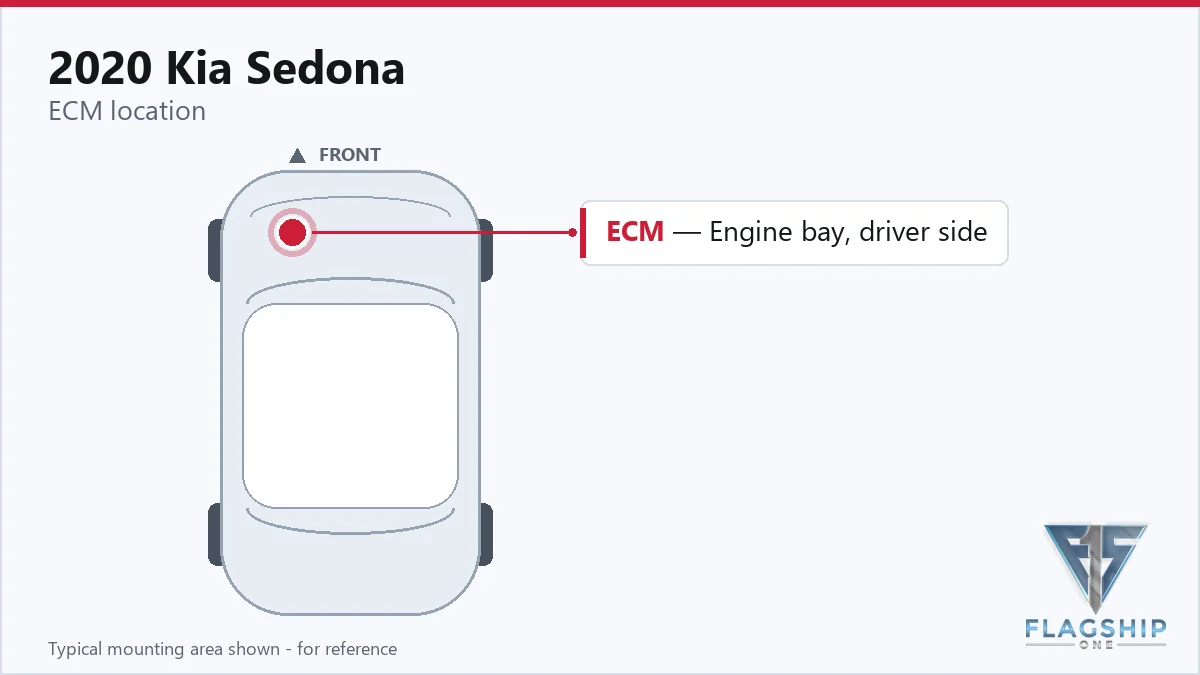
Work with the ignition off, and treat the module as static-sensitive: avoid touching the connector pins at any point.
| Operation | Configuration | Book Time |
|---|---|---|
| Powertrain Control Module R&R | All configurations | 0.8 hr |
| Powertrain Control Module Relearn | All configurations | 0.5 hr |
| Engine Control Module Reset | All configurations | 0.3 hr |
| Engine Control Module R&R | All configurations | 0.8 hr |
| Engine Control Module Relearn | All configurations | 0.5 hr |
Kia’s factory procedure mandates that the vehicle identification number be entered into a replacement ECM before the vehicle can communicate with the engine management system. Flagship One units arrive as a a VIN-programmed replacement unit so the VIN programming step is already satisfied, eliminating the need for a separate coding session. After installation, the Powertrain Control Module Relearn step of 0.5 hours and the Engine Control Module Relearn of 0.5 hours are still required to complete the calibration process and confirm that all sensor inputs are correctly interpreted.
Owners of a 2020 Kia Sedona may notice a range of issues when the PCM or ECM begins to fail. Common signs include a complete no‑start condition, intermittent stalling at idle, rough acceleration, and unexpected transmission shift patterns. Diagnostic trouble codes often appear, such as a communication error between modules that indicates a loss of data exchange. In addition, the check engine light may flash, and fuel economy can drop noticeably as the control strategy reverts to default parameters. These symptoms typically worsen under load or after a cold start, prompting a thorough scan of the powertrain modules.
Factory guidelines suggest that removing and installing the Powertrain Control Module usually takes about 0.8 hours of labor, followed by a 0.5‑hour relearn procedure.
Yes, Kia requires the vehicle identification number to be programmed into a replacement Engine Control Module before the vehicle can operate correctly.
A poor ground connection can introduce erratic sensor readings and may lead to communication errors, which are common precursors to PCM or ECM malfunction.
A frequent symptom of PCM failure is a no‑start condition combined with a flashing check engine light and transmission shift anomalies.
After installing a new Engine Control Module, a 0.5‑hour relearn process is typically performed to synchronize the module with the vehicle’s existing systems.
When the PCM or ECM in your 2020 Kia Sedona needs attention, you can choose a factory‑refurbished unit or a new replacement that matches the original specifications. Both options restore the vehicle’s electronic control capabilities, but a new VIN‑programmed unit from Flagship One eliminates the VIN entry step, streamlining the reinstall process.
Flagship One stocks a refurbished, VIN-programmed PCM for the 2020 Kia Sedona with a lifetime warranty, free shipping and no core charge. The full Kia Sedona module lineup covers other engine configurations as well.
The 2020 Kia Sedona relies on its PCM and ECM for smooth power delivery and transmission operation. Whether you opt for a repaired module or a fresh replacement, ensuring proper installation and programming will keep your vehicle performing as designed. Consider your options and choose the path that best fits your service schedule.