
Last updated on August 25th, 2026 at 02:10 pm
The Engine Control Module (ECM) in your 2017 Kia Optima Plug-In Hybrid manages fuel delivery, ignition timing, and hybrid powertrain coordination. Failures may cause erratic engine behavior, reduced fuel efficiency, or complete no-start conditions due to corrupted data or electrical faults.
If your 2017 Kia Optima Plug-In Hybrid is experiencing unexplained stalling, rough idling, or a no-start condition, the Engine Control Module (ECM) may be the culprit. This small but critical computer oversees everything from fuel injection to hybrid system coordination, ensuring smooth operation. When it fails, symptoms can range from subtle performance issues to complete vehicle immobilization. Replacing the ECM isn’t just about swapping a part—it requires precise programming to match your vehicle’s VIN, a step that ensures seamless integration with the rest of the powertrain. Understanding the process, from diagnosis to installation, can save you time and frustration. Whether you’re a DIY enthusiast or relying on a professional, knowing what to expect helps you make informed decisions about repairs and replacements. This guide covers the essentials: where the ECM is located, what replacement involves, and how to avoid common pitfalls that could lead to repeat failures.
The Engine Control Module (ECM) in your 2017 Kia Optima Plug-In Hybrid serves as the brain of the powertrain, managing both the gasoline engine and hybrid system. It continuously monitors sensors to adjust fuel delivery, ignition timing, and throttle response, optimizing performance and efficiency. In hybrid models, the ECM also coordinates power distribution between the internal combustion engine and electric motor, ensuring smooth transitions during acceleration or regenerative braking. A malfunctioning ECM may disrupt these processes, leading to poor drivability, reduced fuel economy, or even a vehicle that won’t start. Because the ECM is so integral to operation, failures often trigger warning lights on the dashboard and may store trouble codes related to engine or hybrid system performance. When replacement becomes necessary, choosing replacement engine computers for the Optima Plug-In Hybrid ensures compatibility and proper functionality. Without a fully operational ECM, your vehicle’s ability to balance power sources and maintain efficiency is compromised, making timely repairs essential.
2017 Kia Optima Plug-In Hybrid
OEM programmed replacements — plug & play, no dealer visit.
Find yours by year, make & model →
Free shipping · Lifetime warranty
In the 2017 Kia Optima Plug-In Hybrid, the ECM is positioned next to the air cleaner assembly, making it relatively accessible compared to some vehicles where the module is buried deep in the dashboard or under the seats. To replace it, a technician will typically need to remove the air cleaner housing or nearby components to gain clear access. The factory procedure doesn’t specify torque values for the ECM mounting bolts, but care must be taken to avoid overtightening, which could damage the module or its mounting bracket. Labor times vary slightly depending on the exact task: removing and reinstalling the ECM (R&R) takes about 0.4 hours, while a gas-specific R&R procedure may require 0.6 hours. If the module is being reset rather than replaced, the labor time drops to 0.3 hours. After installation, a relearn procedure is often necessary, adding another 0.5 hours to the process. The location near the air cleaner means replacement is less invasive than in some hybrids, but proper handling is still critical to avoid introducing new issues.
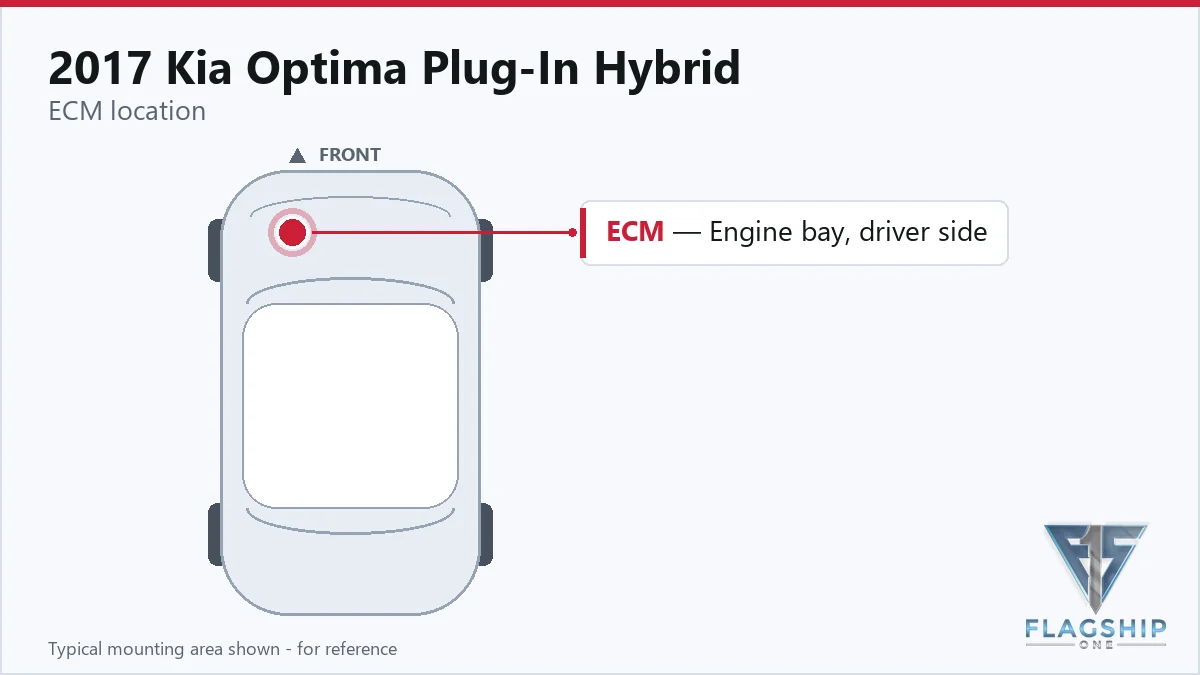
Work with the ignition off, and treat the module as static-sensitive: avoid touching the connector pins at any point.
| Operation | Configuration | Book Time |
|---|---|---|
| Engine Control Module Reset | All configurations | 0.3 hr |
| Engine Control Module R&R | GAS | 0.6 hr |
| Engine Control Module R&R | All configurations | 0.4 hr |
| Engine Control Module Relearn | All configurations | 0.5 hr |
| Powertrain Control Module R&R | GAS | 0.6 hr |
| Powertrain Control Module R&R | All configurations | 0.4 hr |
| Powertrain Control Module Relearn | All configurations | 0.5 hr |
After replacing the ECM in your 2017 Kia Optima Plug-In Hybrid, the factory procedure requires programming the vehicle’s VIN into the new module. This step is non-negotiable—without it, the ECM won’t communicate properly with the rest of the powertrain, leading to potential drivability issues or even a no-start condition. The VIN programming process ensures the module recognizes your specific vehicle’s configuration, including hybrid system parameters and engine calibration data. If you’re using a VIN-programmed replacement unit, this step is already completed, saving you time and eliminating the risk of programming errors. Without pre-programming, a dealership or repair shop would need to use specialized diagnostic tools to input the VIN, a process that can add complexity and cost to the repair. Flagship One units arrive ready to install, so you can focus on the mechanical aspects of the job without worrying about post-installation setup.
When the ECM in your 2017 Kia Optima Plug-In Hybrid begins to fail, symptoms can vary widely but often include noticeable drivability issues. You may experience rough idling, where the engine feels unstable or shakes at stoplights, or stalling, particularly when coming to a stop or accelerating from a standstill. Some drivers report a no-start condition, where the engine cranks but refuses to fire, or intermittent starting problems that resolve temporarily before recurring. Misfires are another common sign, often accompanied by a check engine light and stored trouble codes like internal control module memory checksum error. In hybrid models, ECM failures may also cause erratic transitions between electric and gasoline power, leading to jerky acceleration or unexpected engine starts. Another red flag is poor scan tool communication—if the ECM isn’t responding to diagnostics, it may indicate a complete module failure. Shifting issues, such as delayed or harsh gear changes, can also stem from ECM problems, as the module plays a role in coordinating the transmission’s behavior. If you notice any of these symptoms, prompt diagnosis is key to preventing further damage or a complete breakdown.
Common signs include rough idling, stalling, a no-start condition, or warning lights on the dashboard. If the ECM isn’t communicating with a scan tool, that’s another strong indicator. Hybrid-specific symptoms may include erratic power transitions or unexpected engine starts.
While the ECM is accessible near the air cleaner assembly, replacement requires VIN programming, which typically needs specialized tools. If you’re not comfortable with diagnostics or programming, it’s best to leave this job to a professional.
Without VIN programming, the ECM won’t recognize your vehicle’s specific configuration, leading to drivability issues, poor performance, or a no-start condition. The module must match your vehicle’s calibration data to function correctly.
Stalling at stops can be caused by ECM issues, particularly if the module isn’t properly managing fuel delivery or hybrid system transitions. It may also indicate a problem with sensors or the throttle body, but the ECM is often the first component to check.
The labor time for removing and reinstalling the ECM is typically 0.4 to 0.6 hours, depending on whether it’s a gas-specific procedure. A relearn process may add another 0.5 hours, and a simple reset takes about 0.3 hours.
If your 2017 Kia Optima Plug-In Hybrid is showing signs of ECM failure, you have options. A repair may be possible if the issue is minor, such as a corrupted memory or loose connection, but severe failures often require replacement. Opting for a refurbished or new ECM can restore full functionality, especially if the unit arrives pre-programmed with your vehicle’s VIN. This eliminates the need for post-installation programming, simplifying the process. Whether you choose to tackle the job yourself or rely on a professional, understanding the steps involved helps you make the best decision for your vehicle’s needs.
Flagship One stocks a refurbished, VIN-programmed PCM for the 2017 Kia Optima Plug-In Hybrid with a lifetime warranty, free shipping and no core charge. The full Kia Optima Plug-In Hybrid module lineup covers other engine configurations as well.
The ECM in your 2017 Kia Optima Plug-In Hybrid is a critical component that ensures smooth operation of both the gasoline engine and hybrid system. When it fails, symptoms like stalling, rough idling, or a no-start condition can leave you stranded. Replacing the module involves more than just swapping parts—it requires proper programming to match your vehicle’s VIN. By addressing issues promptly and choosing a reliable replacement, you can restore your Optima Plug-In Hybrid’s performance and avoid future headaches. If you suspect ECM trouble, don’t delay—diagnosing and fixing the problem early can save time and money in the long run.