
Last updated on August 25th, 2026 at 02:10 pm
The Engine Control Module (ECM) in your 2020 Kia Optima Plug-In Hybrid manages fuel delivery, ignition timing, and hybrid system coordination. Failures may cause drivability issues, warning lights, or prevent the vehicle from starting.
If your 2020 Kia Optima Plug-In Hybrid struggles to start, stalls unexpectedly, or triggers warning lights, the Engine Control Module (ECM) may be at fault. This critical component oversees engine performance and hybrid system integration. Replacing it involves precise steps, including programming the vehicle identification number (VIN) to ensure proper operation. Understanding the process, labor expectations, and symptoms can help you make informed decisions about repairs. Whether you’re diagnosing an issue or preparing for a replacement, knowing what to expect simplifies the experience.
The ECM in your 2020 Kia Optima Plug-In Hybrid acts as the brain for engine and hybrid system operations. It regulates fuel injection, ignition timing, and emissions controls while coordinating with the hybrid powertrain to optimize efficiency. A malfunctioning ECM may disrupt these processes, leading to poor performance or a complete no-start condition. When replacement becomes necessary, replacement engine computers for the Optima Plug-In Hybrid are designed to restore functionality, but proper installation and programming are essential to avoid further issues.
2020 Kia Optima Plug-In Hybrid
OEM programmed replacements — plug & play, no dealer visit.
Find yours by year, make & model →
Free shipping · Lifetime warranty
The ECM in your 2020 Kia Optima Plug-In Hybrid is positioned next to the air cleaner assembly, requiring removal of nearby components for access. Factory procedures specify that replacement typically takes 0.4 hours for the standard ECM R&R or 0.6 hours if labeled for gas engine applications. The Powertrain Control Module (PCM) follows similar labor times, with 0.4 hours for standard R&R and 0.6 hours for gas-specific procedures. After installation, a relearn process may add 0.5 hours to ensure the module communicates correctly with the vehicle’s systems.
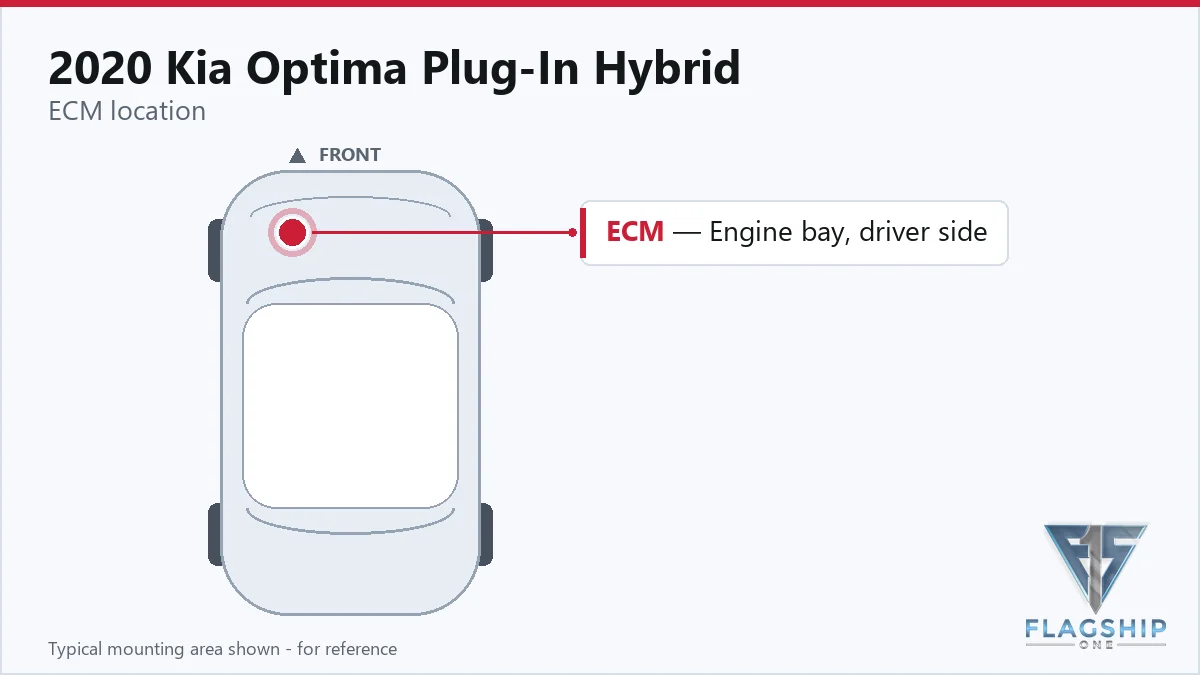
Work with the ignition off, and treat the module as static-sensitive: avoid touching the connector pins at any point.
| Operation | Configuration | Book Time |
|---|---|---|
| Engine Control Module Reset | All configurations | 0.3 hr |
| Engine Control Module R&R | GAS | 0.6 hr |
| Engine Control Module R&R | All configurations | 0.4 hr |
| Engine Control Module Relearn | All configurations | 0.5 hr |
| Powertrain Control Module R&R | GAS | 0.6 hr |
| Powertrain Control Module R&R | All configurations | 0.4 hr |
| Powertrain Control Module Relearn | All configurations | 0.5 hr |
After replacing the ECM in your 2020 Kia Optima Plug-In Hybrid, the VIN must be programmed into the new module to ensure proper functionality. This step is critical for the vehicle to recognize the replacement unit and operate as intended. Flagship One provides a VIN-programmed replacement unit that eliminates the need for this additional step, saving time and reducing the risk of programming errors during installation.
A failing ECM in your 2020 Kia Optima Plug-In Hybrid may cause a range of symptoms, including intermittent stalling, rough idling, or a complete no-start condition. You might also notice warning lights on the dashboard or difficulty communicating with a scan tool. Internal faults, such as an internal control module error, often indicate a deeper issue with the module itself. These symptoms can overlap with other problems, so proper diagnosis is key before proceeding with replacement.
The 2020 Kia Optima Plug-In Hybrid may log specific trouble codes when the ECM experiences internal faults. These codes help pinpoint issues and guide repairs, ensuring accurate diagnosis before replacement.
| Code | Meaning | Full Guide |
|---|---|---|
| P0605 | Internal ROM error | Full P0605 guide → |
Common signs include a no-start condition, stalling, or warning lights on the dashboard. If a scan tool reveals internal fault codes like P0605, the ECM may be failing. Always confirm the diagnosis before replacing the module.
While the physical replacement is straightforward, programming the VIN into the new ECM requires specialized tools. Without proper programming, the vehicle may not start or operate correctly. Professional installation is recommended.
The vehicle may fail to start or operate erratically if the VIN isn’t programmed. The ECM must recognize the vehicle’s identity to function properly, so skipping this step can lead to drivability issues.
If your 2020 Kia Optima Plug-In Hybrid requires an ECM replacement, you have options. A new or refurbished module can restore functionality, but proper installation and programming are critical. Understanding the labor involved and the importance of VIN programming helps you choose the right solution for your vehicle.
Flagship One stocks a refurbished, VIN-programmed PCM for the 2020 Kia Optima Plug-In Hybrid with a lifetime warranty, free shipping and no core charge. The full Kia Optima Plug-In Hybrid module lineup covers other engine configurations as well.
The 2020 Kia Optima Plug-In Hybrid relies on its ECM for smooth operation, and addressing issues promptly ensures reliability. Whether you opt for a repair or replacement, knowing the symptoms, labor expectations, and programming requirements helps you make informed decisions. Keep your vehicle running its best with the right approach.