
Last updated on August 25th, 2026 at 01:44 pm
In the 2016 Nissan Altima, the powertrain control module (PCM) and engine control module (ECM) manage engine timing, fuel delivery, and transmission shifting. A failure typically results from internal circuit degradation, causing loss of communication and erratic engine behavior.
When a 2016 Nissan Altima begins to exhibit sudden loss of power, stalling, or an inability to start, the underlying issue may involve the vehicle’s computer modules. Understanding how the powertrain control module (PCM) and engine control module (ECM) operate, where they reside, and what the factory expects after replacement can help you make an informed decision. This guide walks you through the basics of these modules, typical labor requirements, diagnostic clues, and the steps required to get your Altima back on the road with confidence.
The PCM in a 2016 Nissan Altima serves as the central command for both the engine and transmission, interpreting sensor data to adjust fuel injection, ignition timing, and gear shifts. The ECM, while closely related, focuses specifically on engine management functions such as idle control and emissions monitoring. Together, they ensure smooth acceleration, optimal fuel economy, and compliance with emission standards. A malfunction in either unit can disrupt the vehicle’s ability to maintain proper engine speed or shift gears, leading to drivability concerns. Proper operation is essential for meeting performance expectations and regulatory requirements. The Altima’s design relies on these controllers to coordinate multiple subsystems, and a fault often triggers the 2016 Nissan Altima replacement engine computers to be flagged during service.
2016 Nissan Altima
OEM programmed ECM for your 2016 Nissan Altima — plug & play, no dealer visit.
Free shipping · Lifetime warranty
Both the PCM and ECM in the 2016 Nissan Altima are mounted within the engine compartment, typically attached to the firewall or near the intake manifold. Access usually involves removing the battery and disconnecting the primary harness before the modules can be unbolted. The labor guide lists 2.2 hours for removing and reinstalling each module, reflecting the time needed to safely disconnect electrical connectors and secure the units. After the physical replacement, a 0.5‑hour relearn procedure is required to synchronize the new module with the vehicle’s existing sensors and calibrate parameters for proper operation.
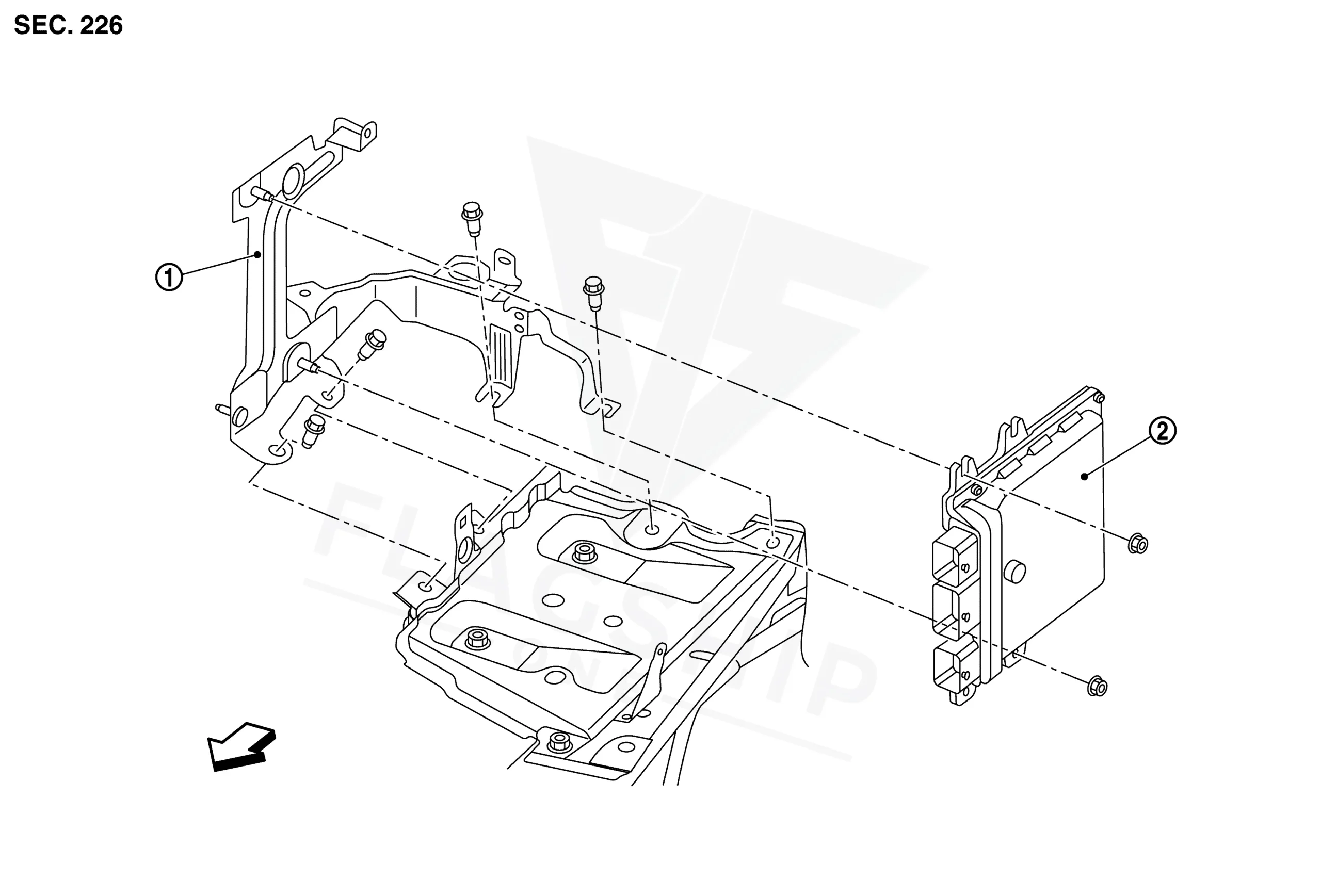
Work with the ignition off, and treat the module as static-sensitive: avoid touching the connector pins at any point.
| Operation | Configuration | Book Time |
|---|---|---|
| Powertrain Control Module R&R | All configurations | 2.2 hr |
| Powertrain Control Module Relearn | All configurations | 0.5 hr |
| Engine Control Module R&R | All configurations | 2.2 hr |
| Engine Control Module Relearn | All configurations | 0.5 hr |
Factory service procedures dictate that once a PCM or ECM is installed in a 2016 Nissan Altima, a relearn routine must be performed to align the module with the vehicle’s sensor suite and transmission control strategy. This step typically takes about half an hour of technician time. Flagship One supplies units that arrive already VIN‑programmed, so the a VIN-programmed replacement unit eliminates the need for additional coding steps, allowing you to proceed directly to the relearn operation and road testing.
A failing PCM or ECM in a 2016 Nissan Altima may manifest as a complete no‑start condition, intermittent stalling while cruising, rough idle, or unexpected transmission shifting. You might also see a loss of communication with scan tools, making diagnostics more challenging. In many cases, the vehicle will store the internal fault PCM internal communication error which points directly to a module issue. Other signs include reduced fuel efficiency and illumination of the check‑engine light with related codes. Recognizing these patterns early can prevent further damage and reduce repair costs.
The following internal trouble codes are commonly logged by the 2016 Nissan Altima when its control modules encounter faults:
| Code | Meaning | Full Guide |
|---|---|---|
| P0605 | Internal ROM error | Full P0605 guide → |
The factory labor guide lists about 2.2 hours for removing and reinstalling the PCM, plus an additional 0.5 hours for the required relearn procedure.
In most cases, a failed ECM will need to be replaced because internal circuitry damage cannot be reliably repaired. A new, VIN‑programmed unit is recommended.
P0605 signals an internal communication error within the PCM, suggesting the module is not processing data correctly and may need replacement.
The relearn procedure generally follows a set of steps outlined in the service manual and can be completed with a standard scan tool that supports Nissan protocols.
If connectors are handled carefully and proper torque specifications are followed, the risk is low. Always disconnect the battery before beginning work.
When your 2016 Nissan Altima requires a new PCM or ECM, you can choose between a brand‑new factory‑spec unit or a refurbished replacement that meets the same performance standards. Both options involve the same labor steps and post‑install relearn, allowing you to weigh cost against warranty preferences while keeping your Altima running as designed.
Flagship One stocks a refurbished, VIN-programmed PCM for the 2016 Nissan Altima with a lifetime warranty, free shipping and no core charge. The full Nissan Altima module lineup covers other engine configurations as well.
A malfunctioning PCM or ECM can sideline a 2016 Nissan Altima, but understanding the repair process and post‑install requirements helps you restore reliability. Consider your options and consult a qualified technician to ensure the job is done correctly.