
Last updated on August 25th, 2026 at 01:44 pm
The Powertrain Control Module (PCM) in your 2017 Nissan Altima manages engine and transmission functions. Failure may cause erratic performance, stalling, or communication errors with diagnostic tools, often triggered by electrical issues or internal faults.
If your 2017 Nissan Altima has been stalling unexpectedly, refusing to start, or throwing cryptic engine codes, the Powertrain Control Module (PCM) may be the culprit. This small but critical computer manages everything from fuel delivery to transmission shifting, and when it fails, your vehicle’s performance can suffer in frustrating ways. Unlike simpler components, a faulty PCM often leaves no obvious physical clues—just symptoms that mimic other issues. Understanding how this module functions, where it’s located, and what replacement involves can help you make informed decisions. Whether you’re a DIYer or relying on a shop, knowing the labor times, programming requirements, and common failure signs will save you time and guesswork. This guide covers everything specific to your Altima, so you can address the problem with confidence rather than trial and error.
The Powertrain Control Module (PCM) in your 2017 Nissan Altima is the brain behind your engine and transmission. It processes data from sensors throughout the vehicle to optimize fuel injection, ignition timing, and shift points, ensuring smooth operation and emissions compliance. Without a functioning PCM, your Altima may struggle to start, run erratically, or even enter a fail-safe mode that limits performance. This module is particularly sensitive to voltage fluctuations, which can corrupt its internal programming or damage circuitry. When replacement becomes necessary, replacement engine computers for the Altima are designed to restore full functionality, but proper installation and programming are critical. The PCM’s role extends beyond basic engine management—it also communicates with other vehicle systems, so a failure can disrupt diagnostics, leaving you with misleading trouble codes or no scan tool communication at all. Given its complexity, the PCM is one of the few components where a refurbished or pre-programmed unit can be a practical alternative to a dealer-ordered part.
2017 Nissan Altima
OEM programmed ECM for your 2017 Nissan Altima — plug & play, no dealer visit.
Free shipping · Lifetime warranty
In the 2017 Nissan Altima, the PCM is mounted in the engine bay, typically near the firewall on the passenger side. Accessing it requires removing the air intake duct and possibly some wiring harnesses or mounting brackets, depending on the exact configuration. The replacement process involves disconnecting the battery, unplugging the electrical connectors, and removing the mounting bolts to free the module. Labor guides estimate 2.2 hours for the removal and reinstallation (R&R) procedure, assuming no complications like seized bolts or corroded connectors. Once the new module is installed, it must be securely fastened, and all electrical connections should be inspected for damage or contamination. The location is chosen for protection from extreme heat and moisture, but it’s still exposed to the elements over time, which can contribute to connector corrosion or wiring issues. Proper reinstallation includes verifying that all seals and gaskets are intact to prevent future water intrusion.
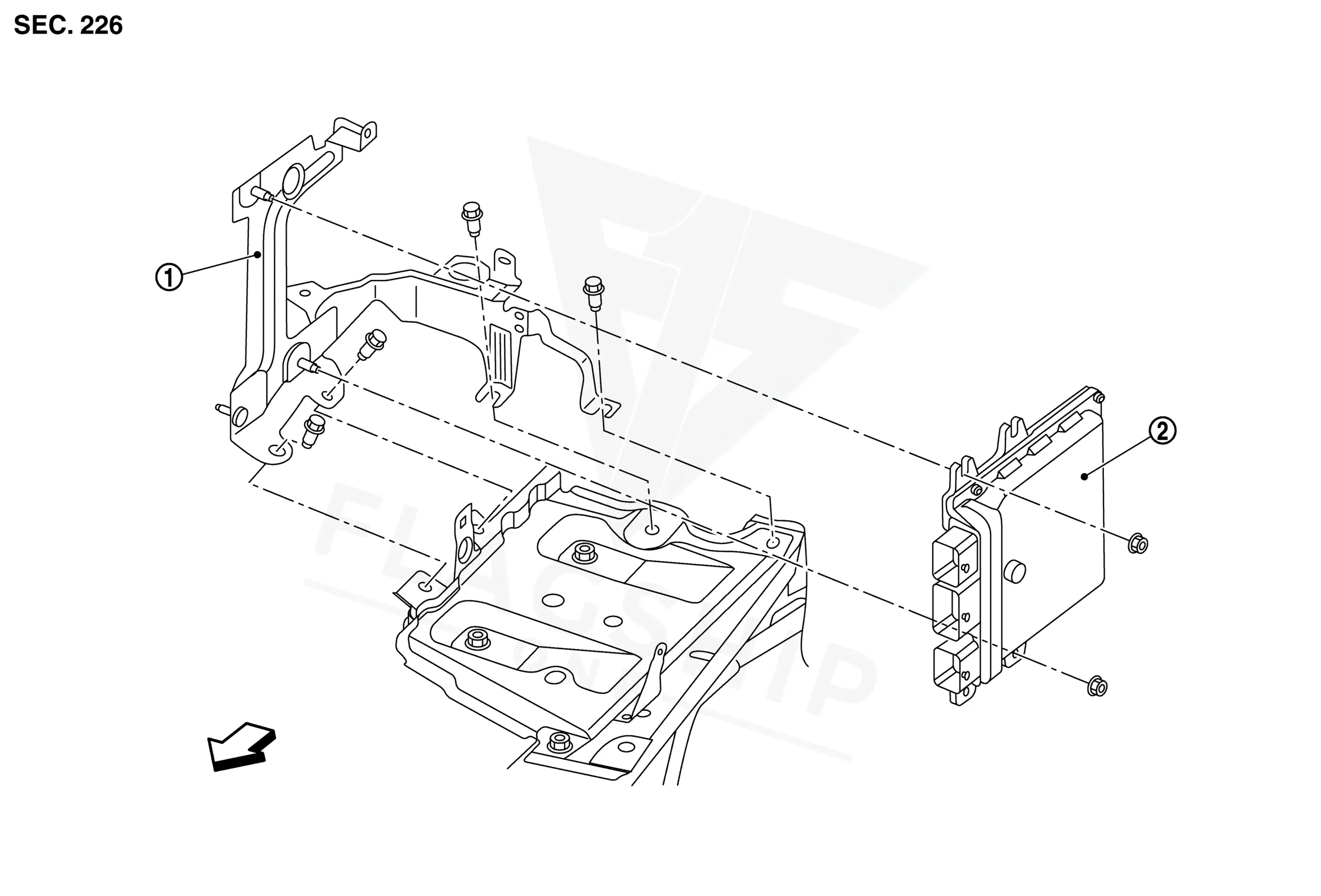
Work with the ignition off, and treat the module as static-sensitive: avoid touching the connector pins at any point.
| Operation | Configuration | Book Time |
|---|---|---|
| Powertrain Control Module R&R | All configurations | 2.2 hr |
| Powertrain Control Module Relearn | All configurations | 0.5 hr |
| Engine Control Module R&R | All configurations | 2.2 hr |
| Engine Control Module Relearn | All configurations | 0.5 hr |
After replacing the PCM in your 2017 Nissan Altima, the factory procedure requires a relearn process to synchronize the module with the vehicle’s immobilizer and other systems. This typically involves a 0.5-hour procedure using a scan tool to reset adaptive values, recalibrate the throttle position, and ensure proper communication with the transmission control module. However, if you install a VIN-programmed replacement unit, these steps are already completed, saving you time and potential headaches. The relearn process is not just a formality—skipping it may result in poor engine performance, shifting issues, or even a no-start condition. While some aftermarket tools claim to handle this automatically, the factory-recommended procedure ensures all systems are properly aligned. If you’re working with a shop, confirm they’re prepared to perform the relearn, as some may overlook it or charge extra for the service.
A failing PCM in your 2017 Nissan Altima can manifest in ways that mimic other issues, making diagnosis tricky. One of the most common signs is a no-start condition, where the engine cranks but refuses to fire, often due to the PCM cutting fuel or spark delivery. Stalling at idle or during acceleration is another red flag, particularly if it happens intermittently and without a clear pattern. You may also notice the transmission shifting erratically or getting stuck in a single gear, as the PCM controls shift points and torque converter lockup. Diagnostic trouble codes like an internal control module fault are strong indicators of PCM failure, though other codes (e.g., misfire or sensor-related) may appear as secondary symptoms. In some cases, the check engine light may flash or stay illuminated, while in others, the vehicle may run poorly without triggering any codes at all. Another telltale sign is a complete loss of communication with a scan tool, leaving you unable to retrieve codes or monitor live data. If your Altima exhibits any of these symptoms, especially in combination, the PCM should be high on your list of suspects.
The 2017 Nissan Altima’s PCM may store specific trouble codes when internal faults occur. These codes help pinpoint issues but can also be misleading if interpreted incorrectly. Below are the documented module-internal trouble codes for this vehicle.
| Code | Meaning | Full Guide |
|---|---|---|
| P0605 | Internal ROM error | Full P0605 guide → |
Random stalling in your Altima can stem from several issues, but the PCM is a likely culprit if the problem occurs without warning and is accompanied by other symptoms like rough idle or transmission hesitation. The PCM controls fuel delivery and ignition timing, so a fault may cause it to cut power unexpectedly. A scan tool can help confirm if the PCM is storing relevant trouble codes.
Reprogramming may resolve issues caused by software glitches, but physical failures—like internal circuitry damage—require replacement. If your vehicle exhibits no-start conditions, stalling, or communication errors with a scan tool, replacement is often the only solution. A diagnostic scan can help determine whether the PCM is responding at all.
Replacing the PCM is technically feasible for a DIYer with mechanical experience, but the process requires careful handling of electrical connections and a post-installation relearn procedure. If you’re not comfortable with scan tools or working in tight engine bay spaces, a shop may be the better option. The labor time is typically 2.2 hours, plus 0.5 hours for the relearn.
Skipping the relearn procedure may result in poor engine performance, erratic shifting, or even a no-start condition. The PCM needs to synchronize with the vehicle’s immobilizer and other systems to function correctly. Without this step, adaptive values like fuel trims or throttle position may not reset, leading to drivability issues.
Ignoring a P0605 code can lead to worsening performance or even a complete breakdown. This code indicates an internal PCM fault, which may cause the module to fail entirely over time. If the PCM stops communicating with other systems, you could lose access to critical functions like fuel injection or transmission control, leaving your vehicle undriveable.
If your 2017 Nissan Altima is showing signs of PCM failure, you have a few options. A dealer-ordered replacement may come with a higher price tag and longer wait times, while a refurbished or pre-programmed unit can offer a faster, more cost-effective solution. Flagship One specializes in providing VIN-programmed PCMs for the Altima, eliminating the need for additional programming steps and ensuring a smoother installation. Whether you choose to tackle the replacement yourself or leave it to a professional, addressing the issue promptly can restore your vehicle’s performance and reliability.
Flagship One stocks a refurbished, VIN-programmed PCM for the 2017 Nissan Altima with a lifetime warranty, free shipping and no core charge. The full Nissan Altima module lineup covers other engine configurations as well.
The Powertrain Control Module in your 2017 Nissan Altima plays a critical role in keeping your vehicle running smoothly. If you’re experiencing stalling, no-start conditions, or trouble codes like P0605, the PCM may be to blame. Replacement involves a straightforward but precise process, and opting for a VIN-programmed unit can simplify the job. By addressing the issue early and following proper installation procedures, you can avoid further complications and get back on the road with confidence. Whether you’re a DIYer or relying on a shop, understanding the symptoms and steps involved will help you make the best decision for your Altima.