
Last updated on August 25th, 2026 at 12:18 pm
The Engine Control Module (ECM) and Powertrain Control Module (PCM) in your 2015 Audi allroad serve as the central brain managing engine operation, transmission shifting, and emissions systems. When these units fail, the vehicle may experience drivability issues or no-start conditions.
If your 2015 Audi allroad has developed starting problems, running issues, or is storing multiple trouble codes related to the control module, you may be facing an Engine Control Module or Powertrain Control Module failure. These electronic control units serve as the central nervous system of your vehicle, processing data from dozens of sensors and commanding actuators throughout the engine and transmission. Unlike simple sensor replacements, a failed ECM or PCM often requires complete module replacement rather than repair. This guide explains where the module is located on your allroad, what the factory replacement procedure involves, what symptoms typically appear when these units fail, and what programming steps are necessary after installation. Understanding these details helps you make informed decisions about repair options and recognize when professional intervention is needed.
The Engine Control Module in your 2015 Audi allroad functions as the primary computer responsible for managing the 2.0L turbocharged engine’s operation. This unit controls fuel injection timing and duration, ignition spark advance, turbocharger boost pressure regulation, variable valve timing, and emissions control systems including the catalytic converter and evaporative emissions system. The PCM variant integrates transmission control functions, managing the dual-clutch automated manual gearbox that this vehicle uses. Both modules communicate over the Controller Area Network bus with other vehicle systems including the anti-lock brakes, airbag control module, and instrument cluster. When either module experiences internal failure, the vehicle may enter a limited-operation mode or fail to start entirely because critical engine functions cannot be executed. The module contains non-volatile memory that stores adaptation values learned during driving, and when this memory becomes corrupted or the processor fails, replacement becomes necessary rather than repair. For owners of the 2015 Audi allroad seeking replacement engine computers for the allroad, understanding these functions helps clarify why the module is considered irreplaceable without substitution.
The control module on your 2015 Audi allroad is located in the plenum chamber at the base of the windshield, requiring significant disassembly to access. The factory removal procedure involves removing the windshield wiper arms, the plenum cover panel, and typically requires working through the engine bay with the hood open. This location places the module near the HVAC intake ducting and behind the dashboard top panel, exposing it to heat cycles and occasional moisture intrusion over time. The module itself is mounted in a protective housing with an electrical connector that must be carefully released. The book time for Powertrain Control Module R&R is 1.4 hours according to factory labor guides, while Engine Control Module R&R carries the same 1.4 hour book time. After the new module is secured and connected, the electrical system requires initialization before the vehicle will run properly. Accessing this location often requires specialized tools for panel removal and patience to avoid breaking plastic clips that secure the interior trim pieces.
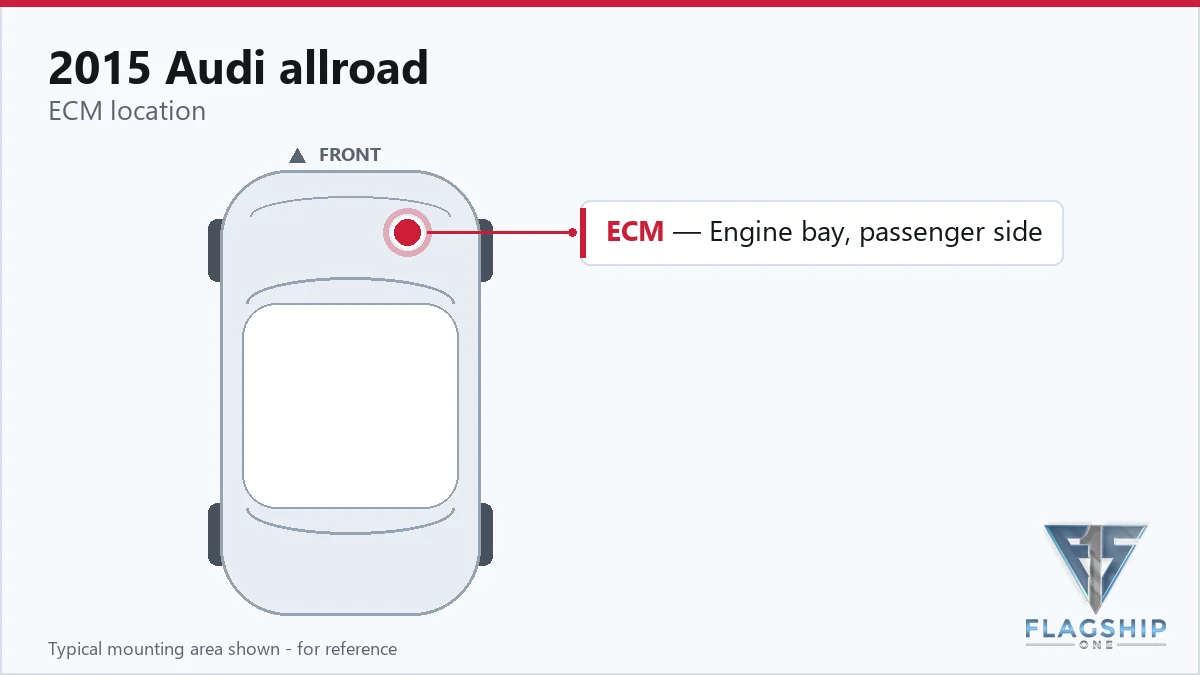
Work with the ignition off, and treat the module as static-sensitive: avoid touching the connector pins at any point.
| Operation | Configuration | Book Time |
|---|---|---|
| Powertrain Control Module R&R | All configurations | 1.4 hr |
| Engine Control Module Relearn | All configurations | 0.5 hr |
| Engine Control Module R&R | All configurations | 1.4 hr |
2015 Audi allroad
OEM programmed ECM for your 2015 Audi allroad — plug & play, no dealer visit.
Free shipping · Lifetime warranty
Following module replacement on your 2015 Audi allroad, the factory procedure requires an ECM relearn process that takes an additional 0.5 hours of book time. This relearn procedure allows the new control module to adapt to your specific engine’s characteristics and calibrate sensors for accurate operation. The vehicle must be driven through various operating conditions so the module can learn fuel trims, transmission shift points, and other adaptive values unique to your drivetrain. Without this procedure, the engine may run roughly, exhibit poor throttle response, or the transmission may shift harshly. When you purchase a replacement unit from Flagship One, the module arrives pre-programmed with your vehicle’s VIN so the basic immobilizer and configuration data is already loaded. This means the initial startup sequence will recognize your vehicle and the gauge cluster will function normally without additional programming at the dealership. You still need to complete the driving relearn procedure yourself or have a qualified independent shop perform it, but you avoid the expensive dealer programming session that would otherwise be required. Consider that a a VIN-programmed replacement unit eliminates the need for dealer-side configuration while still requiring the adaptation drive cycle.
When the ECM or PCM fails on your 2015 Audi allroad, symptoms often appear suddenly and progress rapidly if the fault is internal. The most common presentation is a no-start condition where the engine cranks normally but receives no fuel or spark because the control module has stopped sending commands to the injectors and ignition coils. Another frequent symptom involves stalling shortly after startup, particularly when the engine is warm and the module’s internal circuits have thermally cycled. Misfire codes may appear across multiple cylinders simultaneously rather than isolated to one cylinder, which points to a supply-side problem rather than individual ignition or fuel issues. Dead scan-tool communication represents another classic failure indicator; if your diagnostic scanner cannot establish a connection with the ECM or displays communication errors, the module itself may be the root cause. Some owners report intermittent shifting problems where the transmission seems to hunt between gears or becomes unresponsive to throttle inputs. The check engine light typically accompanies these symptoms and may flash rapidly indicating multiple faults are present. If your vehicle displays any of these patterns along with internal control module memory fault codes, module replacement becomes the likely solution.
The 2015 Audi allroad may store several module-internal trouble codes when the ECM or PCM experiences failure. These codes indicate specific internal problems within the control module itself rather than faults in external sensors or wiring. Code P0603 signals that the internal non-volatile memory has failed, while P0604 and P0605 indicate various memory verification failures. Code P0606 represents a processor fault, P0608 indicates a processor performance problem, and P060A and P060B relate to system monitoring failures. Additional codes including P0613, P062F, P0667 and U0100 may also appear depending on the specific failure mode. When multiple of these codes appear simultaneously without corresponding sensor failures, the control module should be suspected as the failing component.
| Code | Meaning | Full Guide |
|---|---|---|
| P0603 | Keep-alive memory (KAM) error | Full P0603 guide → |
| P0604 | Internal RAM error | Full P0604 guide → |
| P0605 | Internal ROM error | Full P0605 guide → |
| P0606 | Module processor failure | Full P0606 guide → |
| P0608 | Module-internal fault | Full P0608 guide → |
| P060A | Module-internal fault | — |
| P060B | Module-internal fault | — |
| P0613 | Module-internal fault | Full P0613 guide → |
| P062F | Internal EEPROM error | Full P062F guide → |
| P0667 | Module-internal fault | Full P0667 guide → |
| U0100 | Module-internal fault | Full U0100 guide → |
A replacement ECM or PCM will require initialization to communicate with your vehicle’s immobilizer system. Units from Flagship One arrive VIN-programmed so basic starting is possible, but you must complete the factory relearn procedure which takes approximately 0.5 hours of driving to allow the module to adapt to your engine.
A used module from another vehicle will not have your specific VIN programmed into it, and the immobilizer system will prevent the engine from starting. Additionally, used modules may have the same internal failure modes that caused the original unit to fail. New or professionally refurbished replacement units are the recommended solution.
Skipping the relearn procedure on your 2015 Audi allroad will likely result in poor idle quality, erratic throttle response, reduced fuel economy, and potentially harsh transmission shifting. The module needs to learn your specific engine’s fuel trims and sensor calibrations before optimal operation is restored.
Multiple simultaneous fault codes pointing to different engine systems, inability to communicate with the module via scan tool, and failure symptoms that resist sensor replacement all point toward control module issues. A professional diagnostic can isolate whether the problem lies with the module itself or external wiring and sensors.
The plenum chamber location requires significant disassembly including wiper arm removal, trim panel removal, and working in a confined space. While a skilled DIY mechanic may attempt this, the electrical connector clips are fragile and proper torque specifications must be followed for reassembly.
When your 2015 Audi allroad requires ECM or PCM replacement, you have two primary paths: purchasing a new unit from the dealer at significant cost, or choosing a professionally refurbished replacement module that arrives VIN-programmed for your vehicle. The refurbished option from Flagship One provides the same functional replacement without the dealer markup, and the pre-programming eliminates one of the more expensive steps in the factory procedure. Consider that the 1.4 hour book time for R&R plus the 0.5 hour relearn procedure represents the bulk of the labor cost regardless of which module source you choose. Factor in your mechanical skill level and access to diagnostic tools when deciding whether to tackle this repair yourself or leave it to a professional shop.
Flagship One stocks a refurbished, VIN-programmed PCM for the 2015 Audi allroad with a lifetime warranty, free shipping and no core charge. The full Audi allroad module lineup covers other engine configurations as well.
The 2015 Audi allroad relies on its Engine Control Module and Powertrain Control Module to manage the sophisticated 2.0L turbocharged powertrain and dual-clutch transmission. When these modules fail, the vehicle experiences drivability issues that cannot be resolved through sensor replacement alone. Understanding the module location in the plenum chamber, the factory labor times, and the post-installation relearn procedure helps you approach this repair with realistic expectations. Whether you choose professional installation or DIY, ensuring the replacement module is properly programmed and the relearn procedure is completed will restore your vehicle to reliable operation.