
Last updated on August 25th, 2026 at 12:18 pm
The powertrain control module in your 2014 Audi allroad is the central computer governing engine and transmission operations. It processes sensor data to control fuel delivery, ignition timing, variable valve timing, and gear selection. When internal circuitry fails, the module may store memory codes and lose communication with diagnostic tools despite externally functional sensors and wiring.
Facing a powertrain control module fault on your 2014 Audi allroad can feel overwhelming, especially when diagnostic trouble codes suggest an internal problem despite seemingly normal sensor readings. The module that manages your vehicle’s engine and automatic transmission operations may eventually require replacement due to internal circuitry failure. This guide explains how these control modules function in your specific vehicle, where technicians access them, what factory procedures involve after installation, and what symptoms typically accompany this type of failure. You will learn to distinguish between external sensor issues and true module-internal problems, understand the labor expectations based on standard service data, and recognize why pre-programmed replacement units from suppliers like Flagship One simplify the repair process. Whether you are evaluating repair quotes or deciding between replacement options, the information here helps you make informed decisions about your vehicle’s specific situation.
The powertrain control module in your 2014 Audi allroad serves as the primary computer managing both engine and transmission operations within a single housing. This integrated unit continuously monitors dozens of sensors positioned throughout the engine bay and drivetrain to calculate optimal fuel injection quantities, spark advance angles, variable valve timing positions, and automatic transmission shift schedules based on real-time driving conditions. The module executes these calculations through its internal processor and stores operational data in memory circuits that retain learned adaptives even when the vehicle is powered down.
When the module experiences internal electrical failures within its processor, memory cells, or voltage regulation circuits, the unit may lose the ability to perform basic calculations or maintain stable outputs. External sensors and wiring harness connections often test perfectly normal in these situations because the fault exists within the module itself rather than in peripheral components. The 2014 Audi allroad may exhibit multiple simultaneous symptoms when this occurs, including no-start conditions, stalling, irregular transmission behavior, and illumination of warning lights. This integrated design means that a single internal fault can affect multiple vehicle systems simultaneously, which explains why technicians sometimes find several seemingly unrelated trouble codes stored together. Replacement engine computers for the 2014 Audi allroad must match the exact specifications and programming to ensure proper communication with your vehicle’s unique sensor network and security features.
Flagship One keeps Audi allroad replacement engine computers in stock for exactly this failure pattern.
2014 Audi allroad
OEM programmed ECM for your 2014 Audi allroad — plug & play, no dealer visit.
Free shipping · Lifetime warranty
Accessing the powertrain control module in your 2014 Audi allroad requires work in the plenum chamber located at the base of the windshield inside the passenger compartment. The factory service procedure specifies removal of interior trim components and the plenum panel to reach the module housing, which means working through the cabin rather than the engine bay. Labor estimates from standard service data suggest approximately 1.4 hours for the removal and installation portion of this job, though actual shop time may vary based on technician experience and vehicle condition.
Once technicians gain access to the module, they disconnect the electrical harness, remove mounting fasteners, and extract the unit from its mounting location. Installation reverses this sequence, requiring careful connection of all electrical connectors and verification of secure mounting before reassembling trim panels. After the new module is physically installed, the system requires a relearn procedure to establish proper communication between the replacement unit and your vehicle’s remaining control modules and sensors. Standard labor estimates assign 0.5 hours for this engine control module relearn step. Completing the relearn procedure ensures that adaptive fuel and transmission values are properly initialized and that the new module operates correctly within your Audi’s network.
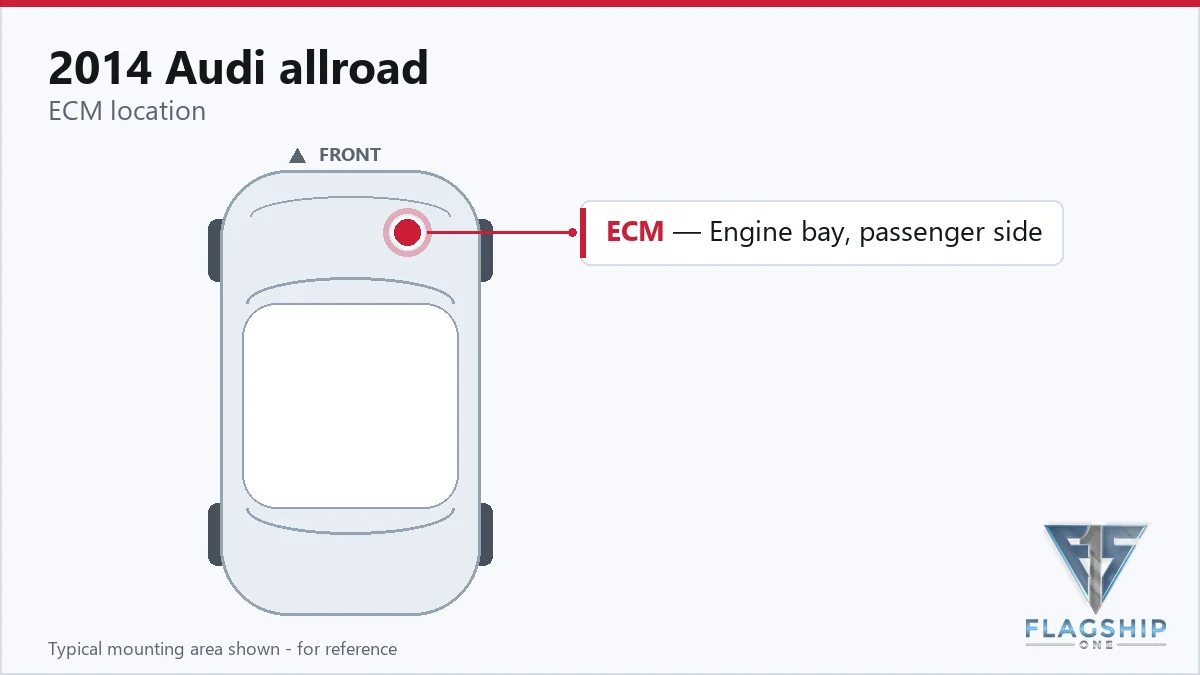
Work with the ignition off, and treat the module as static-sensitive: avoid touching the connector pins at any point.
| Operation | Configuration | Book Time |
|---|---|---|
| Powertrain Control Module R&R | All configurations | 1.4 hr |
| Engine Control Module Relearn | All configurations | 0.5 hr |
| Engine Control Module R&R | All configurations | 1.4 hr |
Following module installation, the factory service procedure for your 2014 Audi allroad requires a post-installation relearn process to synchronize the replacement powertrain control module with vehicle systems. This initialization step allows the new module to establish communication pathways with other control units, learn ambient sensor baselines, and configure transmission adaptive values specific to your vehicle’s drivetrain condition. The relearn procedure typically involves connecting professional diagnostic equipment to guide technicians through factory-specified steps and verification checks.
When ordering a replacement unit from Flagship One, you receive a VIN-programmed replacement unit that arrives configured with your specific vehicle identification number already written into the module’s memory. This means the manual VIN programming steps that the factory procedure would normally require have been completed before the part reaches your technician. Your shop still needs to perform the engine control module relearn procedure to finalize system integration, but the pre-programming eliminates a separate programming appointment or software update session that would otherwise be necessary. This convenience reduces shop time and removes the need to coordinate with third-party programming services for certain vehicles.
Every VIN-programmed replacement unit from Flagship One arrives with these steps already completed.
When the powertrain control module in your 2014 Audi allroad develops internal faults, multiple symptoms may appear together or in sequence, often confusing initial diagnostics because external components appear functional. Your vehicle might refuse to start entirely if the module fails to command fuel injection or ignition spark, leaving the engine cranking without catching. Intermittent or complete stalling during driving can occur when the module loses control over idle air control, fuel delivery sequencing, or transmission torque management. The check engine light and transmission warning indicator may illuminate simultaneously as invalid data streams trigger multiple subsystem alerts.
Engine misfire codes such as random misfire or specific cylinder misfires often populate the diagnostic memory when the module cannot properly sequence fuel injection events or maintain accurate spark timing across all cylinders. In more severe cases, the module may stop responding to scan tool requests entirely, preventing technicians from reading live data streams or clearing codes until the module is replaced. Automatic transmission symptoms can include harsh gear engagements, failure to shift into certain gears, or defaulting to limp-home mode that restricts operation to lower gears. Memory code faults like P0603 often appear alongside other module-internal trouble codes, frequently serving as early indicators that the module’s internal diagnostics have detected processor or memory subsystem irregularities. If you have experienced multiple seemingly unrelated codes alongside these memory faults, internal module failure becomes a more likely root cause than individual sensor or wiring problems.
The 2014 Audi allroad equipped with this powertrain control module may store several module-internal diagnostic trouble codes that specifically indicate faults within the module’s own circuitry rather than external component failures. Codes beginning with P0600-series generally denote internal processor errors, memory corruption, or voltage regulation problems within the module itself. When multiple memory-related codes appear simultaneously or codes persist after normal sensor replacements, technicians often investigate module-internal failure as the underlying cause rather than pursuing additional sensor or wiring diagnostics.
| Code | Meaning | Full Guide |
|---|---|---|
| P0603 | Keep-alive memory (KAM) error | Full P0603 guide → |
| P0604 | Internal RAM error | Full P0604 guide → |
| P0605 | Internal ROM error | Full P0605 guide → |
| P0606 | Module processor failure | Full P0606 guide → |
| P0608 | Module-internal fault | Full P0608 guide → |
| P060A | Module-internal fault | — |
| P060B | Module-internal fault | — |
| P0613 | Module-internal fault | Full P0613 guide → |
| P062F | Internal EEPROM error | Full P062F guide → |
| P0667 | Module-internal fault | Full P0667 guide → |
| U0100 | Module-internal fault | Full U0100 guide → |
When multiple module-internal codes like P0603 or P0606 appear alongside various sensor codes, internal module failure often becomes the more likely cause. If external sensors and wiring test normal but symptoms persist after sensor replacement, the powertrain control module itself may be generating invalid data. A qualified technician can perform additional module-internal diagnostics to confirm before recommending replacement.
Salvage yard modules typically require programming with your specific VIN and may not match your vehicle’s exact configuration and calibration. Professional programming equipment and access to factory software are necessary to properly initialize a used unit. Flagship One units arrive VIN-programmed, eliminating this additional step and potential compatibility concerns.
Standard automotive tools suffice for physical removal and installation of the module from its plenum location. Professional-grade diagnostic equipment is required for post-installation relearn procedures. Most independent shops and all dealerships possess the necessary scan tools to complete factory-specified initialization steps.
Labor estimates from standard service data suggest approximately 1.4 hours for module removal and installation plus 0.5 hours for the relearn procedure, totaling around 2 hours when performed consecutively. Actual shop time may vary depending on technician familiarity with the procedure and any unexpected complications during trim removal or connector access.
Continued operation with a compromised module may result in worsening drivability symptoms, unexpected stalling, transmission malfunctions, or complete vehicle no-start conditions. Module failures rarely improve without intervention and often eventually leave the vehicle inoperable. Prompt diagnosis and replacement prevent further damage and inconvenient breakdowns.
Deciding between repair and replacement for your 2014 Audi allroad powertrain control module depends on diagnostic findings and cost-effectiveness. Module repair may be possible in limited circumstances, but replacement typically provides a known-good baseline with fresh internal circuitry. Flagship One offers VIN-programmed replacement units configured for your specific vehicle before shipping, reducing shop time and eliminating separate programming appointments. Consult with your preferred repair facility to determine whether your technician can complete the relearn procedure in-house or requires additional support for post-installation initialization.
Flagship One stocks a refurbished, VIN-programmed PCM for the 2014 Audi allroad with a lifetime warranty, free shipping and no core charge. The full Audi allroad module lineup covers other engine configurations as well.
The 2014 Audi allroad powertrain control module represents a critical integration point for your vehicle’s engine and transmission management. When internal faults develop, the symptoms can range from minor drivability concerns to complete vehicle disablement. Understanding the module’s location, the labor expectations based on standard service data, and the post-installation requirements helps you evaluate repair options intelligently. Replacement units from Flagship One arrive pre-programmed with your VIN, simplifying the process significantly compared to ordering unmapped components. Contact your technician or Parts Specialist to discuss replacement options for your specific situation.