
Last updated on August 25th, 2026 at 12:53 pm
If your 2010 Chrysler 300 2.7L uses a Powertrain Control Module that manages engine and transmission functions, a failure can trigger misfires, idle instability, or a no‑start condition. The PCM monitors sensors, controls fuel injection, ignition timing, and shift logic to keep the vehicle running smoothly.
Replacing the Powertrain Control Module on a 2010 Chrysler 300 2.7L can restore smooth acceleration, eliminate idle problems, and resolve engine codes that prevent a start. This guide explains where the PCM sits in the engine bay, the labor times for removal, installation, and relearning, and how the module’s firmware is managed by Flagship One. You will learn what to expect during the process, how to avoid common pitfalls, and why a VIN‑programmed unit saves you from extra steps after the swap.
The Powertrain Control Module on the 2010 Chrysler 300 2.7L is the brain that coordinates engine timing, fuel delivery, and transmission shift logic. When it misreads sensor data or its internal software becomes corrupted, the vehicle may stall, misfire, or refuse to start. The module also limits top speed until a relearn procedure is run, ensuring proper throttle response. Chrysler 300 2.7L PCM plays a key role in maintaining power delivery and emissions compliance.
2010 Chrysler 300 2.7L
OEM programmed ECM for your 2010 Chrysler 300 2.7L — plug & play, no dealer visit.
Free shipping · Lifetime warranty
The PCM is located in the engine compartment, mounted on the firewall near the front of the vehicle. To replace it, disconnect the battery, remove the cover panel, and detach the electrical connector. The module is secured with a single mounting bolt; removal requires 1.0 hour of labor. Install the new unit, reconnect the wiring, and torque the mounting bolt to manufacturer specifications. Finally, reconnect the battery and allow a brief warm‑up before proceeding to relearn.
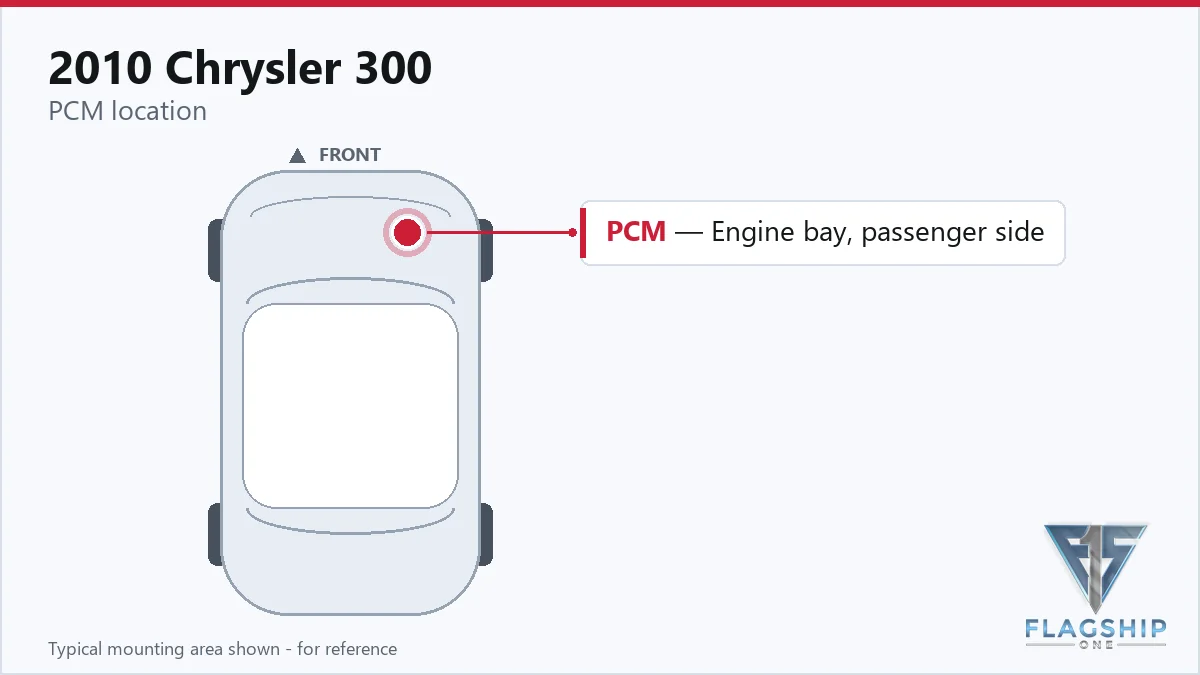
Work with the ignition off, and treat the module as static-sensitive: avoid touching the connector pins at any point.
| Operation | Configuration | Book Time |
|---|---|---|
| Powertrain Control Module R&R | All configurations | 1.0 hr |
| Engine Control Module Relearn | All configurations | 0.5 hr |
| Engine Control Module R&R | All configurations | 1.0 hr |
After the new PCM is installed, the factory requires a relearn of engine parameters and speed limit settings. Because Flagship One units arrive VIN‑programmed, these steps are already completed, eliminating the need for a separate relearn procedure. VIN‑programmed replacement unit ensures the module is calibrated for your specific vehicle from the moment it is installed.
When the PCM fails, you may notice a no‑start condition, sudden stalling, or irregular idle. Misfire codes and loss of communication between the scan tool and the module can also appear. If the trouble code P0601 is present, it indicates a PCM failure and may be accompanied by other engine performance issues. Addressing the PCM promptly can prevent further damage to the engine and transmission.
The 2010 Chrysler 300 2.7L may generate internal trouble codes that point to issues within the Powertrain Control Module. Common codes include P0601 and P0606, which indicate communication or functional problems.
| Code | Meaning | Full Guide |
|---|---|---|
| P0601 | Internal memory checksum error | Full P0601 guide → |
| P0606 | Module processor failure | Full P0606 guide → |
Two factory service bulletins are relevant to PCM issues on the 2010 Chrysler 300 2.7L. Bulletin #18-021-13 addresses a performance derate that occurs above 55 mph immediately after startup when accelerating at wide open throttle. Bulletin #18-023-10 covers rough idle that can appear on startup when ambient temperatures fall below 50 °F (10 °C). These bulletins provide updated firmware and relearn procedures to mitigate the symptoms.
| Bulletin | Subject | What It Addresses |
|---|---|---|
| 18-021-13 | 18-021-13 Flash: Performance Derate Above 55 MPH Immediately After Start-Up When Accelerating A | — |
| 18-023-10 | 18-023-10 Flash: Rough Idle On Start Up With Ambient Temperatures Below 50° (10° C) | — |
Yes, a VIN‑programmed replacement unit from Flagship One eliminates the relearn step, allowing the new PCM to function immediately after installation.
Check for any remaining codes, ensure the battery is fully charged, and verify that the new module is properly seated and torqued. If stalling persists, re‑inspect the wiring harness for loose connections.
A properly programmed module can optimize fuel injection timing, which may slightly improve fuel economy, but the impact will vary based on driving habits and engine wear.
Replacing the PCM on your 2010 Chrysler 300 2.7L can bring back smooth acceleration and reliable starts. If you prefer a quick fix, a refurbished PCM may be available; however, a new VIN‑programmed unit from Flagship One ensures factory‑level performance without extra relearn steps.

Flagship One stocks a refurbished, VIN-programmed PCM for the 2010 Chrysler 300 with a lifetime warranty, free shipping and no core charge. The full Chrysler 300 module lineup covers other engine configurations as well.
A new PCM can restore confidence in your 2010 Chrysler 300 2.7L, ensuring that engine and transmission functions run as intended. Consider a VIN‑programmed unit to avoid the relearn hassle and keep your vehicle running reliably.