
Last updated on August 25th, 2026 at 12:17 pm
In the 2007 Chrysler 300 the Powertrain Control Module (PCM) governs engine and transmission operation, interpreting sensor data to manage fuel, ignition and shift timing. When the PCM malfunctions, the vehicle may experience rough idle, loss of power, erratic shifting, or a complete no‑start condition, often accompanied by diagnostic codes such as P0601 or P0606.
When a 2007 Chrysler 300 begins to exhibit unpredictable shifting, intermittent loss of power, or an engine that refuses to start, the Powertrain Control Module often lies at the heart of the problem. The PCM acts as the vehicle’s central brain, translating sensor inputs into precise commands for fuel delivery, spark timing and transmission actuation. Because the module is integral to both engine and drivetrain performance, any degradation can manifest as a range of drivability issues that are difficult to isolate without proper diagnostic tools. Understanding where the PCM resides, how long it typically takes to replace, and what post‑install procedures are required can help you assess repair options, avoid unnecessary downtime, and ensure that any replacement unit is correctly programmed for your vehicle’s specifications. This guide walks you through the module’s role, its location, the labor involved, the factory‑issued service bulletins, and practical steps to keep the PCM functioning reliably.
The Powertrain Control Module in the 2007 Chrysler 300 serves as the electronic command center for both the gasoline V6 engine and the automatic transmission. It continuously monitors inputs from dozens of sensors—including throttle position, crankshaft speed, transmission output speed and exhaust temperature—to calculate the optimal fuel injection quantity, spark timing and shift points. By adjusting these parameters in real time, the PCM helps the vehicle meet performance, emissions and fuel‑efficiency targets while protecting components from overload. When the module’s internal processor encounters a fault, it may revert to a default limp‑home mode or shut down entirely, resulting in the driver experiencing reduced power, hard shifts or a no‑start condition. The PCM also stores diagnostic trouble codes that technicians use to pinpoint failures. Proper operation of this module is essential for smooth acceleration, consistent cruise performance and reliable gear changes. If the original unit fails, a replacement such as a 2007 Chrysler 300 PCM can restore full functionality, provided the vehicle’s software is correctly initialized after installation.
Engine computer (ECM/PCM)
OEM programmed replacements — plug & play, no dealer visit.
Find yours by year, make & model →
Free shipping · Lifetime warranty
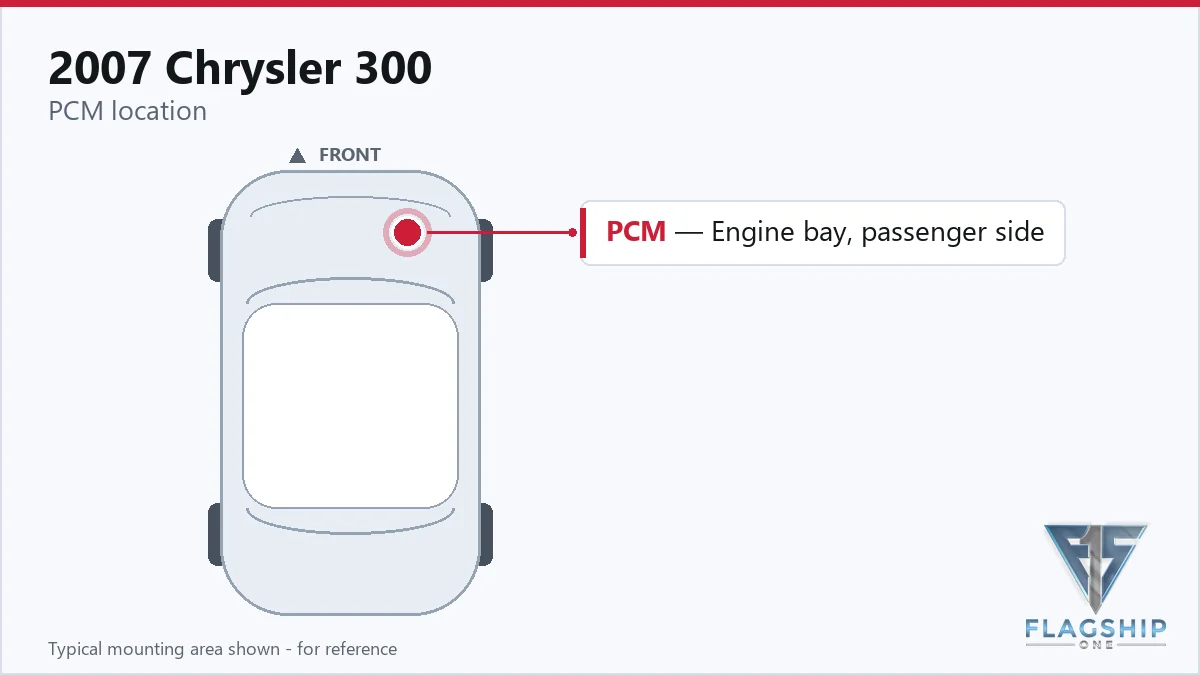
Work with the ignition off, and treat the module as static-sensitive: avoid touching the connector pins at any point.
| Operation | Configuration | Book Time |
|---|---|---|
| Powertrain Control Module Relearn | All configurations | 0.5 hr |
| Powertrain Control Module R&R | All configurations | 0.4 hr |
| Engine Control Module Relearn | All configurations | 0.5 hr |
| Engine Control Module R&R | All configurations | 0.4 hr |
After a PCM is swapped on the 2007 Chrysler 300, the factory service procedure calls for a relearn operation to synchronize the new unit with the vehicle’s existing sensors and transmission control logic. The labor times indicate a 0.5‑hour relearn for the Powertrain Control Module and a separate 0.5‑hour relearn for the Engine Control Module. Flagship One supplies units that arrive pre‑programmed to the vehicle’s VIN, so the required initialization steps are already completed. When you install a a VIN-programmed replacement unit, the additional factory‑required relearn process is effectively bypassed, saving time and reducing the risk of improper calibration.
A failing PCM in the 2007 Chrysler 300 often reveals itself through a mix of drivability and diagnostic clues. Drivers may notice the engine hesitating during acceleration, sudden loss of power, or a complete inability to start. Transmission symptoms can include harsh or delayed shifts, especially when the vehicle is under load. On‑board diagnostics may flag internal processor faults such as processor fault or communication errors like P0606, prompting the check‑engine light. In some cases, the scan tool may lose communication with the control module entirely, indicating a possible loss of power or corrupted firmware. Because the PCM controls both engine and transmission, any malfunction tends to affect multiple systems simultaneously, making early detection through code reading and symptom monitoring important.
The following diagnostic trouble codes are commonly logged by the Powertrain Control Module in the 2007 Chrysler 300:
| Code | Meaning | Full Guide |
|---|---|---|
| P0601 | Internal memory checksum error | Full P0601 guide → |
| P0606 | Module processor failure | Full P0606 guide → |
Factory Service Bulletin 08-030-06 Rev. A outlines the Powertrain Control Module initialization procedure required after replacement. Additionally, Recall Rc-If43-06 addresses a safety recall that reprograms the PCM to correct transmission shift logic. Both documents emphasize the need for a proper relearn step to ensure seamless integration with the vehicle’s existing systems.
| Bulletin | Subject | What It Addresses |
|---|---|---|
| 08-030-06 Rev. A | 08-030-06 Rev. A Powertrain Control Module Initialization | — |
| — | Rc-If43-06 Safety Recall F43 Reprogram PCM – Transmission Shift Logic | — |
P0601 points to an internal processor fault within the PCM, which can cause erratic engine behavior or a no‑start condition. Reprogramming or replacement may be required.
The labor guide lists about 0.4 hours for removal and another 0.4 hours for installation, so a qualified technician can complete the swap in less than an hour.
Factory procedures call for a PCM relearn of 0.5 hours. When using a VIN‑programmed replacement from Flagship One, the relearn is already performed at the factory.
Yes, because the PCM also manages shift timing, a malfunction can lead to harsh or delayed shifts, especially under load.
Bulletin 08-030-06 Rev. A covers PCM initialization, and Recall Rc-If43-06 deals with transmission shift‑logic reprogramming for the 2007 Chrysler 300.
When the PCM in your 2007 Chrysler 300 shows signs of failure, you can choose a direct repair using a refurbished unit or opt for a brand‑new, VIN‑programmed replacement from Flagship One. Both paths aim to restore full engine and transmission control, but the pre‑programmed option eliminates the need for the factory relearn step, potentially reducing shop time and complexity.

Flagship One stocks a refurbished, VIN-programmed PCM for the 2007 Chrysler 300 with a lifetime warranty, free shipping and no core charge. The full Chrysler 300 module lineup covers other engine configurations as well.
The Powertrain Control Module is essential to the performance of your 2007 Chrysler 300. Whether you decide on a repaired or a new replacement, ensuring proper installation and programming will help keep the vehicle running smoothly. Consider a VIN‑programmed unit to simplify the post‑install process.