
Last updated on August 25th, 2026 at 11:51 am
The engine control module governs fuel injection, ignition timing, and emissions systems in your 2005 Volkswagen Golf. When internal circuit boards degrade from voltage fluctuations or thermal cycling, the 1.9L diesel may experience driveability problems. Replacement typically requires specific programming procedures to match your vehicle’s immobilizer and calibration settings.
If your 2005 Volkswagen Golf has suddenly developed a no-start condition or the check engine light remains illuminated after basic repairs, the engine control module may require attention. This onboard computer coordinates critical functions for your 1.9L engine, including fuel delivery calculations and emissions monitoring. When it fails, symptoms often appear intermittent at first, then progress to complete communication loss with diagnostic scanners. Understanding how this module operates, where it resides, and what professional replacement entails helps you make informed decisions about repairs. This guide explains the specific procedures Volkswagen technicians follow, the labor times involved, and why proper programming proves essential for restoring normal operation to your vehicle without unnecessary delays or additional shop visits that complicate the process.
2005 Volkswagen Golf
OEM programmed ECM for your 2005 Volkswagen Golf — plug & play, no dealer visit.
Free shipping · Lifetime warranty
The engine control module in your 2005 Volkswagen Golf serves as the central processing unit for powertrain management, continuously adjusting fuel injection timing and quantity for the 1.9L diesel engine. It receives data from oxygen sensors, coolant temperature senders, and the mass airflow meter to optimize combustion efficiency while maintaining emissions compliance. Unlike simpler relay-based systems, this processor stores adaptive learning data that fine-tunes performance based on driving habits and component wear. When you install replacement control modules for the Golf, the unit must communicate with the immobilizer system and retain specific calibration data for your exact transmission and axle configuration. Failure to maintain these electronic relationships typically results in security lockout or reduced engine performance, making proper initialization as critical as the physical installation itself.
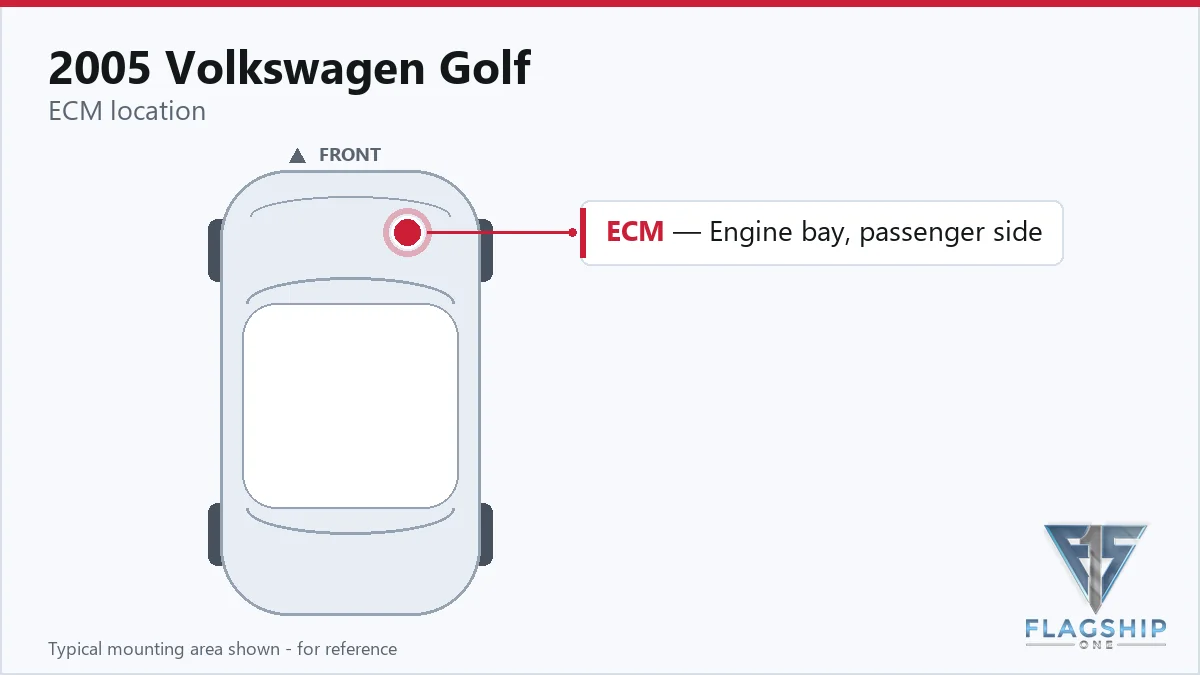
Technicians access the engine control module inside the plenum chamber, which requires removing weather seals and intake ducting to reach the mounting bracket. The control module arrow indicates positioning on the rear final drive, right front side, though this secondary location reference may apply to specific Golf variants or related control units. According to factory labor guides, engine control module removal and replacement calls for 1.1 hours of shop time. Additionally, powertrain control module removal and replacement requires 1.1 hours. These time allowances cover physical disconnection of multi-pin connectors and securing hardware, but do not include the subsequent programming phases. You should expect the installation to involve careful handling of the aluminum housing to prevent connector pin damage during reassembly.
| Operation | Configuration | Book Time |
|---|---|---|
| Powertrain Control Module Relearn | All configurations | 0.5 hr |
| Powertrain Control Module R&R | All configurations | 1.1 hr |
| Engine Control Module R&R | All configurations | 1.1 hr |
| Engine Control Module Reset | All configurations | 0.3 hr |
| Engine Control Module Relearn | All configurations | 0.5 hr |
Volkswagen specifies several distinct procedures after physical installation. Engine control module relearn requires 0.5 hours, while engine control module reset calls for 0.3 hours. Additionally, powertrain control module relearn adds another 0.5 hours to the workflow. When you receive a VIN-programmed replacement unit, these initialization sequences are already completed using your specific vehicle data. This preparation eliminates the need for dealership programming appointments and allows immediate startup verification. Your technician can proceed directly to installation without waiting for security coding downloads or parameterization routines that normally extend the service visit beyond the standard book times.
A failing engine computer in your 2005 Volkswagen Golf often produces intermittent symptoms before complete failure. You may notice extended cranking periods, sudden stalling at traffic signals, or erratic idle speed fluctuations that resist throttle input. The instrument cluster might display a persistent check engine light accompanied by stored faults such as random multiple misfire P0300 or communication errors between the ECM and transmission controller. Some drivers experience unexplained power loss during acceleration or complete no-start conditions where the starter engages but the engine never fires. Scan tools may fail to establish connection with the module entirely, indicating internal processor or memory corruption that typically requires module replacement rather than circuit repair.
Factory service bulletins provide important guidance for 2005 Volkswagen Golf diagnostics. Bulletin #01-07-54 specifically advises technicians not to replace the engine control module when certain diagnostic trouble codes appear, preventing unnecessary repairs. Bulletin #01-09-09 addresses update programming procedures when the malfunction indicator lamp illuminates alongside codes P0300 through P0304, P0102, P1297, P0420, or P0441 stored in ECM fault memory. Additionally, bulletin #24-07-102 covers ECM replacement procedures for 1999 and newer vehicles with all engine codes except the 2.0L AEG variant. These documents emphasize verifying software updates and wiring integrity before condemning the module itself.
| Bulletin | Subject | What It Addresses |
|---|---|---|
| 01-07-54 | 01-07-54 – Engine Control Module (ECM), DO NOT Replace for These Diagnostic Trouble Codes (DTCs | — |
| 01-09-09 | Attachment: 01-09-09 – Update Programming, MIL ON, DTCs P0300-P0304, P0102, P1297, P0420 and P0 | — |
| 24-07-102 | TT 24-07-102 1999 > All Vehicles, All Engine Codes except 2.0L AEG – ECM Replacement | — |
Factory procedures specify 0.5 hours for relearn and 0.3 hours for reset. However, VIN-programmed units arrive pre-configured with your vehicle data, eliminating the need for additional dealership programming.
The engine control module sits inside the plenum chamber, which requires removing intake ducting to access. Some variants also reference positioning near the rear final drive on the right front side.
Module failures often produce multiple random codes simultaneously or complete scan-tool communication loss, whereas single sensor faults typically trigger specific codes. Intermittent stalling and no-start conditions that persist after sensor replacement suggest module issues.
When deciding between repair attempts and replacement for your 2005 Volkswagen Golf, consider that module rebuilding often proves unreliable given the complex solder connections and sealed components. A refurbished unit that has undergone thermal cycling and component testing offers more predictable long-term performance than attempting circuit-level repairs on the original failed module. This approach aligns with the factory labor guides and ensures compatibility with your 1.9L engine management system.
Flagship One stocks a refurbished, VIN-programmed PCM for the 2005 Volkswagen Golf with a lifetime warranty, free shipping and no core charge. The full Volkswagen Golf module lineup covers other engine configurations as well.
Addressing engine control module issues in your 2005 Volkswagen Golf requires understanding both the physical location in the plenum chamber and the programming requirements outlined in factory service bulletins. With proper diagnosis and a correctly initialized replacement, you can restore reliable operation to your vehicle and avoid the repeated shop visits associated with improper installation or unprogrammed units that lack your specific immobilizer data.