
Last updated on August 25th, 2026 at 11:51 am
The engine control module on your 2003 Volkswagen Golf governs fuel injection, ignition timing, and emissions systems. Failure typically stems from voltage spikes, moisture intrusion through worn seals, or thermal cycling that degrades internal solder connections over time, interrupting critical communication with sensors and actuators.
When your 2003 Volkswagen Golf begins exhibiting erratic behavior such as unexpected stalling or complete failure to start, the engine control module often becomes the primary suspect. This onboard computer serves as the central nervous system for your vehicle’s powertrain, continuously processing data from sensors and commanding fuel injection, ignition timing, and emission controls. Understanding how this component functions within your specific 1.9-liter diesel configuration helps you make informed decisions about diagnostics and replacement. The module’s location in the plenum chamber and the specific labor requirements for removal differ slightly from other Golf variants, making model-specific knowledge essential for accurate estimates. Whether you are troubleshooting communication errors with your scan tool or planning a complete replacement, grasping the basics of this technology saves time and prevents misdiagnosis. This guide explains what the computer controls, where it resides, and what steps follow installation so you can approach repairs with confidence. You will learn why voltage stability matters, how to identify failure symptoms, and what programming requirements apply to your particular vehicle. Equipped with this information, you can discuss options with your technician and determine whether a pre-programmed replacement suits your needs.
The engine control module on your 2003 Volkswagen Golf functions as the brain of the diesel powertrain, interpreting signals from the crankshaft position sensor, mass airflow meter, and coolant temperature switch to optimize combustion. Every millisecond, it adjusts fuel delivery from the injection pump and manages turbocharger boost pressure to balance performance with emissions standards. In the 1.9-liter TDI configuration, this computer also coordinates with the transmission control system to ensure smooth shifting and torque converter lockup. When you install replacement engine computers for the Golf, you are restoring the factory calibration that governs these interactions. The module contains non-volatile memory storing VIN-specific data, immobilizer codes, and adaptive learning values for injector timing. Heat, vibration, and electrical system fluctuations gradually degrade the internal circuit boards and solder joints, leading to intermittent faults or complete signal loss. Unlike generic aftermarket controllers, units engineered for this specific model year maintain communication with the instrument cluster and anti-theft systems. The computer continuously monitors OBD-II parameters, setting fault codes when sensor readings drift outside programmed thresholds. Understanding that this component integrates engine, transmission, and security functions explains why replacement requires more than simple bolt-on installation. The module’s role extends beyond basic engine management to encompass idle speed stabilization through the throttle plate and exhaust gas recirculation valve operation. It processes inputs from the accelerator pedal position sensor to determine driver demand, then calculates appropriate response curves based on altitude and ambient temperature. During cold starts, it modifies injection timing to reduce combustion noise while protecting the cylinder head from thermal shock. This sophisticated orchestration explains why failures manifest across multiple vehicle systems rather than isolated drivability concerns.
2003 Volkswagen Golf
OEM programmed ECM for your 2003 Volkswagen Golf — plug & play, no dealer visit.
Free shipping · Lifetime warranty
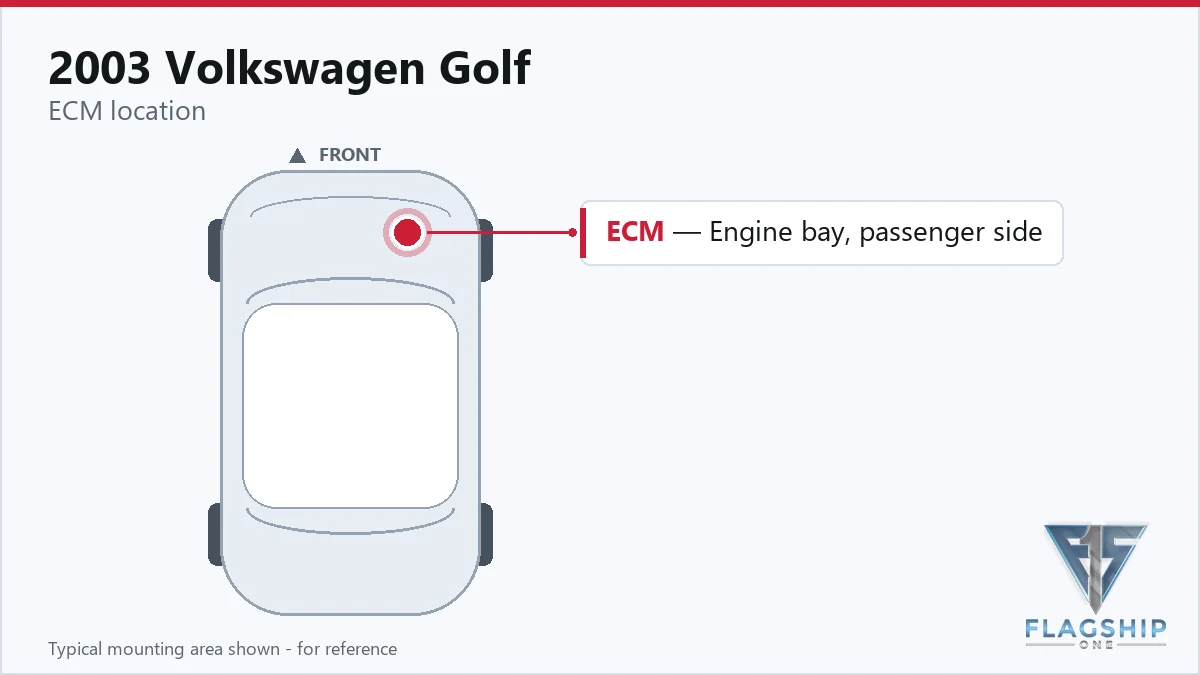
Accessing the engine control module on your 2003 Volkswagen Golf requires removing the protective cover in the plenum chamber, situated near the base of the windshield. Some control configurations for this model also sit near the rear final drive toward the right front. Factory labor guides indicate that removing and replacing the powertrain control module on this vehicle typically requires 0.5 hours for the relearn procedure. For the physical removal and installation, the 1.9-liter engine variant calls for 0.6 hours, while the general Golf specification lists 1.1 hours for engine control module replacement. Technicians disconnect the battery, release the mounting bracket fasteners, and carefully unplug the multi-pin connectors to avoid damaging the sealed harnesses. The plenum chamber location exposes the unit to moisture and temperature cycling, so inspecting the connector seals during service prevents future corrosion. Reinstallation demands proper torque on the mounting hardware to ensure heat dissipation through the case. Because the module sits in a high-temperature environment, routing the wiring harness without strain points remains critical for long-term reliability.
| Operation | Configuration | Book Time |
|---|---|---|
| Powertrain Control Module Relearn | Golf | 0.5 hr |
| Powertrain Control Module Relearn | Jetta | 0.5 hr |
| Powertrain Control Module R&R | Golf | 1.1 hr |
| Powertrain Control Module R&R | 1.8L | 0.7 hr |
| Powertrain Control Module R&R | 2.0L | 1.1 hr |
| Powertrain Control Module R&R | 1.9L | 0.6 hr |
| Engine Control Module R&R | Golf | 1.1 hr |
| Engine Control Module R&R | 1.8L | 1.5 hr |
After installing new hardware, your 2003 Volkswagen Golf requires specific configuration procedures to establish communication between the engine computer and the immobilizer system. The factory service manual lists 0.5 hours for the powertrain control module relearn procedure, which involves synchronizing the VIN, injector quantity adjustment values, and transmission shift points. Technicians must also perform basic settings for the throttle body and exhaust gas recirculation valve using manufacturer-specific scan equipment. When you receive a VIN-programmed replacement unit, these steps have already been completed at the factory using your specific vehicle identification number and calibration data. This pre-configuration eliminates the need for dealer intervention or specialized programming tools during installation. The module arrives ready to communicate with your instrument cluster and anti-theft transponder immediately upon connection. You simply install the component, reconnect the battery, and cycle the ignition to establish the link. This approach reduces the total labor time required at your repair facility and minimizes the risk of programming errors that could trigger additional fault codes or drivability concerns. The streamlined process allows your technician to focus on physical installation and verification rather than lengthy software downloads.
A failing engine control module in your 2003 Volkswagen Golf often produces symptoms that mimic other component failures, requiring careful diagnosis before replacement. You may notice the engine cranks normally but refuses to fire, particularly after the vehicle sits overnight or experiences extreme temperature changes. Intermittent stalling while driving at steady speeds suggests internal circuit board faults that disrupt injector pulse signals or sensor reference voltages. The check engine light might illuminate with memory or processor error codes, or your scan tool may fail to establish communication with the powertrain controller entirely. Rough idle quality, hesitation during acceleration, or unexpected limp-home mode activation frequently trace to corrupted adaptive memory within the computer. Transmission shifting abnormalities, including harsh engagements or refusal to shift out of park, can occur when the module loses communication with the transmission control unit. You might observe inaccurate temperature gauge readings or fuel level displays caused by disrupted data bus communications between modules. In some cases, the cooling fans run continuously or not at all due to faulty relay drivers inside the computer. These symptoms typically worsen as thermal expansion and contraction stress solder joints during normal heating and cooling cycles. Addressing these issues promptly prevents secondary damage to the turbocharger, injection pump, or emission control components that rely on precise timing commands from the processor. Early identification helps avoid roadside breakdowns and expensive towing charges.
A software update typically resolves calibration issues while the hardware functions normally. If your scan tool cannot communicate with the module, or if you observe no-start conditions accompanied by internal processor fault codes, replacement often becomes necessary. Dealers can verify whether updated flash files exist for your specific VIN before condemning the hardware.
Used modules contain immobilizer codes and VIN data from their original vehicles that do not match your Golf. Installation typically results in a no-start condition because the anti-theft system prevents fuel delivery. Only units specifically programmed to your vehicle identification number will establish the required communication with your instrument cluster and ignition transponder.
The 0.6-hour specification applies specifically to the 1.9-liter engine configuration, while the 1.1-hour guideline covers general Golf engine control module replacement procedures that may involve additional access steps or diagnostic verification. Your technician will reference the specific procedure matching your vehicle’s equipment.
The engine and transmission computers communicate constantly to manage shift timing. If the engine module fails to send torque reduction signals or throttle position data, shifting may feel harsh. However, mechanical transmission issues or dedicated transmission control module faults require separate diagnosis. Replacing the engine computer resolves only those shift concerns stemming from lost communication or incorrect engine data.
The factory labor guide allocates 0.5 hours for the powertrain control module relearn procedure on your Golf. This timeframe covers VIN synchronization, injector adaptation, and basic settings. If you receive a pre-programmed unit, you eliminate this labor step entirely, reducing your total time in the service bay.
When facing engine computer failure on your 2003 Volkswagen Golf, you must decide between attempting board-level repair or installing a replacement unit. Repair services may fix specific solder joint failures but rarely address underlying component degradation. A refurbished module engineered for your 1.9-liter configuration provides updated hardware with factory calibration restored. This option typically offers faster turnaround than dealer backorders while ensuring compatibility with your existing immobilizer and sensor array. Evaluate your timeline and warranty preferences to determine the most practical path forward.
Flagship One stocks a refurbished, VIN-programmed PCM for the 2003 Volkswagen Golf with a lifetime warranty, free shipping and no core charge. The full Volkswagen Golf module lineup covers other engine configurations as well.
Understanding the function and replacement requirements of the engine control module helps you maintain your 2003 Volkswagen Golf with confidence. Whether you are diagnosing communication errors or planning a complete installation, accurate information prevents costly delays. Properly sourced and programmed components restore factory drivability and emission compliance. Address symptoms early to protect supporting systems and ensure reliable operation from your Golf’s diesel powertrain for years to come.