
Last updated on August 25th, 2026 at 02:18 pm
The powertrain control module (PCM) in the 2000 Chevrolet Metro manages engine performance and transmission shifting. Failures may cause drivability issues like stalling, misfires, or transmission hesitation, often triggered by electrical faults or internal memory errors.
If your 2000 Chevrolet Metro is experiencing unexplained stalling, rough idling, or transmission shifting problems, the powertrain control module (PCM) may be the culprit. This small but critical computer manages fuel delivery, ignition timing, and transmission behavior, ensuring smooth operation. When it fails, symptoms can range from subtle drivability issues to complete engine shutdown. Replacing the PCM is a straightforward process, but it requires careful handling to avoid damage from static electricity or improper installation. Understanding the role of this module, where it’s located, and what to expect during replacement can help you make an informed decision. Whether you’re diagnosing a persistent issue or preparing for a repair, knowing these details ensures you’re ready for the task ahead.
The powertrain control module in the 2000 Chevrolet Metro serves as the brain of the engine and transmission system. It continuously monitors sensor inputs—like throttle position, engine speed, and oxygen levels—to adjust fuel injection, ignition timing, and shift points for optimal performance. Without a functioning PCM, your Metro may struggle to start, run inefficiently, or shift unpredictably. This module also communicates with the instrument panel to control the upshift indicator lamp, alerting you when to shift for better fuel economy. Because it integrates engine and transmission control, a failure here can disrupt multiple systems simultaneously. If replacement becomes necessary, replacement engine computers for the Metro are designed to restore full functionality without requiring extensive reprogramming on your end.
In the 2000 Chevrolet Metro, the powertrain control module is typically mounted inside the vehicle, often behind the instrument panel or near the firewall on the passenger side. Replacing it involves disconnecting the negative battery cable first to prevent electrical shorts or damage. Once the battery is disconnected, you’ll need to remove the module’s electrical connector and mounting bolts to free the unit. The labor guide estimates 0.4 hours for removal and reinstallation, though this may vary slightly depending on accessibility. After installing the new module, a relearn procedure is required, which adds another 0.5 hours of labor. This step ensures the PCM synchronizes with the engine and transmission, allowing for proper operation. Avoid touching the connector pins or circuit board components to prevent electrostatic discharge, which can damage sensitive electronics.
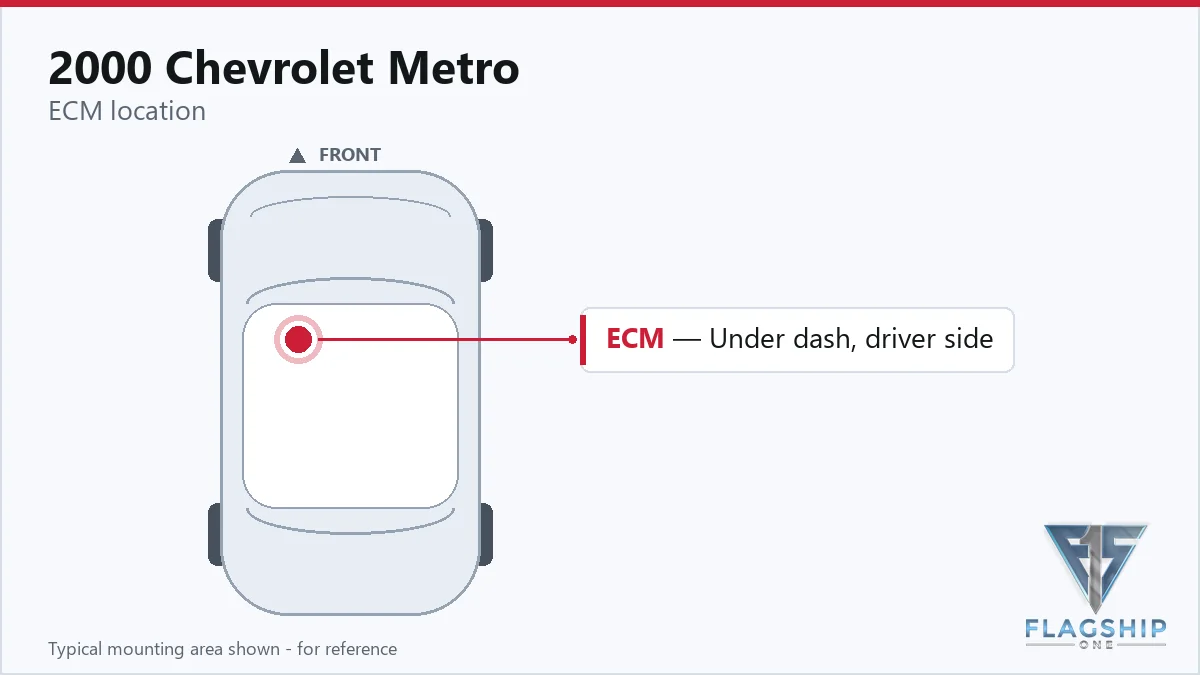
Work with the ignition off, and treat the module as static-sensitive: avoid touching the connector pins at any point.
| Operation | Configuration | Book Time |
|---|---|---|
| Powertrain Control Module R&R | All configurations | 0.4 hr |
| Engine Control Module R&R | All configurations | 0.4 hr |
| Engine Control Module Relearn | All configurations | 0.5 hr |
2000 Chevrolet Metro
OEM programmed ECM for your 2000 Chevrolet Metro — plug & play, no dealer visit.
Free shipping · Lifetime warranty
After replacing the powertrain control module in your 2000 Chevrolet Metro, the factory procedure requires a relearn process to ensure the new unit communicates correctly with the engine and transmission. This typically involves using a scan tool to reset adaptive values and may include driving the vehicle under specific conditions to allow the PCM to recalibrate. However, if you opt for a VIN-programmed replacement unit, these steps are already completed before the module arrives. This means you can install the unit and immediately start the vehicle without additional programming, saving time and reducing the risk of errors during the relearn process. Always follow the manufacturer’s guidelines for battery disconnection and reconnection to avoid voltage spikes that could damage the new module.
When the powertrain control module in your 2000 Chevrolet Metro begins to fail, you may notice a range of symptoms that can disrupt daily driving. A common issue is a no-start condition, where the engine cranks but refuses to fire, often due to incorrect fuel or spark signals from the PCM. Stalling or rough idling may also occur, especially at stoplights or during deceleration, as the module struggles to maintain stable engine operation. Transmission shifting problems, such as delayed or harsh gear changes, are another telltale sign, since the PCM controls shift points based on sensor data. In some cases, the check engine light may illuminate, accompanied by trouble codes like internal control module memory checksum error, indicating a fault within the module itself. Other potential symptoms include poor fuel economy, erratic tachometer readings, or even a complete loss of communication with a scan tool. If you experience any of these issues, it’s worth checking the PCM as a possible cause, especially if no other mechanical problems are found.
The 2000 Chevrolet Metro’s powertrain control module can generate several internal trouble codes when it malfunctions. These codes often point to memory errors, communication faults, or processing failures within the module itself. Diagnosing these codes early can help prevent more severe drivability issues.
A factory service bulletin, #99-06-04-053, addresses PCM reprogramming for the 2000 Chevrolet Metro. This bulletin, issued in October 1999, provides guidelines for updating the module’s software to resolve potential drivability or communication issues. While reprogramming may not always be necessary, it’s worth checking if your vehicle exhibits persistent symptoms that don’t align with mechanical failures. The bulletin outlines the steps for dealers to follow, ensuring the PCM operates with the latest calibration. If you’re replacing the module, this bulletin may influence whether a software update is recommended alongside the hardware swap.
| Bulletin | Subject | What It Addresses |
|---|---|---|
| 99-06-04-053 | Info – PCM Reprogramming – (Oct 26, 1999) | — |
Common signs include a no-start condition, stalling, rough idling, or transmission shifting problems. The check engine light may also illuminate with module-related trouble codes. If these symptoms persist after checking for mechanical issues, the PCM may be the cause.
Replacing the PCM is a straightforward process, but it requires careful handling to avoid electrostatic discharge. Disconnect the battery first, then remove the old module and install the new one. A relearn procedure is typically needed afterward, which may require a scan tool.
The relearn procedure allows the new PCM to synchronize with the engine and transmission, ensuring proper fuel delivery, ignition timing, and shift points. Without this step, the vehicle may run poorly or fail to start.
Failing to disconnect the battery can result in electrical shorts or voltage spikes, which may damage the new PCM or other sensitive electronics. Always follow the factory caution to disconnect the negative battery cable first.
Excessive voltage spikes from a faulty alternator or improper jump-starting can damage the PCM. Additionally, exposure to moisture or extreme temperatures may shorten its lifespan. Regular maintenance of the electrical system can help prevent these issues.
If your 2000 Chevrolet Metro is showing signs of a failing PCM, you have options for repair or replacement. While reprogramming the existing module may resolve some issues, a replacement is often the most reliable solution for internal faults. A new or refurbished unit can restore full functionality, especially if it arrives pre-programmed to your vehicle’s VIN. Given the labor time involved, choosing a ready-to-install module can save time and reduce the risk of complications during the relearn process.
Flagship One stocks a refurbished, VIN-programmed PCM for the 2000 Chevrolet Metro with a lifetime warranty, free shipping and no core charge. The full Chevrolet Metro module lineup covers other engine configurations as well.
The powertrain control module plays a critical role in the operation of your 2000 Chevrolet Metro, managing everything from fuel delivery to transmission shifting. If you’re experiencing drivability issues like stalling, no-start conditions, or erratic shifting, the PCM may be the source of the problem. Replacing it is a manageable task, but it requires attention to detail to avoid damage and ensure proper installation. Whether you tackle the job yourself or leave it to a professional, understanding the process and symptoms can help you make an informed decision. With the right replacement unit, your Metro can return to reliable performance.