
Last updated on August 25th, 2026 at 02:29 pm
The Powertrain Control Module (PCM) on your 1998 Chevrolet Metro is the central computer managing the 1.0L engine and transmission functions. It controls fuel delivery, ignition timing, and the upshift indicator lamp. Internal memory failures trigger codes like P0601 and P0603.
If your 1998 Chevrolet Metro is experiencing drivability issues such as hard starting, stalling, or unexpected transmission behavior, the Powertrain Control Module may be the culprit. The PCM serves as the central brain for your vehicle’s 1.0L engine and automatic transmission, continuously monitoring sensors and adjusting operating parameters to maintain performance. This guide explains what the PCM does, where it’s located, the replacement process, and what to expect from a replacement unit. Understanding these fundamentals helps you make informed decisions about repairs and replacement options for your Metro.
The Powertrain Control Module in your 1998 Chevrolet Metro functions as the primary electronic brain for the entire powertrain. This computer manages the fuel injection system, ignition timing, transmission shift points, and the upshift indicator lamp located in the instrument panel cluster. It receives input from numerous sensors throughout the engine and transmission, processing this data in real time to optimize combustion and shifting behavior. When the PCM develops internal faults—commonly indicated by trouble codes P0601 (internal memory check sum error) or P0603 (keep alive memory error)—its ability to properly control these functions becomes compromised. The module stores calibration data specific to your vehicle, and when this internal memory fails, the resulting symptoms can range from intermittent drivability complaints to a complete no-start condition. Replacement requires installing replacement engine computers for the Metro that match your vehicle’s specifications.
1998 Chevrolet Metro
OEM programmed ECM for your 1998 Chevrolet Metro — plug & play, no dealer visit.
Free shipping · Lifetime warranty
The Powertrain Control Module on the 1998 Chevrolet Metro is positioned within the vehicle’s engine compartment or interior cavity, with the exact location determined by GM’s factory assembly. Replacement involves disconnecting the negative battery cable first—a critical step to prevent electrostatic discharge damage to the PCM’s sensitive circuitry. The factory cautions explicitly warn against touching connector pins or soldered components on the circuit board due to ESD risks. The labor standard for Powertrain Control Module R&R is 0.4 hours, while Engine Control Module R&R carries the same 0.4 hour book time. After the physical replacement, an Engine Control Module Relearn procedure requiring 0.5 additional hours must be performed to allow the new module to adapt to your specific vehicle’s sensors and calibration.
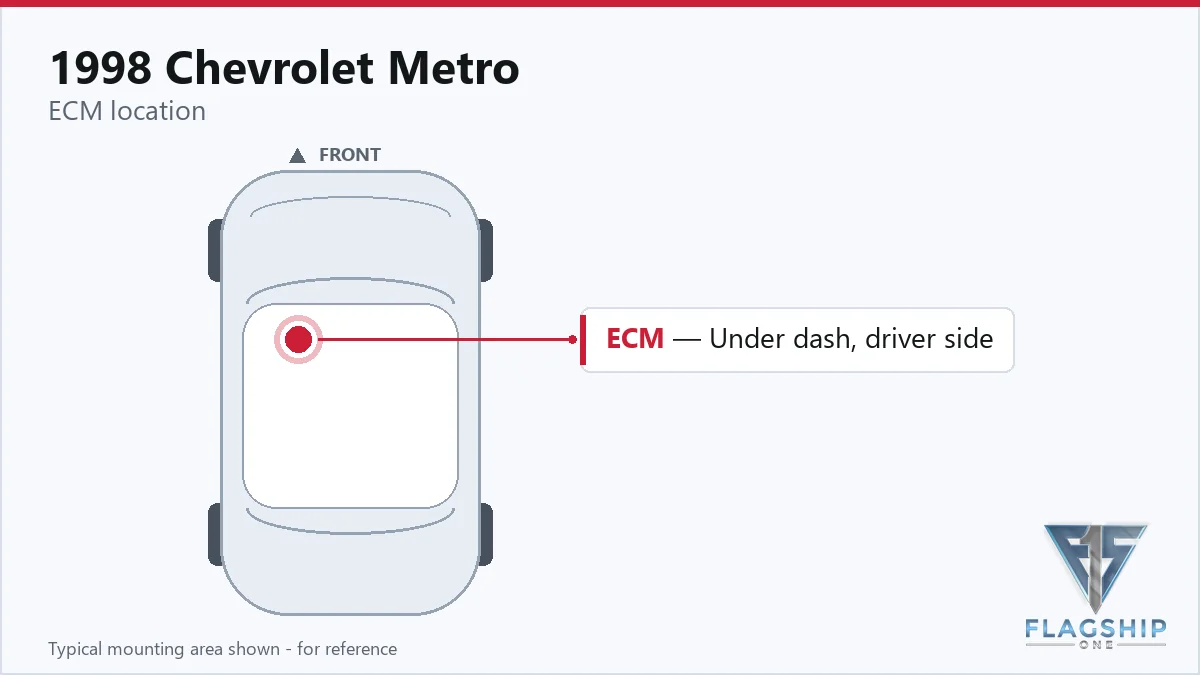
Work with the ignition off, and treat the module as static-sensitive: avoid touching the connector pins at any point.
| Operation | Configuration | Book Time |
|---|---|---|
| Powertrain Control Module R&R | All configurations | 0.4 hr |
| Engine Control Module R&R | All configurations | 0.4 hr |
| Engine Control Module Relearn | All configurations | 0.5 hr |
Following replacement of the PCM on your 1998 Metro, the factory procedure requires performing an Engine Control Module Relearn procedure. This step allows the new control module to initialize and establish communication with the vehicle’s sensors and actuators. The relearn process calibrates the module to your specific engine and transmission characteristics. If you install a VIN-programmed replacement unit, this programming step is completed before the module ships, meaning the unit arrives ready to install and communicate with your vehicle’s systems immediately upon installation. This pre-programming eliminates the need for you to visit a dealer or specialty shop for post-installation setup, though a battery reconnect and brief idle relearn period is still recommended.
When the Powertrain Control Module on a 1998 Chevrolet Metro fails, several distinct symptoms typically emerge. The most common complaint is a no-start condition or hard starting, where the engine cranks but fails to fire due to incorrect fuel or ignition commands. Stalling after startup is another frequent indicator, especially when the PCM cannot maintain proper idle air control. Misfire codes may populate across multiple cylinders as the module fails to properly sequence fuel injection. In some cases, scan tools cannot communicate with the vehicle at all—a dead diagnostic link suggests catastrophic PCM failure. Transmission shifting issues often accompany PCM problems since the module controls shift points and line pressure. The presence of trouble codes P0601 or P0603 specifically points to internal memory corruption within the PCM itself, a condition that cannot be repaired and requires module replacement.
The 1998 Chevrolet Metro may store module-internal trouble codes indicating PCM hardware failures. These codes originate from the control module’s self-diagnostic routines and signal that internal memory has experienced corruption or checksum errors. Unlike conventional powertrain codes that refer to external sensors or actuators, P0601 and P0603 represent failures within the PCM’s internal circuitry itself. When these codes are present alongside drivability symptoms, replacement of the Powertrain Control Module is the factory-authorized repair.
| Code | Meaning | Full Guide |
|---|---|---|
| P0601 | Internal memory checksum error | Full P0601 guide → |
| P0603 | Keep-alive memory (KAM) error | Full P0603 guide → |
| Bulletin | Subject | What It Addresses |
|---|---|---|
| 99-06-04-053 | Info – PCM Reprogramming – (Oct 26, 1999) | — |
No. The PCM must be matched to your specific vehicle identification number (VIN) to ensure proper calibration for the 1.0L engine and transmission. Generic or unprogrammed units will not function correctly.
Skilled DIYers can perform the replacement using basic tools, but you must follow the ESD precautions and battery disconnect procedure. However, programming the replacement unit typically requires dealer-level software or a pre-programmed unit from a specialist supplier.
These codes indicate internal PCM hardware failure, not external sensor issues. Clearing them provides temporary relief, but the underlying memory corruption causes them to recur. Module replacement is the permanent solution.
When your 1998 Chevrolet Metro requires PCM replacement, you have two primary paths: a new OEM unit from the dealer at full retail pricing, or a quality refurbished replacement from a specialist supplier. Flagship One provides VIN-programmed replacement units calibrated specifically for your Metro, eliminating the need for post-install programming appointments. Consider your budget, timeline, and warranty preferences when choosing between these options for your 1.0L vehicle.
Flagship One stocks a refurbished, VIN-programmed PCM for the 1998 Chevrolet Metro with a lifetime warranty, free shipping and no core charge. The full Chevrolet Metro module lineup covers other engine configurations as well.
The Powertrain Control Module is the heart of your 1998 Chevrolet Metro’s powertrain management system. When internal codes like P0601 or P0603 appear alongside drivability symptoms, replacement restores proper engine and transmission operation. Whether you pursue dealer sourcing or a quality pre-programmed replacement, addressing PCM failure promptly prevents secondary damage and gets your Metro back on the road reliably.