
Last updated on August 25th, 2026 at 11:52 am
The engine control module in a 1995 Volkswagen Golf 2.0L is the central computer that manages fuel delivery, ignition timing, and emission controls. When it fails, the engine may crank without starting, run roughly, or stall unexpectedly.
When your 1995 Volkswagen Golf 2.0L develops hard-starting, stalling, or no-start conditions, the engine control module (ECM) is often a prime suspect. This computer orchestrates critical engine functions, and a malfunction can leave you stranded. Replacing the module yourself is a practical repair, but understanding the correct procedures for your specific Golf is essential. This guide walks you through the module’s role, its location, the replacement process, and the programming steps the factory requires. You will also learn how a pre-programmed replacement can save you time and eliminate the need for specialized scan tools.
The engine control module in your 1995 Golf 2.0L is the brain behind the multiport fuel injection and oxygen sensor management. It continuously adjusts the air-fuel mixture and spark timing based on inputs from sensors like the mass airflow sensor, throttle position sensor, and coolant temperature sensor. When this module fails, the engine may crank without firing, run erratically, or stall without warning. Because the module is specific to the Golf’s 2.0L engine and its emission control system, a direct replacement is required. Many owners seek out replacement engine computers for the Golf to restore proper driveability and pass emissions tests.
1995 Volkswagen Golf 2.0L
OEM programmed ECM for your 1995 Volkswagen Golf 2.0L — plug & play, no dealer visit.
Free shipping · Lifetime warranty
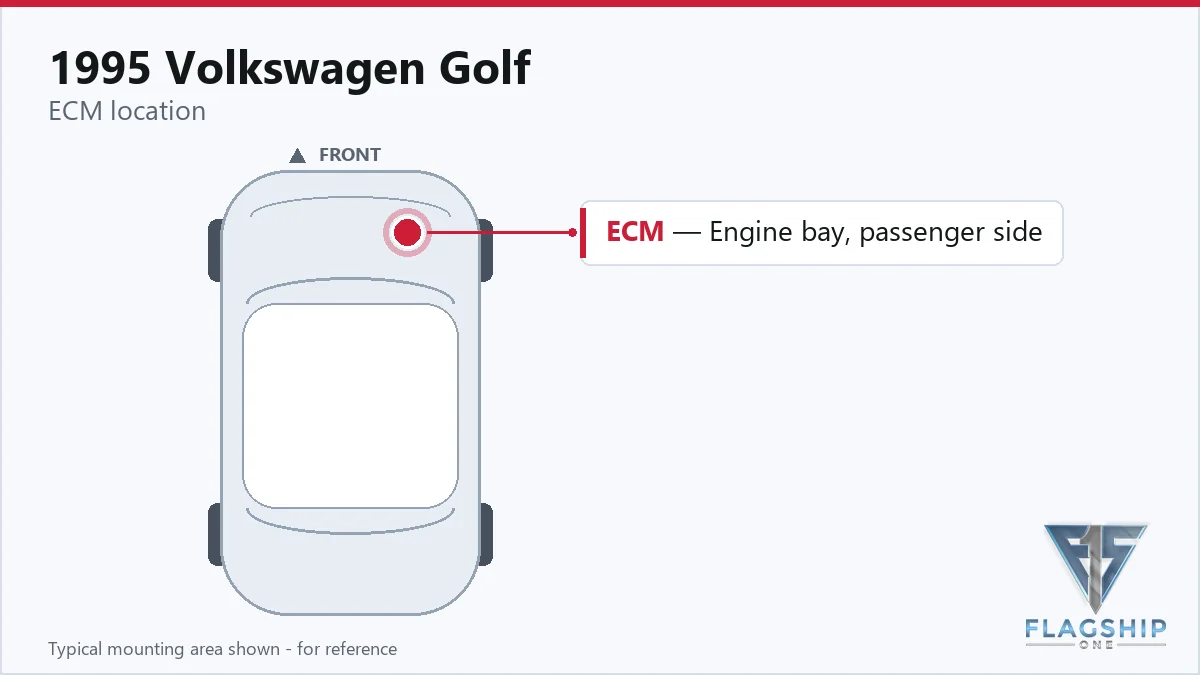
The factory component-location overview places the engine control module in the plenum chamber, right side, for multiport fuel injection and oxygen sensor control. Another factory note indicates the module is also associated with the catalytic converter area, cautioning that threads must be lubricated only with G5 paste and that G5 must not enter sensor slots. Replacing the module involves a straightforward removal and installation procedure. The book time for ECM R&R on a 1995 Golf is 0.3 hours. After installation, a powertrain control module relearn procedure is specified, which carries a book time of 0.5 hours. An additional engine control module reset may also be required, listed at 0.3 hours.
| Operation | Configuration | Book Time |
|---|---|---|
| Powertrain Control Module Relearn | Golf | 0.5 hr |
| Powertrain Control Module Relearn | Jetta | 0.5 hr |
| Powertrain Control Module R&R | Golf | 0.3 hr |
| Powertrain Control Module R&R | Jetta | 0.3 hr |
| Engine Control Module R&R | Golf | 0.3 hr |
| Engine Control Module R&R | Jetta | 0.3 hr |
| Engine Control Module Reset | Golf | 0.3 hr |
| Engine Control Module Reset | Jetta | 0.3 hr |
After installing a replacement engine control module, the factory procedure calls for an immobilizer adaptation on vehicles equipped with Immobilizer 3 or 4, as outlined in technical bulletin 96-07-42. This process typically requires a factory scan tool to match the new module to the vehicle’s security system. However, when you order a VIN-programmed replacement unit, this adaptation is already completed before the module ships. The unit arrives ready to install, so you can skip the dealer-level programming and the associated relearn steps, getting your Golf back on the road faster.
A failing engine control module in a 1995 Volkswagen Golf 2.0L often produces symptoms that mimic other issues. The engine may crank strongly but refuse to start, or it may start and then stall without warning. Intermittent misfires and rough idling are common, as the module loses its ability to manage fuel and spark timing accurately. You might also experience a complete loss of communication with a diagnostic scan tool, making it impossible to retrieve any stored fault codes. In some cases, the transmission may shift erratically if the module’s failure affects the signals it sends to the transmission control unit.
Factory bulletin 96-07-42 addresses the immobilizer adaptation procedure required when replacing the engine control module on all models equipped with Immobilizer 3 or 4. This bulletin outlines the steps to synchronize the new module with the vehicle’s existing immobilizer system using a factory scan tool. Failure to perform this adaptation may result in a no-start condition even after a correct physical installation.
| Bulletin | Subject | What It Addresses |
|---|---|---|
| 96-07-42 | TT 96-07-42 All Models With Immobilizer 3 or 4, Immobilizer Adaptation When Replacing the ECM | — |
A no-start with a healthy battery and starter that cranks the engine but fails to fire often points to the ECM. Check for spark and fuel pressure first; if both are missing and the main relay is functional, the module may not be triggering the ignition or injectors. A scan tool that cannot communicate with the ECM is another strong indicator.
A used module from an identical 1995 Golf 2.0L may physically plug in, but it will likely require immobilizer adaptation to start the car. Without performing the adaptation procedure with a factory scan tool, the engine may crank but not run. A pre-programmed replacement module avoids this complication.
A reset typically clears stored fault codes and returns the module to its base settings, while a relearn procedure allows the module to recalibrate idle speed, fuel trims, and other adaptive values. The factory specifies both an ECM reset (0.3 hours) and a powertrain control module relearn (0.5 hours) for the 1995 Golf.
When your 1995 Volkswagen Golf 2.0L needs a new engine control module, you can choose between sourcing a used unit that may still require dealer programming or opting for a refurbished replacement that arrives ready to install. A pre-programmed module eliminates the need for expensive factory scan tools and the immobilizer adaptation procedure, making it a practical choice for a straightforward driveway repair.
Flagship One stocks a refurbished, VIN-programmed PCM for the 1995 Volkswagen Golf with a lifetime warranty, free shipping and no core charge. The full Volkswagen Golf module lineup covers other engine configurations as well.
Replacing the engine control module in your 1995 Volkswagen Golf 2.0L restores proper engine management and gets you back on the road. With the module’s location in the plenum chamber and a straightforward R&R procedure, the physical swap is simple. Choosing a pre-programmed unit removes the programming hurdle, making this a repair you can complete with confidence.