
Last updated on August 25th, 2026 at 02:02 pm
The powertrain control module (PCM) in your 1991 Mazda B2600 manages fuel delivery, ignition timing, and emissions systems. When it fails, you may experience hard starts, stalling, or poor engine performance, often without warning.
If your 1991 Mazda B2600 has been acting up—stalling unexpectedly, refusing to start, or running rough—it may not just be a fuel or ignition issue. The powertrain control module (PCM), often called the engine computer, is a small but critical component that manages how your engine runs. Over time, these modules can degrade due to heat, vibration, or electrical surges, leading to frustrating and unpredictable symptoms. Replacing it isn’t just about swapping a part; it’s about restoring the precise control your engine needs to run smoothly. Understanding where the PCM is located, how it fails, and what replacement involves can help you make an informed decision without unnecessary guesswork. Whether you’re diagnosing a persistent issue or planning ahead, knowing the role of this module—and how to address its failures—can save you time, money, and frustration down the road.
The powertrain control module (PCM) in your 1991 Mazda B2600 serves as the brain of the engine, continuously monitoring and adjusting fuel injection, ignition timing, and idle speed to keep the vehicle running efficiently. It relies on inputs from sensors throughout the engine bay, such as the throttle position sensor, oxygen sensor, and coolant temperature sensor, to make real-time adjustments. When the PCM fails, these adjustments become erratic or stop altogether, often leading to symptoms like rough idling, poor acceleration, or even a complete no-start condition. Because the PCM also plays a role in emissions control, a malfunctioning unit may cause the engine to run rich or lean, potentially triggering other issues down the line. If you’re considering a replacement, replacement engine computers for the B2600 are available to restore proper function without the need for extensive reprogramming or dealer visits.
1991 Mazda B2600
OEM programmed ECM for your 1991 Mazda B2600 — plug & play, no dealer visit.
Free shipping · Lifetime warranty
In the 1991 Mazda B2600, the PCM is mounted under the dashboard on the right (passenger) side of the interior. Accessing it requires removing the lower dashboard panel, which typically involves unscrewing a few fasteners and gently pulling the panel away from the firewall. Once the panel is removed, the PCM is visible and secured with a mounting bracket or screws. Disconnecting the wiring harness is straightforward, but it’s important to handle the connectors carefully to avoid damaging the pins. Reinstallation follows the reverse process: secure the new module, reconnect the harness, and reattach the dashboard panel. While the job doesn’t require specialized tools, it does demand patience to avoid snapping plastic clips or misaligning the panel during reassembly.
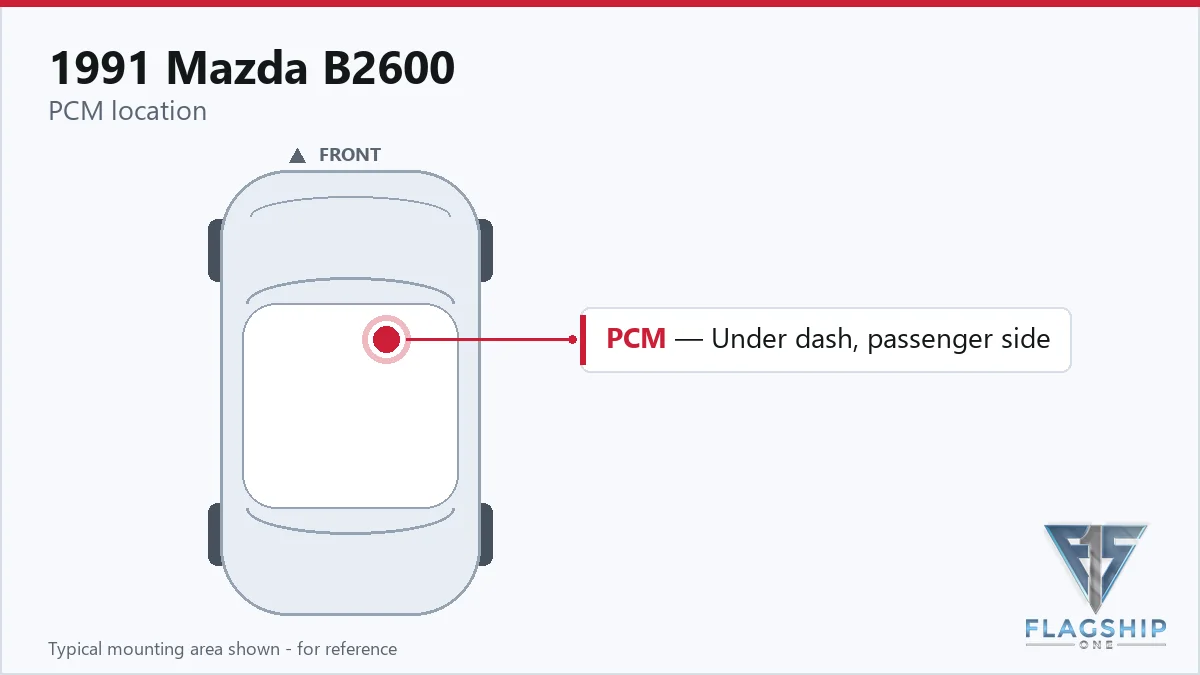
Work with the ignition off, and treat the module as static-sensitive: avoid touching the connector pins at any point.
After replacing the PCM in your 1991 Mazda B2600, the factory procedure typically requires programming the vehicle identification number (VIN) into the new module to ensure proper communication with the engine and emissions systems. This step is critical because an unprogrammed module may not recognize sensor inputs or adjust fuel and ignition parameters correctly, leading to poor performance or even a no-start condition. However, a VIN-programmed replacement unit from Flagship One arrives ready to install, eliminating the need for additional programming or dealer visits. This not only saves time but also reduces the risk of errors during the setup process. Once installed, the module should immediately restore proper engine operation, assuming no other underlying issues are present.
A failing PCM in your 1991 Mazda B2600 can manifest in several ways, often mimicking other common engine problems. One of the most frequent signs is a no-start condition, where the engine cranks but refuses to fire, often due to incorrect fuel or spark timing signals from the module. Stalling or rough idling may also occur, particularly when the PCM struggles to maintain consistent engine speeds or adjust to changing loads. Some drivers report poor acceleration or hesitation under throttle, which can feel like a fuel delivery issue but stems from the PCM’s inability to adjust fuel trim or ignition timing properly. In some cases, the vehicle may run excessively rich or lean, leading to fouled spark plugs, black smoke from the exhaust, or a strong fuel odor. Another telltale sign is erratic or non-functional dashboard gauges, as the PCM may fail to communicate with other onboard systems. If you’ve scanned for trouble codes and found something like an internal control module memory check error, it’s a strong indicator that the PCM itself is the root cause rather than a sensor or wiring issue.
Testing the PCM directly requires specialized diagnostic equipment, such as an oscilloscope or a dedicated PCM tester, which most home mechanics don’t have. However, you can perform basic checks by inspecting the wiring harness and connectors for damage or corrosion. If the vehicle exhibits symptoms like no-start conditions or stalling, and other components like the fuel pump or ignition system check out, the PCM is often the next logical suspect.
A used PCM from another 1991 Mazda B2600 may work, but it depends on whether the module has been programmed with the correct VIN and calibration for your specific vehicle. Without proper programming, the PCM may not communicate correctly with the engine or emissions systems, leading to poor performance or a no-start condition. Additionally, used modules carry the risk of hidden internal damage or wear, which could cause the same issues you’re trying to fix.
Distinguishing between a failing PCM and a faulty sensor can be challenging, as both can cause similar symptoms like rough idling or poor acceleration. Start by checking for trouble codes, which may point to specific sensors or the PCM itself. If the codes indicate an internal PCM fault, such as a memory check error, the module is likely the issue. You can also test sensors individually with a multimeter or scan tool to rule them out. If all sensors check out but the symptoms persist, the PCM is often the culprit.
Driving with a failing PCM is risky, as it can lead to unpredictable engine behavior, including stalling, misfires, or even a complete loss of power. In some cases, a failing PCM may cause the engine to run excessively rich or lean, which can damage other components like the catalytic converter or oxygen sensors over time. If you suspect the PCM is failing, it’s best to address the issue promptly to avoid further damage or unsafe driving conditions.
Resetting the PCM after replacement isn’t always necessary, but it can help clear any stored codes or learned values from the old module. If you’re installing a VIN-programmed replacement unit, the module should be ready to go without additional steps. However, disconnecting the battery for a few minutes after installation can help reset the vehicle’s adaptive memory, allowing the new PCM to start fresh with its own calibration. This step is optional but may help smooth out any lingering drivability issues.
If your 1991 Mazda B2600 is showing signs of PCM failure, you have a few options to consider. A repair may be possible if the issue is limited to a specific component, such as a faulty capacitor or corroded connector, but this isn’t always reliable for long-term fixes. A refurbished or new replacement module, pre-programmed with your vehicle’s VIN, offers a more dependable solution without the hassle of dealer programming. Flagship One provides units that are ready to install, ensuring your B2600 gets back on the road with minimal downtime.
Flagship One stocks a refurbished, VIN-programmed ECM for the 1991 Mazda B2600 with a lifetime warranty, free shipping and no core charge. The full Mazda B2600 module lineup covers other engine configurations as well.
The PCM in your 1991 Mazda B2600 plays a critical role in keeping your engine running smoothly, and when it fails, the symptoms can be frustrating and unpredictable. By understanding where the module is located, how it functions, and what signs to watch for, you can diagnose issues more confidently and make informed decisions about replacement. Whether you opt for a repair or a pre-programmed replacement, addressing PCM issues promptly can help restore your vehicle’s performance and reliability. If you’re ready to move forward, a VIN-programmed unit can simplify the process and get you back on the road faster.