
Last updated on August 25th, 2026 at 12:31 pm
The engine control module in the 1990 Pontiac Bonneville manages fuel delivery, ignition timing, and emissions systems for the 3.8L V6. When this module fails, it often leads to no-start conditions, engine stalling, or poor fuel economy.
When your 1990 Pontiac Bonneville starts experiencing engine management issues, the engine control module often becomes a prime suspect. This critical component governs how your 3.8L V6 runs, from fuel injector pulse width to ignition spark timing. A failing module can leave you stranded or cause frustrating intermittent problems that seem to appear without warning. Understanding what this module does, where it lives in your vehicle, and how to properly replace it saves you time and prevents costly mistakes during diagnosis and repair. This guide walks through the module’s role, its physical location, common failure indicators, and the replacement process specific to your Bonneville. You will also learn important precautions that protect the new unit from damage during installation, along with how a pre-programmed unit from Flagship One simplifies the entire job.
The engine control module in your 1990 Pontiac Bonneville serves as the central processing unit for the entire engine management system on the 3.8L V6. It continuously reads input signals from various sensors throughout the vehicle, including the throttle position sensor, coolant temperature sensor, mass airflow sensor, and oxygen sensor. Using these inputs, the module calculates and commands the appropriate fuel injector pulse width, ignition timing advance, and emissions control functions. This constant calculation and adjustment process happens dozens of times per second while the engine runs, ensuring optimal combustion efficiency and drivability under all operating conditions. When the module operates correctly, your Bonneville delivers smooth acceleration, steady idle, and reliable cold starts. However, when internal components degrade or fail, the module can no longer process sensor data accurately or command outputs properly. This degradation often manifests as intermittent drivability glitches that gradually worsen over time. Because this vehicle predates the OBD-II standard, diagnostic trouble codes are accessed differently than on later models, which can make pinpointing module faults more challenging without proper test equipment. Selecting 1990 Pontiac Bonneville replacement ECM units that match your specific calibration ensures the replacement communicates properly with the rest of the onboard electronics.
1990 Pontiac Bonneville
OEM programmed ECM for your 1990 Pontiac Bonneville — plug & play, no dealer visit.
Free shipping · Lifetime warranty
On the 1990 Pontiac Bonneville, the engine control module is positioned in the engine compartment, specifically in front of the right side shock tower and above the EVAP canister. This location exposes the module to significant underhood heat and vibration over the life of the vehicle, both of which can contribute to eventual internal component degradation. Accessing the module requires reaching into the area between the shock tower and the adjacent fender structure. Before beginning any removal work, disconnect the negative battery cable to prevent electrical damage, but only after verifying the ignition switch is in the off position. The module connector unplugs from the unit, and the mounting hardware can then be removed to free the old module from its bracket. Reverse the process to install the replacement, ensuring the connector seats fully and the mounting fasteners are secure. Because the module sits in a relatively open area of the engine compartment, take care not to drop tools onto nearby components during the swap.
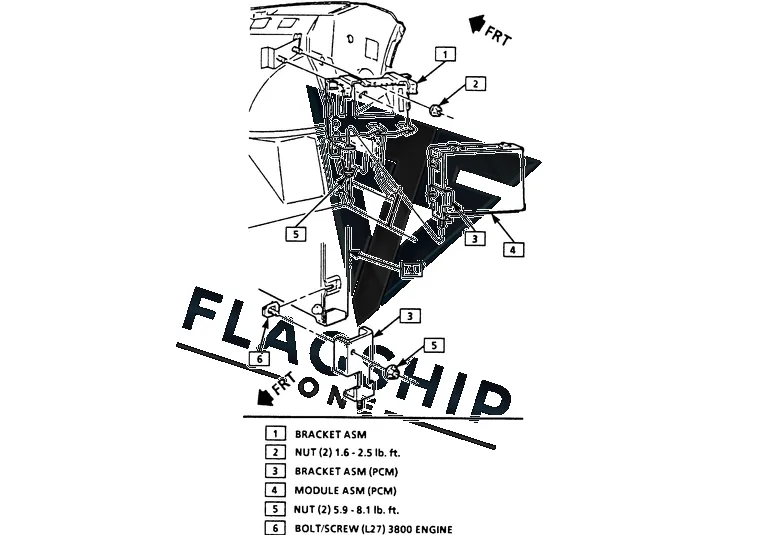
Work with the ignition off, and treat the module as static-sensitive: avoid touching the connector pins at any point.
After installing a replacement engine control module in your 1990 Pontiac Bonneville, the factory service procedure typically requires that the unit be programmed with your vehicle’s specific calibration data and vehicle identification number. This programming step ensures the module matches the exact engine configuration, transmission type, and emissions equipment originally installed at the factory. Without proper programming, the module may not communicate correctly with other onboard systems, potentially leading to poor performance or illuminated warning indicators. Having this work performed at a dealership or qualified shop adds time and expense to the replacement process. Choosing a VIN-programmed replacement unit from Flagship One eliminates this extra step entirely, since each unit arrives already loaded with the correct calibration for your specific vehicle identification number. You install the module, reconnect the battery, and start the engine without additional programming procedures.
A failing engine control module in the 1990 Pontiac Bonneville can produce a range of drivability problems that often mimic other component failures, making accurate diagnosis essential. One of the most common symptoms is a no-start condition where the engine cranks normally but fails to fire because the module has stopped commanding fuel or spark. Intermittent stalling is another frequent complaint, particularly when the vehicle is at operating temperature, as heat-related expansion inside the module can temporarily interrupt circuit function. Some drivers report rough idle or hesitation during acceleration, which occurs when the module processes sensor data incorrectly and delivers inaccurate fuel or timing commands. Misfire-like symptoms may also appear, even though the root cause traces back to the module rather than individual ignition components. In more advanced failure cases, the module may stop communicating with diagnostic test equipment entirely, preventing technicians from retrieving stored fault information. Because this vehicle predates OBD-II, code access requires specific procedures that differ from later diagnostic standards. Transmission shifting irregularities can also surface on models with electronically controlled transmissions, since the module governs shift points and torque converter lockup timing alongside its engine management duties.
The engine control module sits in the engine compartment, positioned in front of the right side shock tower and above the EVAP canister. This underhood location exposes the unit to heat and vibration throughout its service life.
Swapping a module from another vehicle may not work correctly unless the calibration matches your specific engine and transmission combination. Even among identical model years, differences in equipment packages can require different module calibrations.
Always ensure the ignition switch is in the off position before unplugging the module connector, disconnecting the negative battery cable, removing the module fuse, or attempting to jump-start the vehicle. Failure to do so may cause permanent damage to the module.
Factory procedures typically require the replacement module to be programmed with your vehicle identification number and specific calibration data. Flagship One units arrive already VIN-programmed, so this additional step is completed before shipment.
Module failures often produce multiple unrelated symptoms simultaneously, such as no-start combined with loss of diagnostic communication. Sensor problems tend to create more predictable, repeatable drivability issues that follow specific operating conditions.
Choosing between a repair and a refurbished replacement for your 1990 Pontiac Bonneville engine control module depends on the nature and extent of the failure. A VIN-programmed replacement unit eliminates the uncertainty of a repaired component and removes the need for post-install programming at a dealership.
Flagship One stocks a refurbished, VIN-programmed ECM for the 1990 Pontiac Bonneville with a lifetime warranty, free shipping and no core charge. The full Pontiac Bonneville module lineup covers other engine configurations as well.
The engine control module in your 1990 Pontiac Bonneville plays a vital role in keeping the 3.8L V6 running smoothly. When symptoms point to module failure, a correctly programmed replacement restores reliable vehicle operation. Flagship One offers pre-programmed units tailored to your specific VIN.