
Last updated on August 25th, 2026 at 11:49 am
The engine control module in the 2012 Volkswagen Jetta GLI manages fuel delivery and ignition timing. When this computer fails, it often causes stalling, poor fuel economy, or erratic idling, as the vehicle cannot properly process sensor data to maintain engine efficiency.
Owning a 2012 Volkswagen Jetta GLI means relying on a sophisticated network of electronics to maintain performance. When the engine or powertrain control module begins to fail, the vehicle may exhibit unpredictable behavior, ranging from intermittent stalling to a complete failure to start. Understanding the role of these computers helps you identify whether a hardware replacement is necessary or if the issue is sensor-related. This guide explains the function of these modules, where they are situated, and the steps required to return your vehicle to factory specifications. By reviewing the common symptoms and the labor involved in replacement, you can better prepare for the repair process and ensure the engine management system operates reliably for the long term.
The engine control module acts as the brain for the 2012 Volkswagen Jetta GLI, processing data from numerous sensors to optimize combustion and emissions. It regulates the air-fuel mixture and spark timing to ensure the 2.0L engine runs efficiently across various loads. Because it manages critical safety and performance parameters, a malfunctioning unit can lead to severe drivability issues. If you are searching for replacement 2012 Jetta GLI modules, it is important to recognize that these modules are integrated with the vehicle’s security and emissions systems. Failure typically manifests as a loss of communication with the onboard diagnostics system or the triggering of multiple unrelated fault codes. Ensuring this component functions correctly is vital for maintaining the fuel economy and power delivery expected from the GLI model.
2012 Volkswagen Jetta GLI
OEM programmed ECM for your 2012 Volkswagen Jetta GLI — plug & play, no dealer visit.
Free shipping · Lifetime warranty
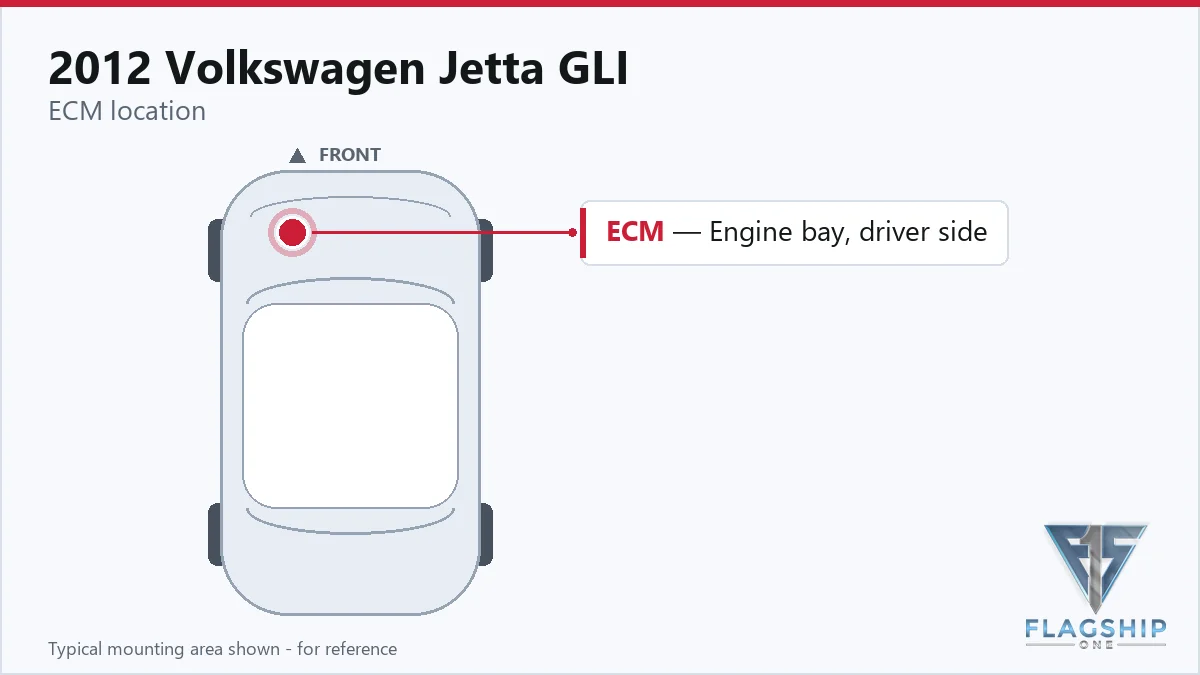
The control module is situated within the right-side plenum chamber of the 2012 Volkswagen Jetta GLI. Accessing this area typically requires removing the cowl components to reach the hardware. According to standard labor guides, replacing the engine control module takes 1.0 hours. Similarly, the powertrain control module requires 1.0 hours for removal and installation. Once the physical hardware is swapped, additional time is needed for system synchronization. The relearn process for the engine control module is listed at 0.5 hours, and the powertrain control module relearn also takes 0.5 hours. These steps ensure the new hardware communicates correctly with the vehicle’s sensors and actuators before the vehicle is returned to service.
Work with the ignition off, and treat the module as static-sensitive: avoid touching the connector pins at any point.
| Operation | Configuration | Book Time |
|---|---|---|
| Engine Control Module R&R | All configurations | 1.0 hr |
| Engine Control Module Relearn | All configurations | 0.5 hr |
| Powertrain Control Module Relearn | All configurations | 0.5 hr |
| Powertrain Control Module R&R | All configurations | 1.0 hr |
After installing a new module in the 2012 Volkswagen Jetta GLI, the factory requires a specific relearn procedure to synchronize the computer with the vehicle’s unique identity and options. This process usually involves connecting a diagnostic tool to calibrate the engine and powertrain settings. However, choosing a VIN-programmed replacement unit ensures that the necessary vehicle-specific data is already loaded onto the hardware. This eliminates the need for the initial programming steps, as the module is configured to match your specific vehicle’s requirements before it arrives. This streamlined approach reduces the time the vehicle spends in the shop and minimizes the risk of software mismatches during the installation process.
A failing control module in the 2012 Volkswagen Jetta GLI often presents as a series of erratic engine behaviors. You may experience a complete no-start condition or sudden stalling while driving. In many cases, the vehicle may trigger a variety of misfire codes or show a steady malfunction indicator lamp. Some drivers notice a total loss of communication when attempting to use a scan tool. You might see a random misfire fault appearing in the memory, which can be a sign of internal processor failure rather than a mechanical issue. Other symptoms include poor acceleration, erratic shifting patterns, or the sudden appearance of multiple unrelated fault codes that do not resolve after clearing the memory. These signs typically indicate that the internal circuitry of the module has degraded.
Manufacturer bulletins provide guidance for specific issues with the 2012 Volkswagen Jetta GLI. Bulletin #24-11-05 addresses vehicles equipped with UDS communication engine control modules, specifically focusing on the process for clearing the stored codes within the ECM. Additionally, bulletin #01-09-09 discusses updating programming when the malfunction indicator lamp is illuminated. This bulletin is relevant when specific fault codes are stored in the ECM memory, including P0300 through P0304, P0102, P1297, P0420, and P0441. These updates are intended to correct software anomalies that may cause incorrect diagnostic triggers.
| Bulletin | Subject | What It Addresses |
|---|---|---|
| 24-11-05 | TT 24-11-05 2011> Vehicles with UDS communication Engine Control Modules – Erasing DTCs in t | — |
| 01-09-09 | Attachment: 01-09-09 – Update Programming, MIL ON, DTCs P0300-P0304, P0102, P1297, P0420 and P0 | — |
The module is found inside the plenum chamber on the right side. This area is typically accessed by removing the cowl components.
The removal and installation process is listed at 1.0 hours. An additional 0.5 hours is typically required for the relearn procedure.
Yes, bulletin #01-09-09 mentions updating programming for specific codes like P0300-P0304. This may resolve issues where the MIL is illuminated.
When deciding how to restore the 2012 Volkswagen Jetta GLI, you have a choice between attempting a repair of the existing board or opting for a refurbished replacement. Because these modules are complex and sensitive to heat, a fully tested replacement often provides a more reliable long-term solution. Choosing a unit that is pre-configured for your specific vehicle ensures a faster installation and restores the original factory performance without the need for extensive dealership programming.
Flagship One stocks a refurbished, VIN-programmed PCM for the 2012 Volkswagen Jetta GLI with a lifetime warranty, free shipping and no core charge. The full Volkswagen Jetta GLI module lineup covers other engine configurations as well.
Maintaining the electronic integrity of your 2012 Volkswagen Jetta GLI is essential for reliable operation. By identifying the symptoms of module failure and following the correct replacement procedures, you can ensure your vehicle continues to perform as intended. If you suspect your engine or powertrain computer is failing, exploring a VIN-programmed replacement is a practical way to resolve the issue and get back on the road.