
Last updated on August 25th, 2026 at 11:50 am
The engine control module in the 2009 Volkswagen Jetta GLI manages fuel injection, ignition timing, and emissions systems for the 2.0L turbocharged engine. When this unit fails, the vehicle may experience rough running, no-start conditions, or illuminated warning lights due to lost communication or corrupted data.
When the check engine light stays on or the 2009 Volkswagen Jetta GLI begins to run poorly, the engine control module often becomes a suspect. This computer governs critical functions such as fuel delivery, spark timing, and emission controls for the 2.0L turbocharged engine. A failure can mimic sensor faults or mechanical issues, leading to unnecessary part swaps. Understanding where the module sits, how long the job takes, and what the factory expects after installation helps you plan the repair efficiently. The following sections cover the module’s role, its location in the plenum chamber, the book time for replacement, the required relearn step, and a relevant service bulletin that may resolve certain codes without hardware replacement. You will also learn how a pre-programmed unit can simplify the process.
The engine control module in the 2009 Volkswagen Jetta GLI acts as the central processor for the 2.0L turbocharged engine, coordinating fuel injector pulse width, ignition coil firing order, and variable valve timing to meet performance and emissions targets. It continuously monitors inputs from the mass airflow sensor, throttle position, crankshaft and camshaft position sensors, and oxygen sensors, adjusting outputs in real time. When the module develops an internal fault — often due to heat cycling, voltage spikes, or contaminated connectors — it can set random misfire codes, cause erratic idle, or prevent the engine from starting altogether. Because the module also stores adaptive values for throttle body alignment and fuel trim, losing that data can leave the vehicle running poorly even after a sensor repair. Selecting a quality replacement ECM for the Jetta GLI ensures the hardware matches the original calibration and communicates correctly with the vehicle’s network. The unit is housed in a sealed enclosure within the plenum chamber, which protects it from moisture but makes access more involved than under-hood modules.
2009 Volkswagen Jetta GLI
OEM programmed ECM for your 2009 Volkswagen Jetta GLI — plug & play, no dealer visit.
Free shipping · Lifetime warranty
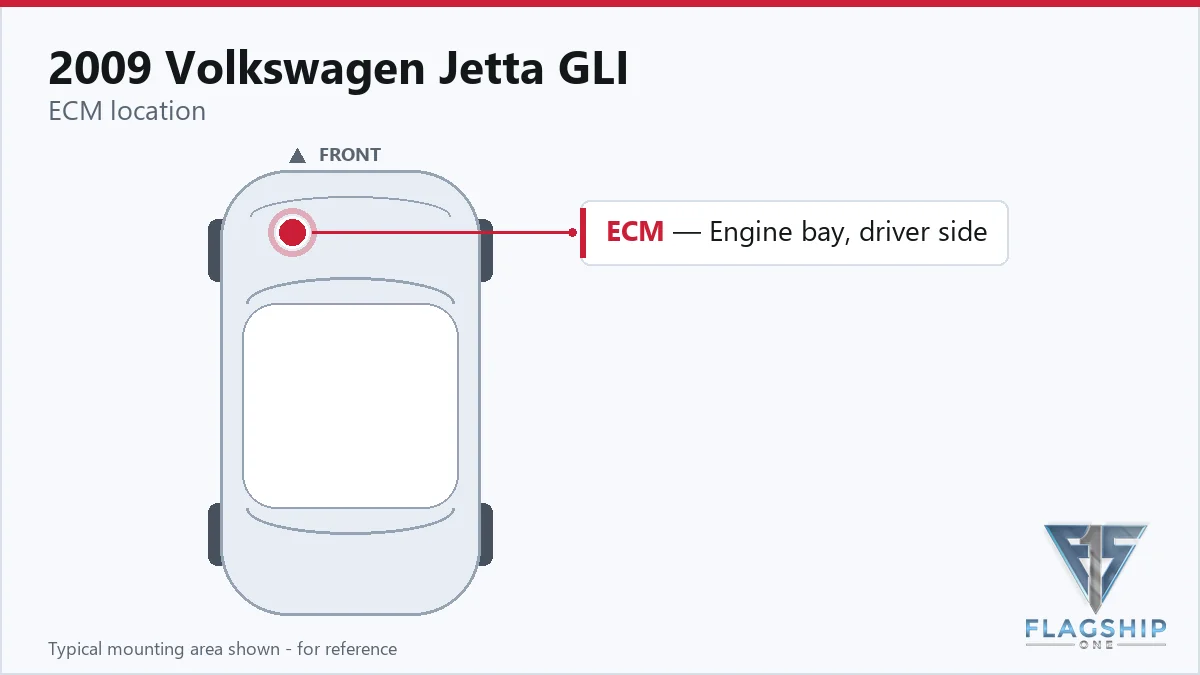
The engine control module is mounted inside the plenum chamber on the right side of the engine bay, while the powertrain control module shares a similar location. To reach the unit, the intake ducting and plenum cover must be removed, which accounts for the 1.4-hour book time listed for sedan models. The wagon version shows a shorter 0.6-hour time, reflecting easier access. After the physical swap, the factory procedure calls for a 0.5-hour relearn for the engine control module and another 0.5-hour relearn for the powertrain control module to restore adaptive values such as throttle position and fuel trim. No torque specifications are published for the module fasteners in the available data. The transmission control module, located in the left front wheel housing, is a separate unit and not covered by these times.
Work with the ignition off, and treat the module as static-sensitive: avoid touching the connector pins at any point.
| Operation | Configuration | Book Time |
|---|---|---|
| Engine Control Module R&R | Sedan | 1.4 hr |
| Engine Control Module R&R | Wagon | 0.6 hr |
| Engine Control Module Relearn | All configurations | 0.5 hr |
| Powertrain Control Module Relearn | All configurations | 0.5 hr |
| Powertrain Control Module R&R | All configurations | 1.4 hr |
Following module installation, the factory service manual requires a relearn sequence that allows the engine and powertrain control modules to recalibrate throttle body position, idle air control, and fuel trim adaptations. This process typically consumes 0.5 hours per module and must be performed with a scan tool capable of bi-directional communication. If the replacement unit arrives with the correct vehicle identification number already programmed, the relearn can be completed without additional software downloads or dealer visits. Flagship One supplies a VIN-programmed replacement unit that includes the latest calibration for the 2009 Jetta GLI, so the technician can proceed directly to the adaptation routine. Skipping the relearn may leave the engine hunting at idle or exhibiting delayed throttle response, even when the hardware is sound.
A failing engine control module in the 2009 Volkswagen Jetta GLI often presents as a no-start condition, sudden stalling, or rough idle that does not clear with sensor replacement. The check engine light may illuminate with codes that point to ignition or fuel system faults, yet the root cause is internal processor corruption or communication loss. Drivers may notice the engine cranks but fails to fire, or it starts and then dies when the throttle is touched. Intermittent misfires under load can also appear, and a scan tool may show random misfire code P0300 alongside other seemingly unrelated codes such as P0102 or P0420. In some cases, the module stops communicating with the diagnostic scanner entirely, preventing any data retrieval. Because the module also controls transmission shift strategies on models equipped with the automatic gearbox, erratic shifting or harsh engagements can be another symptom. Voltage spikes from a weak alternator or improper jump-starting often accelerate the failure.
Service bulletin 01-09-09 addresses a programming update for the engine control module when the malfunction indicator lamp is on and fault codes P0300 through P0304, P0102, P1297, P0420, and P0441 are stored in the ECM fault memory. The bulletin instructs technicians to reflash the module with revised software that corrects fuel trim calculations and misfire detection thresholds. This update can resolve the listed codes without replacing the hardware, provided the module itself is not physically damaged. The attachment referenced as 01-09-09 contains the specific calibration files and installation procedure. If the codes persist after the update, further diagnosis of the module’s internal circuitry or its power and ground supplies is warranted.
| Bulletin | Subject | What It Addresses |
|---|---|---|
| 01-09-09 | Attachment: 01-09-09 – Update Programming, MIL ON, DTCs P0300-P0304, P0102, P1297, P0420 and P0 | — |
The labor guide lists 1.4 hours for removal and installation of the engine control module on the sedan body style, plus an additional 0.5 hours for the required relearn procedure.
The module is mounted inside the plenum chamber on the right side of the engine bay, which requires removing the intake ducting and plenum cover for access.
The factory requires a 0.5-hour relearn to recalibrate adaptive values; however, a unit that arrives pre-programmed to the vehicle identification number eliminates the need for a separate software flash.
When the engine control module in your 2009 Volkswagen Jetta GLI fails, you can choose between repairing the original unit, sourcing a refurbished module, or installing a new pre-programmed computer. Repair may be cost-effective if the fault is limited to a replaceable component, but internal processor damage often makes replacement more reliable. A quality refurbished unit with the correct calibration can restore function without the higher price of a new module, provided it includes the necessary relearn capability.
Flagship One stocks a refurbished, VIN-programmed PCM for the 2009 Volkswagen Jetta GLI with a lifetime warranty, free shipping and no core charge. The full Volkswagen Jetta GLI module lineup covers other engine configurations as well.
The 2009 Volkswagen Jetta GLI relies on a well-functioning engine control module to deliver the performance and efficiency expected from its turbocharged engine. By understanding the module’s location, the required labor time, and the factory relearn step, you can approach the repair with confidence. Whether you opt for a professional diagnosis or a pre-programmed replacement, addressing the issue promptly will keep your Jetta GLI running as intended.