
Last updated on August 25th, 2026 at 12:04 pm
The engine control module (ECM) in the 2002 Toyota Echo 1.5L manages fuel injection, ignition timing, and emissions. When it fails, the engine may not start, run poorly, or trigger diagnostic trouble codes. Replacement requires programming to match the vehicle’s immobilizer and calibration.
Imagine your 2002 Toyota Echo 1.5L cranks but won’t fire, or it stalls unpredictably at a stoplight. The engine control module (ECM) — also called the powertrain control module (PCM) — is the brain behind fuel delivery, spark timing, and emissions control. When this module begins to fail, the entire engine management system can go haywire. This guide explains what the ECM does in your Echo, the symptoms of a failing unit, and the replacement process. You will learn the book labor times for removal and installation, the factory-recommended reprogramming steps, and how a pre-programmed replacement can simplify the job. Whether you are a DIY owner or a professional technician, understanding these details helps you diagnose accurately and avoid unnecessary repairs.
The engine control module in the 2002 Toyota Echo 1.5L is a sealed computer that interprets sensor inputs — from the crankshaft position sensor, oxygen sensors, throttle position sensor, and more — to adjust fuel injector pulse width, ignition timing, and idle speed. It also manages the immobilizer system, which requires a matching key code to start. When the ECM fails, the engine may lose communication with the scan tool, refuse to start, or run in a degraded limp-home mode. Because the Echo relies on a single module for both engine and transmission control (in automatic models), a fault can also affect shift quality. For this reason, sourcing replacement ECMs for the Echo that are correctly programmed is critical. The module is not user-serviceable; internal failures typically require replacement rather than repair.
2002 Toyota Echo
OEM programmed ECM for your 2002 Toyota Echo — plug & play, no dealer visit.
Free shipping · Lifetime warranty
The ECM on the 2002 Toyota Echo is typically located behind the passenger side kick panel, near the glove box. To access it, you must remove the lower trim panel and possibly the glove box assembly. Disconnect the battery negative terminal first. Unplug the two large wiring harness connectors, then remove the mounting bolts (usually 10 mm). The book time for ECM removal and replacement (R&R) is 0.5 hours. After installing the new module, a relearn procedure is required, also listed at 0.5 hours. This relearn allows the ECM to adapt to the vehicle’s specific sensors and driving habits. No special tools are needed for the physical swap, but care must be taken not to damage the connector pins or seals.
| Operation | Configuration | Book Time |
|---|---|---|
| Engine Control Module Relearn | All configurations | 0.5 hr |
| Engine Control Module R&R | All configurations | 0.5 hr |
| Powertrain Control Module R&R | All configurations | 0.5 hr |
| Powertrain Control Module Relearn | All configurations | 0.5 hr |
After installing a new or used ECM in the 2002 Toyota Echo, the factory procedure requires an ECU flash reprogramming using Toyota’s Techstream diagnostic tool. This process, outlined in TSBs SS002-01 and SS002-07, updates the module’s software and calibrates it to the vehicle’s VIN, immobilizer, and emissions configuration. Without this step, the engine may not start or may run poorly. Flagship One offers a VIN-programmed replacement unit that arrives with the correct calibration already loaded. This means you can install the module, perform the 0.5-hour relearn, and drive away without visiting a dealer for programming. The immobilizer data is also pre-set, so your existing keys will work.
A failing ECM in the 2002 Toyota Echo 1.5L often produces a no-start condition where the engine cranks but never fires. You may also experience intermittent stalling, especially when the engine is hot, or a check engine light that stays on. Misfire codes (P0300-P0304) can appear even after replacing spark plugs and coils, because the ECM is misreading sensor data. Another common sign is a dead scan tool — the OBD-II port may not communicate at all. In automatic models, harsh or delayed shifting can occur because the ECM also controls the transmission. One specific internal fault is internal controller fault, which indicates the ECM’s internal memory has corrupted. This code often requires module replacement. Other symptoms include poor fuel economy, surging idle, and failure of the cooling fan to operate correctly.
Toyota issued two service bulletins relevant to the 2002 Echo’s ECM. TSB SS002-01, titled ‘ECU Flash Reprogramming Process (Revised),’ applies to 2001 and later models and describes the correct method for updating the module’s software. TSB SS002-07, ‘Techstream ECU Flash Reprogramming Procedure,’ covers 2001-2008 Toyota vehicles and provides updated steps using the Techstream diagnostic tool. Both bulletins emphasize the importance of following the exact flash sequence to avoid bricking the module. These procedures are required after ECM replacement to ensure proper vehicle operation.
| Bulletin | Subject | What It Addresses |
|---|---|---|
| SS002-01 | :SS002-01: 2001 & Later Applicable Models: ECU Flash Reprogramming Process (Revised) | — |
| SS002-07 | :SS002-07: 01-08 Applicable Toyota: Techstream ECU Flash Reprogramming Procedure | — |
Common signs include no-start, stalling, and a check engine light with code P0601. A professional diagnosis with a scan tool can confirm if the ECM is not communicating or if internal faults are present.
Yes, the physical swap is straightforward with basic hand tools. The book time is 0.5 hours. However, you will need to perform a relearn procedure after installation, and the module must be programmed to your vehicle’s VIN and immobilizer.
In the 2002 Echo, the terms are often used interchangeably. The module controls both engine and transmission functions (in automatic models), so it is technically a powertrain control module (PCM). Toyota service information may refer to it as ECM or PCM.
A used ECM must be reprogrammed to your vehicle’s VIN and immobilizer. Without that step, the engine may not start. Flagship One’s VIN-programmed units are a more reliable option because they come ready to install.
The factory book time for the ECM relearn procedure is 0.5 hours. This involves driving the vehicle under specific conditions so the module can adapt to the engine’s sensors and idle characteristics.
When your 2002 Toyota Echo 1.5L experiences ECM-related issues, you have two paths: attempt a repair (often not possible due to sealed internals) or replace the module. A refurbished ECM from a trusted supplier can restore reliable operation. For the Echo, choosing a unit that is pre-programmed with your VIN saves the dealer visit and gets you back on the road faster.
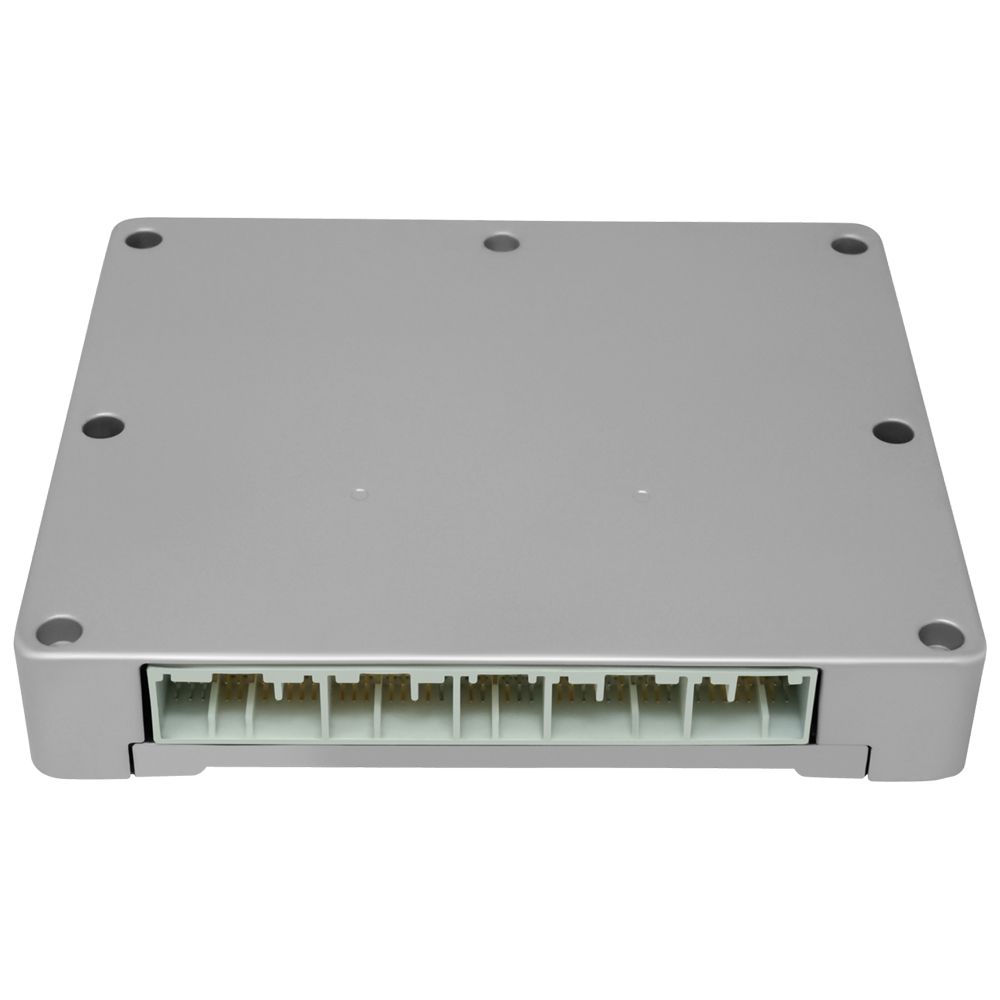
Flagship One stocks a refurbished, VIN-programmed PCM for the 2002 Toyota Echo with a lifetime warranty, free shipping and no core charge. The full Toyota Echo module lineup covers other engine configurations as well.
The 2002 Toyota Echo 1.5L relies on its ECM for smooth engine and transmission operation. Recognizing symptoms like no-start, stalling, or code P0601 early can prevent stranding. Replacement is straightforward with 0.5 hours of labor, but proper programming is essential. Consider a VIN-programmed replacement to simplify the process and ensure your Echo runs as designed.