
Last updated on August 25th, 2026 at 12:07 pm
The engine control module in the 1995 Toyota Paseo acts as the central processor for the 3.5L engine, managing fuel delivery and ignition timing. When this computer fails, it often causes severe drivability issues, including unexpected stalling or a complete inability to start the vehicle.
When a vehicle begins to exhibit unexplained drivability issues, tracing the root cause can feel overwhelming for any owner. In the 1995 Toyota Paseo, the engine control module serves as the primary brain responsible for regulating critical engine parameters. If you are researching this component, you are likely dealing with performance degradation or a complete no-start condition. Understanding how this computer interacts with the rest of your vehicle is the first step toward a reliable repair. This guide breaks down the essential details regarding the module in your specific vehicle, from its physical location to the replacement process. You will discover what the unit actually does within the 3.5L engine system, the typical warning signs of a malfunction, and the factory time requirements for installation. By exploring these details, you gain the knowledge needed to make confident decisions about whether a repair or a replacement is the right path forward. We will also clarify the post-installation programming steps, which are often a source of confusion for many individuals tackling this job for the first time on their own.
1995 Toyota Paseo
OEM programmed ECM for your 1995 Toyota Paseo — plug & play, no dealer visit.
Free shipping · Lifetime warranty
The engine control module in the 1995 Toyota Paseo functions as the central processing unit for the entire engine management system. It continuously monitors data from various sensors distributed throughout the vehicle and uses that information to calculate precise outputs for fuel injection, ignition timing, and idle speed control. In this specific vehicle equipped with the 3.5L engine, the computer ensures the air-fuel mixture remains at the optimal ratio for both performance and efficiency. When this module operates correctly, you experience smooth acceleration and consistent engine behavior under varying load conditions. However, internal electrical failures can disrupt these calculations, leading to conditions that range from poor fuel economy to complete engine shutdown. Because the system relies on the computer to coordinate every firing event, a malfunction essentially disables the core logic the engine needs to run. Mechanics often diagnose these units by evaluating sensor inputs against expected outputs, but internal circuit board degradation is a common root cause that requires replacement. When facing such a failure, sourcing replacement engine computers for the Paseo becomes necessary to restore proper vehicle function. The module does not work in isolation; it constantly communicates with the ignition and fuel delivery systems to maintain overall drivability. Replacing a defective unit with a properly programmed counterpart ensures the 3.5L engine receives the correct operational commands once again, allowing you to get back on the road reliably.
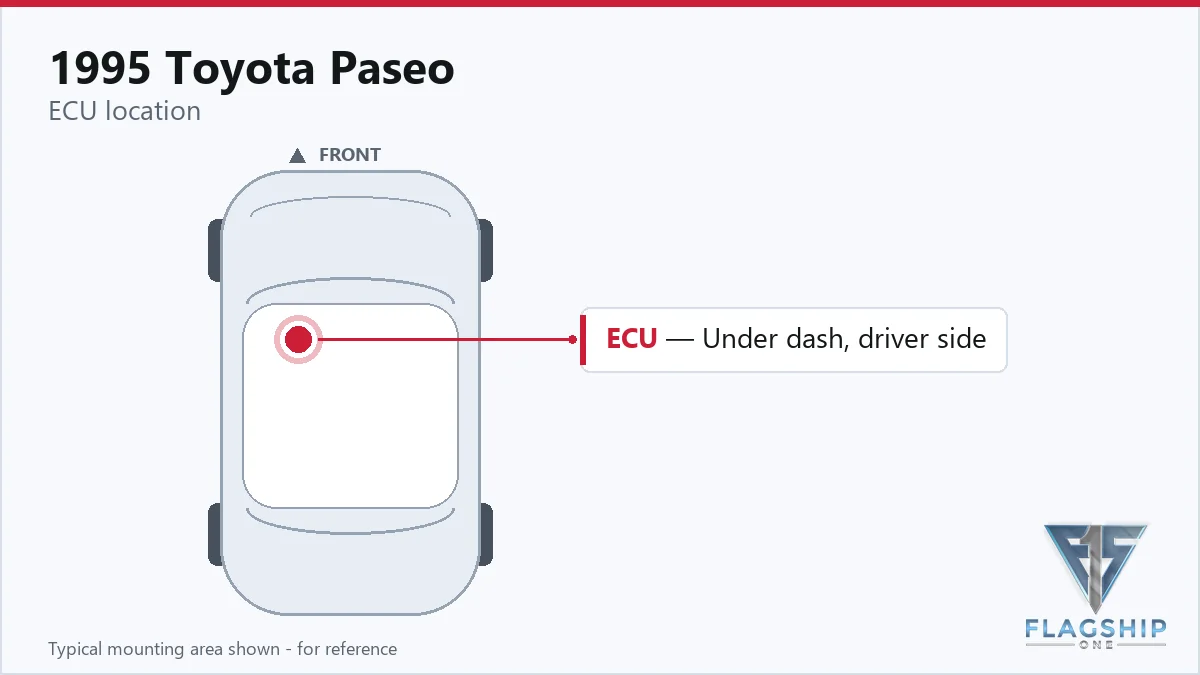
Locating the engine control unit in the 1995 Toyota Paseo requires looking inside the passenger compartment. According to the factory wiring guide, the component grid places the engine ECU within the instrument panel. Accessing it typically involves removing cosmetic trim pieces and possibly sections of the dashboard to reach the mounting bracket. Once you locate the unit, you must disconnect the vehicle battery before unplugging the electrical connectors to prevent short circuits. Removing and reinstalling the powertrain control module carries a book time of 0.8 hours, while the same procedure for the engine control module also requires 0.8 hours. This time accounts for the physical removal of the old hardware and the installation of the new unit. Because the 1995 Toyota Paseo utilizes this specific placement inside the instrument panel, technicians must carefully route the wiring harnesses to avoid pinching them during reassembly. Proper installation ensures the new module communicates effectively with the engine sensors.
| Operation | Configuration | Book Time |
|---|---|---|
| Engine Control Module Relearn | All configurations | 0.5 hr |
| Engine Control Module R&R | All configurations | 0.8 hr |
| Powertrain Control Module R&R | All configurations | 0.8 hr |
| Powertrain Control Module Relearn | All configurations | 0.5 hr |
After physically installing a new computer in your 1995 Toyota Paseo, the factory procedure requires specific relearn steps to synchronize the hardware with your vehicle. The book time for an engine control module relearn is 0.5 hours, and the powertrain control module relearn also requires 0.5 hours. These procedures are essential because a fresh, unprogrammed module does not possess the necessary idle speed parameters or fuel trim adjustments for the 3.5L engine. Without completing these steps, the vehicle may idle roughly or fail to start altogether. The relearn process typically involves following a strict sequence of key cycles, engine running conditions, and driving patterns to let the computer memorize the baseline operational values. However, you can bypass this time-consuming factory sequence by choosing a VIN-programmed replacement unit from Flagship One. Because these modules arrive already flashed with your specific vehicle identification number data, the relearn steps are already completed prior to shipment. This allows you to install the part and immediately drive the vehicle without waiting for the computer to relearn its basic parameters.
When the engine control module in the 1995 Toyota Paseo begins to fail, the vehicle often exhibits clear drivability symptoms that disrupt normal operation. One of the most common indicators is a complete no-start condition, where the engine cranks but fails to ignite because the computer cannot command the fuel injectors or ignition coils properly. Intermittent stalling is another frequent complaint; the engine may shut off unexpectedly while idling or driving, creating potentially hazardous situations on the road. You might also notice severe misfires under acceleration, which occur when the module sends incorrect timing signals to the cylinders, disrupting the combustion process. Because the 1995 Toyota Paseo predates the standardized OBD-II protocol, traditional diagnostic trouble codes are not accessible, making diagnosis more difficult for the average owner. However, you may experience dead scan-tool communication, where diagnostic equipment simply fails to link to the vehicle entirely, strongly pointing toward a computer failure rather than a simple sensor issue. In some instances, the failing module may struggle to manage the transmission effectively, leading to erratic shifting patterns or harsh gear changes that mimic transmission damage. Unexplained drops in fuel economy or rough idling can also signal that the internal circuitry is degrading over time. Recognizing these symptoms early helps prevent further damage and ensures you address the root cause rather than replacing unrelated components.
The factory wiring guide places the engine ECU within the instrument panel of the 1995 Toyota Paseo. Accessing it typically requires removing portions of the dashboard trim to reach the mounting location.
The documented book time for removing and reinstalling the powertrain control module is 0.8 hours. An additional 0.5 hours is required to complete the powertrain control module relearn procedure.
No, the 1995 Toyota Paseo is a pre-OBD-II vehicle, meaning it does not utilize the standardized P-codes found in newer models. Technicians must rely on module-internal codes and specific manufacturer diagnostic procedures.
Installing a used module often requires completing the factory relearn procedure, which takes 0.5 hours. Choosing a pre-programmed unit eliminates this step, as the necessary vehicle-specific data is already flashed onto the computer.
Common symptoms include a no-start condition, unexpected stalling, and dead scan-tool communication. You may also experience severe engine misfires or erratic shifting due to the computer failing to manage engine parameters correctly.
Deciding between repairing a failing computer or opting for a refurbished replacement depends on the severity of the internal damage in your 1995 Toyota Paseo. While some electrical faults may seem repairable, internal circuit board degradation often requires a complete unit replacement to ensure long-term reliability. Choosing a pre-programmed replacement tailored to the 3.5L engine eliminates the uncertainty of patching a damaged board and restores full functionality to your vehicle.
Flagship One stocks a refurbished, VIN-programmed PCM for the 1995 Toyota Paseo with a lifetime warranty, free shipping and no core charge. The full Toyota Paseo module lineup covers other engine configurations as well.
Dealing with a failing engine control module in your 1995 Toyota Paseo can certainly disrupt your daily routine, but understanding the replacement process simplifies the path forward. By recognizing the failure symptoms and knowing the required factory book times, you can approach the repair with confidence. Ensure your 3.5L engine runs smoothly again by selecting a reliable, VIN-programmed unit tailored to your specific vehicle.