
Last updated on August 25th, 2026 at 12:27 pm
The engine control module in the 1992 Toyota Paseo is the primary computer responsible for managing fuel delivery, ignition timing, and emissions functions. As a pre-OBD-II system, diagnostic capabilities are limited to a simple malfunction indicator light. This module can fail due to age, heat exposure, voltage spikes, or moisture intrusion, leading to hard starting, stalling, poor idle quality, and reduced fuel economy.
If your 1992 Toyota Paseo is running rough, failing to start, or stalling unexpectedly, the engine control module may be the culprit. The ECM serves as the central computer for your vehicle’s engine management, and like any electronic component, it can degrade over time. Replacing this part involves more than simply swapping one box for another — the vehicle requires a relearn procedure to recognize the new module and optimize its calibrations. This article walks you through what the module does, where it lives, what the factory replacement procedure entails, and how Flagship One units arrive ready to install. By the end, you will understand the scope of the repair and what to expect at each stage.
1992 Toyota Paseo
OEM programmed ECM for your 1992 Toyota Paseo — plug & play, no dealer visit.
Free shipping · Lifetime warranty
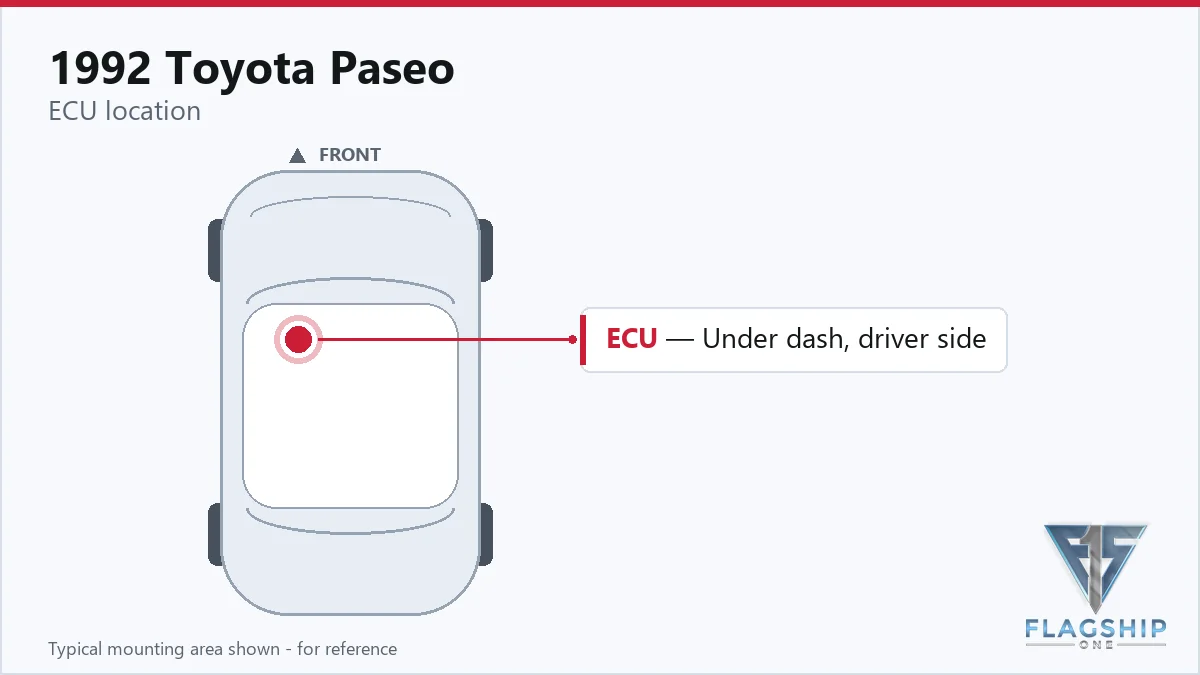
The engine control module in your 1992 Toyota Paseo acts as the brain of the engine management system. It monitors sensor inputs and adjusts fuel delivery and ignition timing to maintain smooth operation. On this pre-OBD-II vehicle, diagnostic capabilities are more limited than on later models — the system triggers a malfunction indicator light but stores fewer specific fault details. A failing module disrupts the precise calculations your engine relies on, often resulting in driveability complaints before a complete failure occurs. Replacement engine computers for the Toyota Paseo is a targeted repair that restores proper sensor communication and closed-loop fuel strategy. Given the instrument panel mounting location, accessing the unit requires interior trim removal, making it a straightforward job for shops familiar with this generation of Toyota products.
The factory wiring guide’s component grid places the engine ECU inside the instrument panel. Reaching it involves removing dashboard trim panels to expose the unit’s mounting location. The physical removal and reinstallation carries a book time of 0.8 hours for the ECM procedure. Replacement requires securing the new module with proper fasteners and reconnecting all associated wiring harnesses. Torque specifications and exact mounting hardware depend on factory documentation specific to this vehicle. Shops following standard procedures will verify all connections are seated and the harness is routed cleanly before reassembly to avoid future electrical faults.
| Operation | Configuration | Book Time |
|---|---|---|
| Engine Control Module Relearn | All configurations | 0.5 hr |
| Engine Control Module R&R | All configurations | 0.8 hr |
| Powertrain Control Module R&R | All configurations | 0.8 hr |
| Powertrain Control Module Relearn | All configurations | 0.5 hr |
After the new module is physically installed, the factory service procedure requires a relearn process to initialize communication between the replacement unit and your vehicle’s sensors. This step carries a book time of 0.5 hours and typically involves connecting diagnostic equipment to cycle the system through specific sequences. Without this initialization, the engine may run poorly or exhibit hesitation until the calibrations align with the vehicle’s hardware. Flagship One units arrive as a VIN-programmed replacement unit, eliminating the need for dealers or specialty shops to perform manual programming. The replacement arrives ready to accept the relearn sequence, reducing total labor compared to sourcing a brand-new module that requires external programming equipment.
A failing ECM on a 1992 Toyota Paseo typically announces itself through several recognizable symptoms. The engine may crank normally but fail to start, indicating the computer is not delivering fuel or spark commands. You might experience rough idle, stalling during warm-up, or intermittent loss of power under acceleration. On automatic transmission models, harsh or unpredictable shifting can occur because the module also governs transmission functions. A dead scan tool connection — where diagnostic equipment cannot communicate with the vehicle — is a common sign of module failure. These issues often develop gradually, escalating from occasional hiccups to a stranded vehicle over weeks or months.
Most independent shops can physically remove and install the module, but pre-OBD-II diagnostic capabilities vary. Shops without compatible diagnostic equipment may not complete the relearn procedure correctly. Verify your chosen shop has experience with this generation of Toyota before committing.
A complete loss of scan tool communication often indicates an ECM failure or a power/ground circuit problem at the module. Professional diagnosis is recommended before replacing the computer to rule out simpler electrical issues like blown fuses or corroded connectors.
Early engine computers have limited diagnostic logic compared to later systems. An ECM may degrade gradually without triggering a specific fault, instead causing vague driveability symptoms. This is why professional diagnosis, not just code reading, matters on vehicles like the 1992 Paseo.
Replacing the engine computer on a 1992 Toyota Paseo requires weighing the cost of a new unit from a dealer against a quality rebuilt replacement. A brand-new ECM carries full factory programming but often requires a programming appointment at significant additional cost. A VIN-programmed replacement from Flagship One arrives ready to install, reducing labor time and eliminating the need for specialty programming equipment. Either path restores proper engine and transmission control — the choice depends on your budget and timeline.
Flagship One stocks a refurbished, VIN-programmed PCM for the 1992 Toyota Paseo with a lifetime warranty, free shipping and no core charge. The full Toyota Paseo module lineup covers other engine configurations as well.
The 1992 Toyota Paseo relies on a single engine control module to manage critical engine functions. Understanding its location, the factory relearn requirement, and how Flagship One simplifies the process helps you make an informed repair decision. Whether you replace the unit yourself or have a shop handle it, a properly programmed replacement restores your vehicle’s driveability and reliability.