
Last updated on August 25th, 2026 at 12:26 pm
The engine control module in your 1993 Toyota Paseo is the central computer that manages fuel delivery, ignition timing, and emissions systems. When this unit fails, your vehicle may experience no-start conditions, stalling, rough idle, or complete shutdown. Replacement requires disassembly of the instrument panel for access.
If your 1993 Toyota Paseo won’t start, runs poorly, or shows no communication with a scan tool, the engine control module may be the culprit. This guide explains what the ECU does in your specific vehicle, where it’s located, common failure symptoms, and your replacement options. Whether you’re diagnosing a no-start condition or planning a repair, you’ll find practical information about the removal process, programming requirements, and what to expect from a replacement unit. The goal is to help you understand the repair scope so you can make informed decisions about proceeding with replacement versus other diagnostics.
1993 Toyota Paseo
OEM programmed ECM for your 1993 Toyota Paseo — plug & play, no dealer visit.
Free shipping · Lifetime warranty
The engine control module in your 1993 Toyota Paseo is the primary computer responsible for managing the 3.5L engine’s fuel injection, ignition timing, and emissions control systems. It receives input from various sensors throughout the engine bay and adjusts operating parameters in real time to maintain performance and efficiency. This unit differs from a simple relay or switch — it’s a programmable microprocessor that stores vehicle-specific calibration data unique to your engine. When the internal circuitry degrades from heat cycles, voltage spikes, or age, the module may lose the ability to process sensor data correctly. A failing ECU commonly produces hard-starting, intermittent stalling, or no-start conditions that persist regardless of other repairs. If you need replacement engine computers for the Toyota Paseo, understanding this module’s role helps you distinguish ECU failures from simpler sensor or wiring issues.
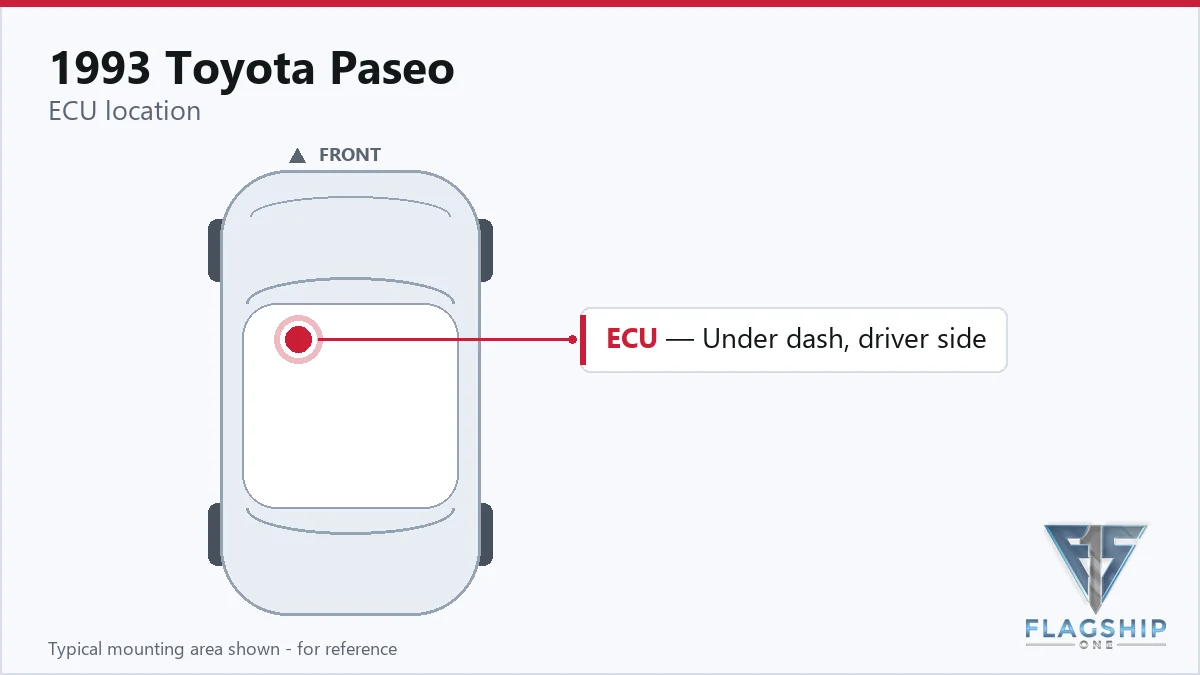
The factory wiring guide places the engine ECU inside the instrument panel, requiring removal of dashboard trim and potentially the cluster assembly for access. The R&R (remove and replace) labor time is 0.8 hours according to book estimates. Access typically involves removing lower dashboard panels, disconnecting the cluster electrical connectors, and extracting the module from its mounting location. Replacement involves installing the new unit, reconnecting all wiring harness plugs, and verifying secure mounting before reassembly. The instrument panel must be fully reinstalled with all trim pieces secured and all electrical connections verified before testing. Plan for additional time if corrosion or broken clips are encountered during disassembly.
| Operation | Configuration | Book Time |
|---|---|---|
| Engine Control Module Relearn | All configurations | 0.5 hr |
| Engine Control Module R&R | All configurations | 0.8 hr |
| Powertrain Control Module R&R | All configurations | 0.8 hr |
| Powertrain Control Module Relearn | All configurations | 0.5 hr |
After installing a replacement engine control module, the factory procedure requires a relearn process to calibrate the new unit to your vehicle’s specific sensors and calibration data. The relearn procedure takes approximately 0.5 hours of book time. This step is necessary because the new module must establish communication with the engine sensors and learn idle characteristics specific to your 3.5L engine. Flagship One units arrive VIN-programmed with your vehicle’s specific calibration pre-loaded, which means the relearn procedure may be simplified or partially completed at the time of installation. This pre-programming helps ensure the replacement unit will communicate properly with your vehicle’s systems right away.
Every VIN-programmed replacement unit from Flagship One arrives with these steps already completed.
Engine control module failures in vehicles like the 1993 Toyota Paseo typically present with several recognizable patterns. A common scenario is a no-start condition where the engine cranking motor operates normally but the engine never catches — this often indicates the ECU is not providing fuel or spark commands. Another frequent symptom is intermittent stalling, where the vehicle runs normally then suddenly dies, often after warming to operating temperature, then restarts normally after cooling. Some owners report a dead scan tool — connecting a code reader yields no communication with the ECU, which strongly suggests an internal module failure rather than a sensor issue. Misfire codes that persist despite replacing spark plugs, wires, or ignition coils may also point to ECU malfunction. In some cases, the vehicle may run but display erratic idle, poor throttle response, or unexplained check engine illumination without underlying mechanical faults.
Not necessarily. The 1993 Paseo requires a module programmed with vehicle-specific calibration data. A used ECU from a different vehicle or without the correct programming will likely cause starting issues or improper engine operation. Always verify the replacement unit matches your vehicle’s VIN and engine configuration.
The replacement is mechanically straightforward for someone comfortable with dashboard disassembly, but the 0.5-hour relearn procedure may require dealer-level scan tools. If your Flagship One unit arrives VIN-programmed, the relearn may be simplified. Plan to have access to proper electrical diagnostic equipment and verify all connections before buttoning everything up.
A scan tool that shows no communication with the ECU strongly suggests internal module failure. Other indicators include multiple unrelated trouble codes appearing simultaneously, symptoms that persist after replacing sensors or coils, or a vehicle that runs differently with the ECU connector unplugged. A professional diagnosis can confirm before spending on replacement.
When your 1993 Toyota Parker’s engine control module fails, you have two primary paths: repair the existing unit or source a replacement. Repair may be possible for some internal faults, but many failures require replacement with a unit programmed for your specific vehicle. A refurbished replacement from a reputable supplier typically arrives ready to install with your VIN and calibration pre-loaded. Consider your budget, timeline, and diagnostic confidence when choosing between repair and replacement options.
Flagship One stocks a refurbished, VIN-programmed PCM for the 1993 Toyota Paseo with a lifetime warranty, free shipping and no core charge. The full Toyota Paseo module lineup covers other engine configurations as well.
The engine control module in your 1993 Toyota Paseo is a critical component that manages your 3.5L engine’s core functions. When it fails, the vehicle may not start or run properly regardless of other repairs. Whether you diagnose the issue yourself or rely on a professional, understanding the location behind the instrument panel and the programming requirements helps set realistic expectations. A properly programmed replacement unit can restore reliable operation to your vehicle.