
Last updated on August 25th, 2026 at 12:38 pm
The PCM in the 2009 Mercedes-Benz CLK-Class 3.5L manages engine timing, fuel delivery, and emissions. When it fails, the vehicle may misfire, stall, or refuse to start, compromising performance and reliability.
If your 2009 Mercedes-Benz CLK-Class 3.5L is showing an engine warning or experiencing inconsistent power, the PCM could be at fault. This guide explains the role of the PCM in your vehicle, where it is located, and how a replacement can quickly bring your car back to reliable operation. You’ll learn the steps involved, the time needed, and what to expect after the new unit is installed.
In the 2009 Mercedes-Benz CLK-Class 3.5L, the PCM coordinates ignition timing, fuel injection, and emission controls to keep the engine running smoothly. It also communicates with other modules to balance performance and fuel economy. Mercedes-Benz CLK-Class 3.5L PCM replacement ensures that the engine runs at optimal parameters and that diagnostic trouble codes are cleared after service.
2009 Mercedes-Benz CLK-Class 3.5L
OEM programmed ECM for your 2009 Mercedes-Benz CLK-Class 3.5L — plug & play, no dealer visit.
Free shipping · Lifetime warranty
The ME 9.7 control unit is mounted on the intake manifold that supports the engine. Removal requires 0.5 hours of labor, followed by a 0.5 hour relearn of the ECM and a 0.5 hour relearn of the PTCM. When the unit is replaced, the new module must be reconnected to the same harness and secured in place before the relearn procedures are performed.
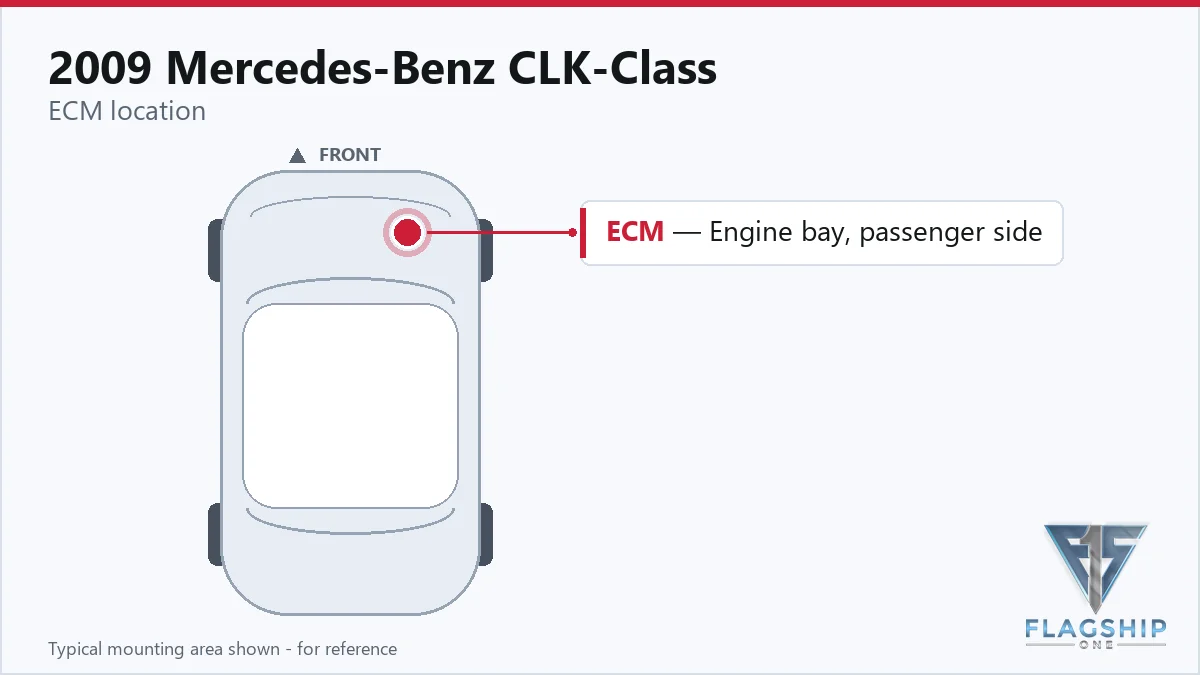
Work with the ignition off, and treat the module as static-sensitive: avoid touching the connector pins at any point.
| Operation | Configuration | Book Time |
|---|---|---|
| Engine Control Module R&R | All configurations | 0.5 hr |
| Engine Control Module Relearn | All configurations | 0.5 hr |
| Powertrain Control Module Relearn | All configurations | 0.5 hr |
| Powertrain Control Module R&R | All configurations | 0.5 hr |
After the new PCM is installed, the factory procedure typically requires a relearn of both the ECM and the PTCM, each taking 0.5 hours. Flagship One units arrive VIN‑programmed, so those relearn steps are already completed. VIN‑programmed replacement unit eliminates the need for post‑install re‑learn, saving time and ensuring the module is ready to operate immediately.
Common signs that the PCM has failed include the engine light illuminating, difficulty starting, rough idle, and stalling during acceleration. You may also notice misfire codes or the scan tool failing to communicate with the module. If you encounter code P0601, it indicates a problem with the PCM’s internal diagnostics, often pointing to a hardware issue within the unit.
| Bulletin | Subject | What It Addresses |
|---|---|---|
| — | S-B-07.61/89a S-B-54.21/244a: Engine Control Module (N3/10) Flashing MY-All Models All | — |
| — | DTB – P-B-07.00/57e: Check Engine Light / Engine Control Module Software Update Revision Docume | — |
Yes, if the light is caused by a failing PCM. Replacing the unit and performing the relearn steps typically clears the code and restores normal operation.
Normally, the relearn of the ECM and PTCM is required. However, if the replacement unit is VIN‑programmed, these relearn steps are already completed by the manufacturer.
Check for other module faults or wiring issues, and confirm that the new PCM is properly seated. If the code persists, consult a qualified technician for a deeper diagnostic.
Whether you choose a quick repair or a refurbished replacement, a new PCM can bring your 2009 Mercedes-Benz CLK-Class 3.5L back to reliable performance. The module’s location on the intake manifold means a skilled technician can handle the job efficiently, and the VIN‑programmed units reduce the time required for relearn procedures.
Flagship One stocks a refurbished, VIN-programmed PCM for the 2009 Mercedes-Benz CLK-Class with a lifetime warranty, free shipping and no core charge. The full Mercedes-Benz CLK-Class module lineup covers other engine configurations as well.
A reliable PCM is essential for your 2009 Mercedes-Benz CLK-Class 3.5L. By addressing failures early and using a properly programmed unit, you can keep your vehicle running smoothly and avoid costly repairs. Consider a replacement if you notice persistent engine warning lights or performance issues.