
Last updated on August 25th, 2026 at 12:39 pm
In the 2007 Mercedes-Benz CLK-Class, the Engine Control Module (ECM) and Powertrain Control Module (PCM) manage fuel delivery, ignition timing, and transmission shift logic. When either unit fails, the engine may refuse to start, run roughly, or lose communication with diagnostic tools, often triggering fault codes that indicate internal timing or sensor processing errors.
When a 2007 Mercedes-Benz CLK-Class begins to exhibit no‑start behavior, erratic idle, or unexpected transmission shifts, the electronic brain of the powertrain is often the first suspect. The ECM and PCM coordinate engine speed, fuel injection, and gear changes, so any glitch can quickly translate into drivability problems. This guide explains what these modules do in your CLK, where they live, the steps required to replace them, and how to avoid future issues. By the end, you should understand the labor involved, the necessary relearn procedures, and why a properly programmed replacement from Flagship One can simplify the process.
The Engine Control Module in the 2007 Mercedes-Benz CLK-Class interprets sensor data to control fuel injection, ignition timing, and emission functions, while the Powertrain Control Module oversees transmission shift points and torque converter lock‑up. Together they ensure smooth acceleration, efficient fuel use, and compliance with emissions standards. When either unit loses internal calibration or develops a hardware fault, the vehicle may experience loss of power, sudden stalling, or an inability to shift correctly. Maintaining accurate module operation is essential for both performance and emissions compliance. Replacement often involves removing the intake manifold‑mounted unit and installing a new one, after which the vehicle must undergo a relearn process to restore proper timing and shift strategies. For owners seeking a direct swap, 2007 Mercedes-Benz CLK engine control modules provide a drop‑in solution that matches factory specifications.
2007 Mercedes-Benz CLK-Class
OEM programmed ECM for your 2007 Mercedes-Benz CLK-Class — plug & play, no dealer visit.
Free shipping · Lifetime warranty
The ECM and PCM are situated on the intake manifold of the 2007 Mercedes-Benz CLK-Class, making them accessible once the upper intake assembly is removed. Removal typically requires half an hour of labor, as indicated by the book time, and involves disconnecting the main harness, unbolting the mounting hardware, and extracting the unit. Installation reverses the steps, with the same half‑hour labor estimate for securing the new module. Care should be taken to protect the connector pins and ensure torque specifications are met if they are provided in the service manual. After the unit is seated, the harness is reconnected and the intake components are reassembled.
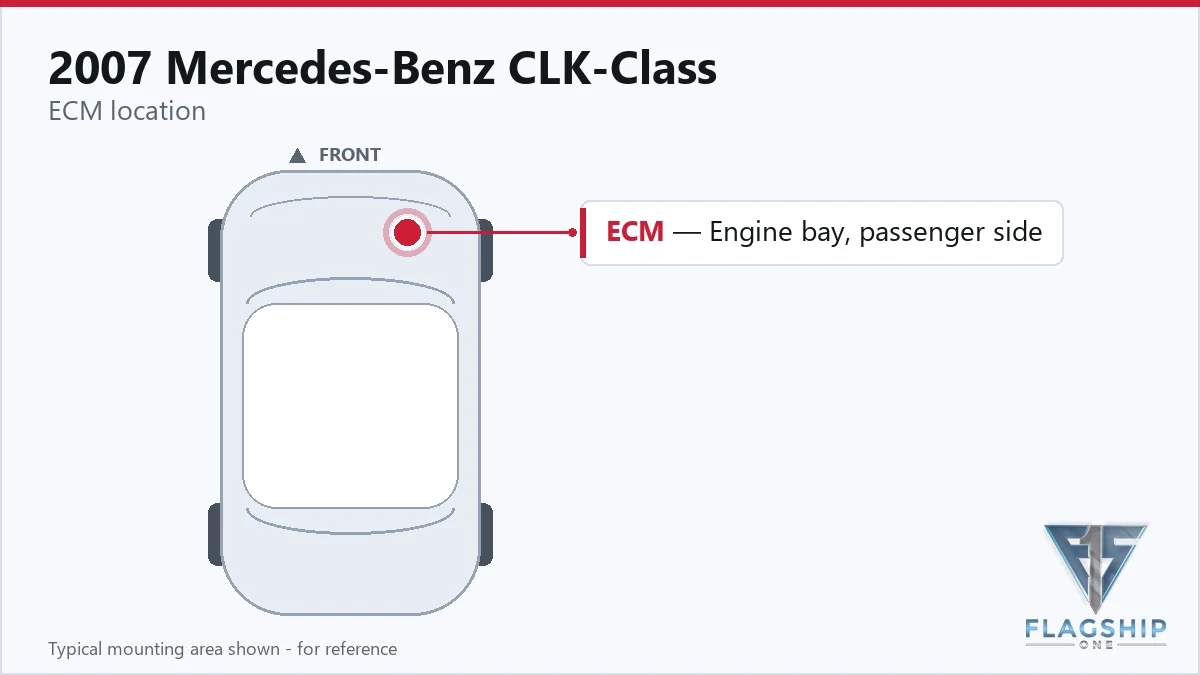
Work with the ignition off, and treat the module as static-sensitive: avoid touching the connector pins at any point.
| Operation | Configuration | Book Time |
|---|---|---|
| Engine Control Module R&R | All configurations | 0.5 hr |
| Engine Control Module Relearn | All configurations | 0.5 hr |
| Powertrain Control Module Relearn | All configurations | 0.5 hr |
| Powertrain Control Module R&R | All configurations | 0.5 hr |
Following replacement, the factory procedure calls for a half‑hour relearn of the Engine Control Module and an additional half‑hour Powertrain Control Module relearn to re‑establish timing and shift maps. Flagship One supplies a VIN-programmed replacement unit that arrives with the necessary calibrations already applied, so the technician can skip the on‑site programming step and proceed directly to the relearn cycles, saving time and reducing the chance of coding errors.
A failing ECM or PCM in the 2007 CLK often reveals itself through a no‑start condition, rough idle, unexpected stalling, or transmission shift anomalies. Drivers may notice the check‑engine light flashing and diagnostic trouble codes appearing, such as timing error that points to internal clock failures. Additional signs include loss of communication with scan tools, erratic fuel trims, and occasional loss of power during acceleration. These symptoms arise because the modules can no longer process sensor inputs correctly or command actuators in a synchronized manner.
Service bulletin S‑B‑07.61/89a and S‑B‑54.21/244a describe a flashing procedure for the Engine Control Module (N3/10) that applies to all model years, providing guidance on updating the module firmware during replacement.
| Bulletin | Subject | What It Addresses |
|---|---|---|
| — | S-B-07.61/89a S-B-54.21/244a: Engine Control Module (N3/10) Flashing MY-All Models All | — |
The ECM is mounted on the intake manifold and can be accessed with basic tools, but the procedure includes a required relearn cycle. If you are comfortable with electrical work and have the proper diagnostic equipment, a DIY replacement is possible.
Factory flashing is outlined in service bulletins S‑B‑07.61/89a and S‑B‑54.21/244a. A Flagship One unit arrives pre‑flashed, eliminating the need for on‑site software.
Both the ECM and PCM each have a booked labor time of 0.5 hours for removal and another 0.5 hours for the relearn procedure, totaling roughly one hour per module.
Yes, because the PCM shares many functions with the ECM, a malfunction can lead to abnormal shift patterns, harsh gear changes, or failure to engage certain gears.
A VIN‑programmed unit ensures that all vehicle‑specific calibrations are correct from the start, reducing the risk of post‑install coding errors and simplifying the relearn process.
When the ECM or PCM in your 2007 Mercedes‑Benz CLK fails, you can choose a brand‑new factory‑spec unit or a refurbished replacement that meets the original performance standards. Both options require the same removal steps and relearn procedures, but a VIN‑programmed replacement from Flagship One can streamline the installation by eliminating on‑site coding. Evaluate your budget and service preferences to select the path that best fits your vehicle’s needs.
Flagship One stocks a refurbished, VIN-programmed PCM for the 2007 Mercedes-Benz CLK-Class with a lifetime warranty, free shipping and no core charge. The full Mercedes-Benz CLK-Class module lineup covers other engine configurations as well.
A malfunctioning ECM or PCM can compromise the reliability of your 2007 Mercedes‑Benz CLK-Class, but with proper replacement and the required relearn steps, you can restore full performance. Consider a VIN‑programmed unit to simplify the process and keep your CLK running smoothly.