
Last updated on August 25th, 2026 at 12:11 pm
The engine control module in the 2008 Mercedes-Benz C-Class 2.5L manages fuel injection, ignition timing, and variable intake manifold operation; internal processor faults or communication loss can cause stalling, misfires, or a no-start condition.
When your 2008 Mercedes-Benz C-Class 2.5L begins to exhibit erratic running, unexpected stalling, or a complete refusal to start, the engine control module often becomes a primary suspect. This module — referred to by Mercedes as the ME-SFI or ME 9.7 control unit — acts as the central processor for fuel delivery, ignition timing, and the variable intake manifold system that optimizes torque across the rev range. Because the module integrates directly with the manifold assembly, its physical location adds a layer of complexity to any diagnostic or replacement effort. In this guide you will learn how the module functions in this specific engine, where it lives on the intake manifold, what the factory labor times indicate for removal and reinstallation, and what programming steps the dealer normally performs after a swap. You will also see how a properly pre-programmed replacement can eliminate the need for specialized dealer equipment, saving both time and uncertainty. Whether you are a technician planning the repair or an owner evaluating options, the details ahead will help you approach the job with realistic expectations and a clear sequence of steps.
2008 Mercedes-Benz C-Class 2.5L
OEM programmed ECM for your 2008 Mercedes-Benz C-Class 2.5L — plug & play, no dealer visit.
Free shipping · Lifetime warranty
In the 2008 Mercedes-Benz C-Class 2.5L the engine control module carries the designation ME-SFI or ME 9.7 depending on the exact production split, but both versions perform the same core duties: they calculate injector pulse width, trigger ignition coils, manage the variable intake manifold flap, and communicate with the transmission control unit, instrument cluster, and diagnostic gateway over the CAN bus. Because the module also stores the vehicle identification number, immobilizer data, and variant coding for equipment such as emissions standards and transmission type, a failure can manifest as a cascade of seemingly unrelated faults — from a dead scan-tool connection to erratic shifting or a manifold flap stuck in one position. The processor monitors its own internal memory and communication integrity, so a checksum error or CAN bus timeout will often trigger a protective limp mode that limits rpm and disables the variable manifold. When that happens the driver may notice a sudden loss of mid-range power, rough idle, or an illuminated check-engine light with codes that point to the control unit itself rather than a sensor. Replacing the module requires a unit that matches the original hardware index and software version, which is why many shops turn to replacement engine computers for the 2008 Mercedes-Benz C-Class 2.5L that are pre-configured to the vehicle’s VIN before they leave the supplier.
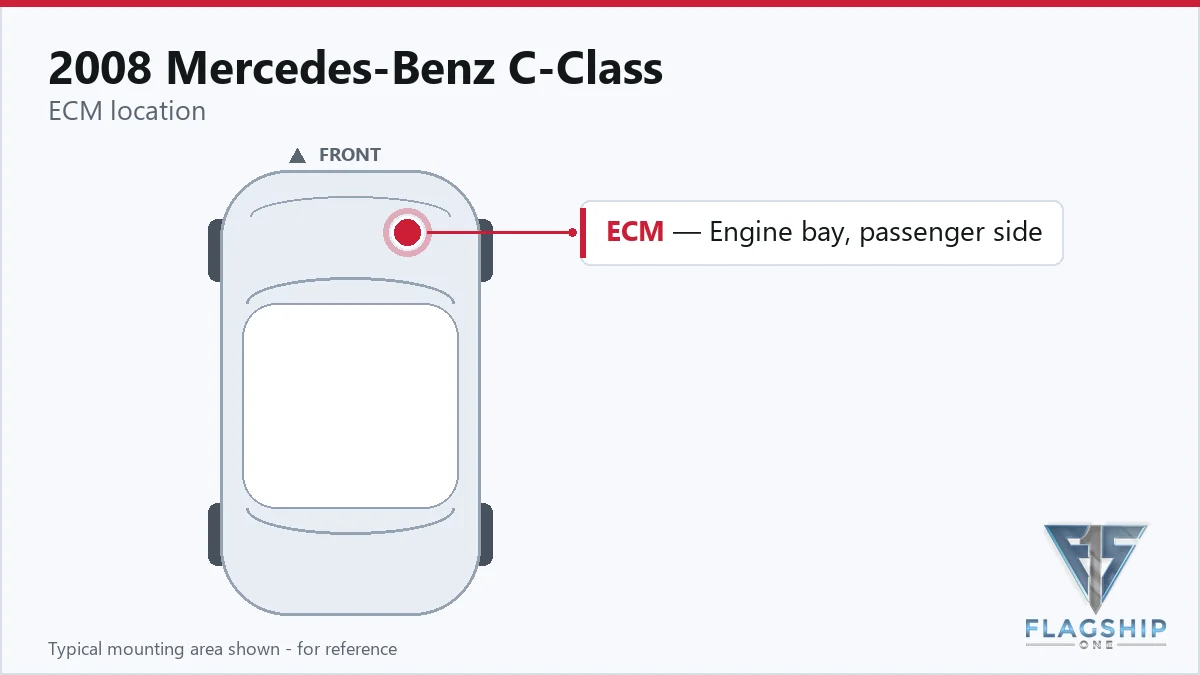
The ME-SFI control unit is mounted in the middle of the variable intake manifold, while the ME 9.7 unit sits on the intake manifold that supports the engine. Both locations place the module atop the engine under the hood, accessible after removing the engine cover and any ducting that obscures the manifold. The factory labor guide allocates 0.9 hours for the removal and installation of either the engine control module or the powertrain control module, reflecting the time needed to disconnect the wiring harness, unbolt the unit from the manifold, and secure the replacement. An additional 0.5 hours is budgeted for the relearn procedure that follows installation. Because the module bolts directly to the manifold, no major component removal is required, but the technician should take care to protect the connector seals and avoid stressing the manifold mounting points during the swap.
Work with the ignition off, and treat the module as static-sensitive: avoid touching the connector pins at any point.
| Operation | Configuration | Book Time |
|---|---|---|
| Engine Control Module R&R | All configurations | 0.9 hr |
| Engine Control Module Relearn | All configurations | 0.5 hr |
| Powertrain Control Module R&R | All configurations | 0.9 hr |
After a new module is installed the factory procedure requires variant coding to match the vehicle’s equipment list, initialization of the adaptive values for idle control and fuel trim, and a relearn of the variable intake manifold flap positions. These steps normally demand a Mercedes-compatible scan tool with online access to the manufacturer’s coding database. Flagship One units arrive a VIN-programmed replacement unit that has already been coded to the specific vehicle identification number, so the variant coding, adaptation reset, and manifold flap relearn are completed before the part ships. The installer can therefore bolt in the module, reconnect the harness, and proceed directly to a functional test without dealer-level software or subscription fees.
Drivers of the 2008 Mercedes-Benz C-Class 2.5L often report a pattern of symptoms that point toward control module degradation. The most common complaint is an intermittent crank-no-start condition where the engine spins normally but fails to fire, only to start minutes or hours later without any apparent intervention. Sudden stalling at idle or low speed, especially when the engine is warm, is another frequent indicator; the engine may cut out as if the ignition were switched off, then restart after a brief pause. Rough idle accompanied by a fluctuating rpm needle can suggest that the variable intake manifold flap is not receiving correct position commands from the module. Loss of communication with a diagnostic scan tool — where the tool powers up but cannot establish a session with the engine controller — strongly implies an internal CAN transceiver failure. Misfire codes that migrate between cylinders without a consistent pattern may stem from corrupted injector driver outputs inside the module. In some cases the transmission may exhibit harsh or delayed shifts because the powertrain control module is not receiving valid torque data from the engine controller. Because these symptoms overlap with sensor or wiring faults, a thorough diagnostic sequence that includes power, ground, and communication checks at the module connector is essential before condemning the unit.
Yes, if you obtain a unit that has been pre-programmed to your vehicle’s VIN, the variant coding and adaptation relearn are already complete. You would still need to perform the manifold flap relearn, but that can often be done with a capable aftermarket scan tool.
The hardware version is printed on the module label; both mount on the intake manifold but in slightly different positions. A VIN lookup through a Mercedes parts database or your supplier will confirm the correct index.
The factory book time is 0.9 hours for removal and installation, plus 0.5 hours for the post-install relearn procedures. Actual shop time may vary based on access and technician experience.
A used module carries the donor vehicle’s VIN and variant coding, so it will not communicate correctly with your immobilizer or other control units. It must be reprogrammed to your VIN before installation.
Continued operation can lead to sudden stalling in traffic, catalytic converter damage from unburned fuel during misfires, and potential loss of transmission protection logic. Prompt diagnosis is advised.
When the module in your 2008 Mercedes-Benz C-Class 2.5L fails, you face a choice between repairing the original unit — which requires specialized microsoldering and may not address latent processor wear — and installing a refurbished replacement that carries a warranty and arrives pre-coded. Because the module integrates so tightly with the variable intake manifold and immobilizer system, a plug-and-play unit eliminates the uncertainty of dealer scheduling and software subscriptions while restoring the factory calibration your engine expects.
Flagship One stocks a refurbished, VIN-programmed PCM for the 2008 Mercedes-Benz C-Class with a lifetime warranty, free shipping and no core charge. The full Mercedes-Benz C-Class module lineup covers other engine configurations as well.
The engine control module in your 2008 Mercedes-Benz C-Class 2.5L is a critical component that governs fuel, ignition, and intake manifold operation. Understanding its location, the labor involved, and the programming requirements helps you make an informed repair decision. A properly matched, VIN-programmed replacement can return your vehicle to reliable service with minimal downtime.