
Last updated on August 25th, 2026 at 12:38 pm
The Engine Control Module (ECM) in the 2009 Mercedes-Benz C-Class manages fuel injection, ignition timing, and emissions systems. Failures may cause erratic engine behavior, poor performance, or a complete no-start condition.
If your 2009 Mercedes-Benz C-Class is experiencing unexplained stalling, rough idling, or a refusal to start, the Engine Control Module (ECM) may be the culprit. This compact but critical component governs everything from fuel delivery to ignition timing, ensuring your engine runs smoothly. When it fails, symptoms can range from subtle performance issues to a complete breakdown. Replacing the ECM is not just about swapping a part—it involves precise installation and programming to restore full functionality. Understanding the role of the ECM, where it’s located, and what to expect during replacement can help you make informed decisions. Whether you’re diagnosing an existing problem or preparing for a potential repair, knowing these details ensures you’re not caught off guard by unexpected complications or costs.
2009 Mercedes-Benz C-Class
OEM programmed ECM for your 2009 Mercedes-Benz C-Class — plug & play, no dealer visit.
Free shipping · Lifetime warranty
The Engine Control Module in your 2009 Mercedes-Benz C-Class acts as the brain of the engine, continuously monitoring sensors and adjusting fuel injection, ignition timing, and emissions controls for optimal performance. This module, often referred to as the ME-SFI or ME 9.7, ensures the engine operates efficiently under all driving conditions, from cold starts to highway cruising. When it malfunctions, you may notice symptoms like hesitation during acceleration, poor fuel economy, or even a complete loss of engine power. The ECM also communicates with other vehicle systems, such as the transmission and emissions controls, making its reliability crucial for overall drivability. If you’re considering replacement engine computers for the C-Class, it’s important to understand that not all units are created equal—some may require additional programming, while others arrive ready to install, saving you time and hassle.
In the 2009 Mercedes-Benz C-Class, the ECM is mounted on the intake manifold, either in the middle of the variable intake manifold or on the supporting structure. Accessing it typically involves removing the engine cover and possibly some intake components to reach the module. Replacement is straightforward once the unit is exposed, but care must be taken to disconnect the battery and handle the electrical connectors gently to avoid damage. The labor time for removing and reinstalling the ECM is typically 0.9 hours, according to factory guidelines. After installation, a relearn procedure of 0.5 hours is required to ensure the new module synchronizes with the vehicle’s systems. This step is critical for restoring proper engine performance and avoiding drivability issues.
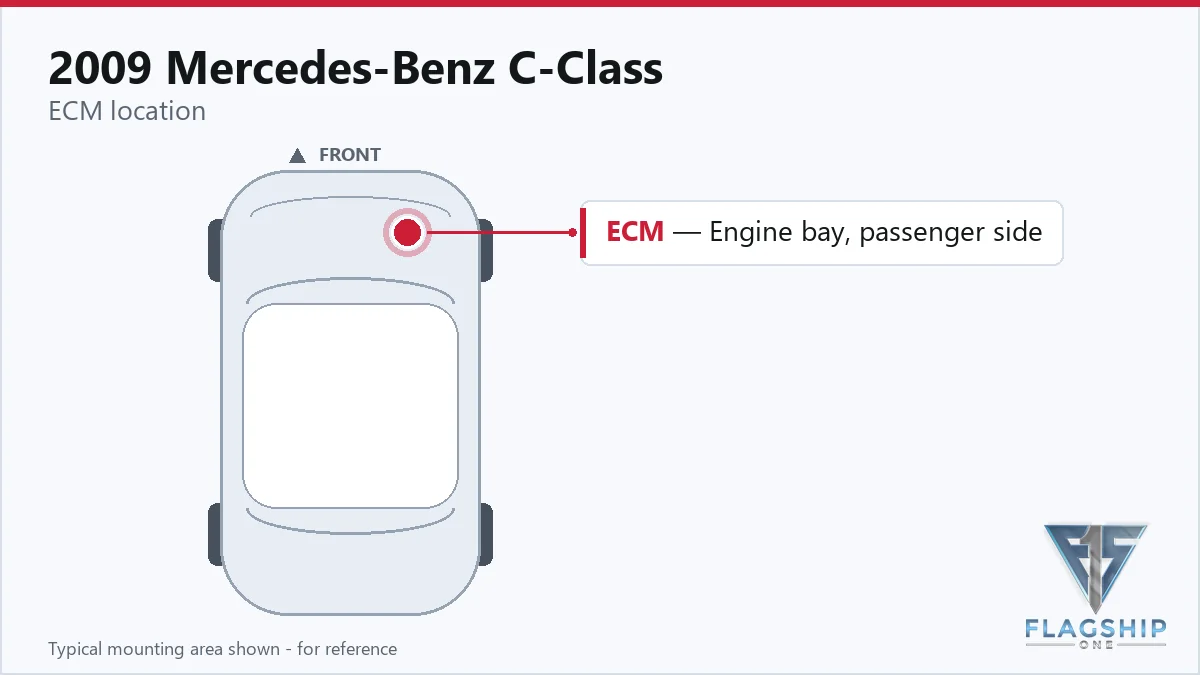
Work with the ignition off, and treat the module as static-sensitive: avoid touching the connector pins at any point.
| Operation | Configuration | Book Time |
|---|---|---|
| Engine Control Module R&R | All configurations | 0.9 hr |
| Engine Control Module Relearn | All configurations | 0.5 hr |
| Powertrain Control Module R&R | All configurations | 0.9 hr |
After replacing the ECM in your 2009 Mercedes-Benz C-Class, the vehicle requires a relearn procedure to ensure the new module communicates correctly with the engine and other systems. This process, which typically takes 0.5 hours, involves resetting adaptive values and synchronizing the ECM with the vehicle’s sensors. However, if you opt for a VIN-programmed replacement unit, these steps are already completed before the module arrives. This means you can install the unit and drive the vehicle without additional programming, reducing downtime and potential diagnostic headaches. While the relearn procedure is not overly complex, it does require specialized tools and knowledge, making a pre-programmed unit a convenient option for many owners.
When the ECM in your 2009 Mercedes-Benz C-Class begins to fail, symptoms can vary but often include noticeable drivability issues. You may experience intermittent stalling, especially at idle or during low-speed driving, as the module struggles to maintain consistent engine operation. Rough idling or misfires are also common, as the ECM loses its ability to precisely control fuel injection and ignition timing. In some cases, the vehicle may fail to start altogether, leaving you stranded with no clear indication of the problem. Another telltale sign is the illumination of the check engine light, often accompanied by trouble codes related to engine performance. For example, a memory checksum error may appear, indicating an internal fault within the ECM. Additionally, you might notice poor fuel economy or reduced power, as the engine compensates for the module’s inability to optimize performance. If your scan tool fails to communicate with the ECM, it could signal a complete module failure, requiring immediate attention.
Common signs include stalling, rough idling, or a no-start condition. You may also see a check engine light with codes related to engine performance or module communication. If your scan tool cannot communicate with the ECM, it may indicate a complete failure.
While the physical replacement is straightforward, the module requires a relearn procedure afterward. If you’re not comfortable with diagnostic tools or programming, it’s best to have a professional handle the installation to avoid drivability issues.
The relearn procedure resets adaptive values and synchronizes the new ECM with the vehicle’s sensors. This ensures the engine runs smoothly and prevents issues like poor idle quality or hesitation during acceleration.
Skipping the relearn procedure may result in poor engine performance, including rough idling, stalling, or reduced power. The vehicle may also fail to start or exhibit erratic behavior until the procedure is completed.
Not all replacement ECMs are identical. Some may require additional programming, while others, like those from Flagship One, arrive VIN-programmed and ready to install. Choosing the right unit can save time and ensure compatibility with your vehicle.
If your 2009 Mercedes-Benz C-Class is showing signs of ECM failure, you have options. A repair may be possible in some cases, but it often involves diagnostic uncertainty and potential recurring issues. A refurbished or new replacement unit, particularly one that arrives pre-programmed, can restore your vehicle’s performance quickly and reliably. Given the labor involved in installation and programming, selecting the right module upfront can save you time and frustration down the road.
Flagship One stocks a refurbished, VIN-programmed PCM for the 2009 Mercedes-Benz C-Class with a lifetime warranty, free shipping and no core charge. The full Mercedes-Benz C-Class module lineup covers other engine configurations as well.
The ECM in your 2009 Mercedes-Benz C-Class plays a vital role in engine performance and drivability. Whether you’re dealing with stalling, misfires, or a no-start condition, understanding the module’s function and replacement process can help you make informed decisions. With the right approach, you can restore your vehicle’s reliability and get back on the road with confidence.