
Last updated on August 25th, 2026 at 12:58 pm
The engine control module (ECM) in your 2012 Audi A7 manages fuel delivery, ignition timing, and emissions systems. A failing ECM may cause rough running, stalling, or a no-start condition, often triggering the check engine light with specific trouble codes.
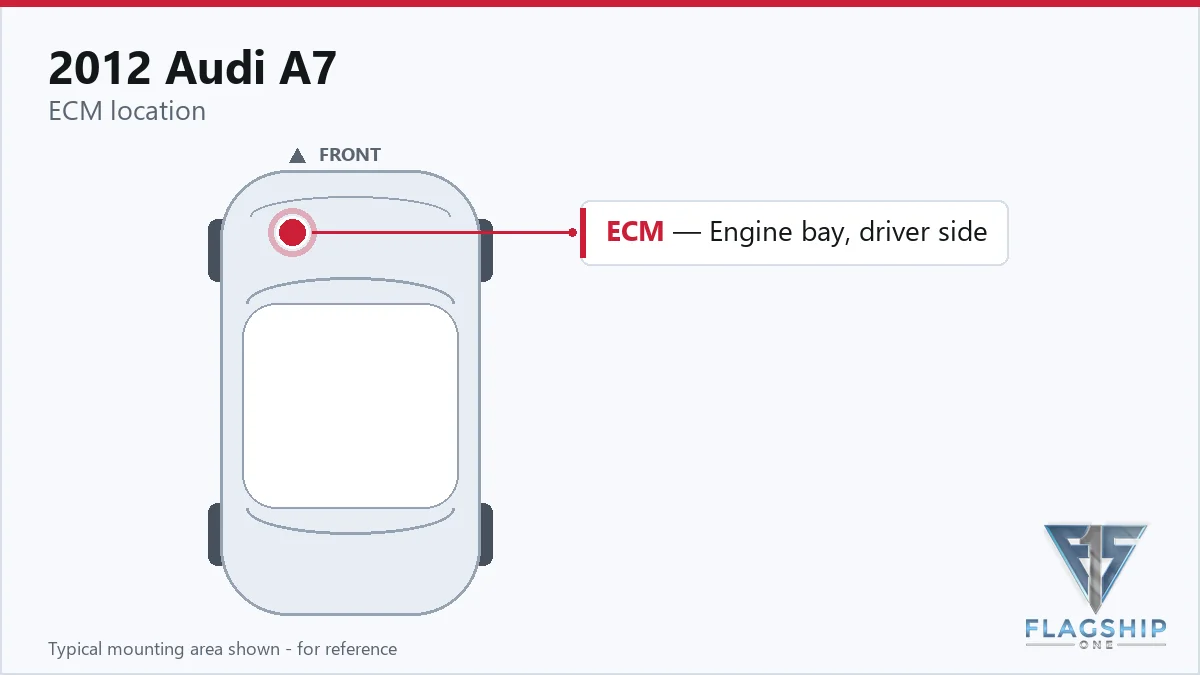
If your 2012 Audi A7 is running poorly or refusing to start, the engine control module (ECM) may be the culprit. This critical component oversees fuel injection, ignition, and emissions systems, and its failure can lead to a range of drivability issues. Replacing the ECM involves more than just swapping hardware—it requires precise programming to match your vehicle’s specifications. Understanding the location, labor time, and post-install steps helps you make an informed decision, whether you’re tackling the job yourself or working with a shop. A properly functioning ECM restores smooth operation and prevents recurring trouble codes.
2012 Audi A7
OEM programmed ECM for your 2012 Audi A7 — plug & play, no dealer visit.
Free shipping · Lifetime warranty
In your 2012 Audi A7, the engine control module (ECM) acts as the brain for the powertrain, continuously adjusting fuel and ignition timing to optimize performance and efficiency. It also monitors emissions systems, ensuring compliance with environmental standards. When the ECM fails, you may experience rough idling, hesitation under acceleration, or even a complete no-start condition. The module’s role extends beyond the engine, as it shares critical data with other systems, including the replacement engine control modules for the Audi A7 and the all-wheel-drive control unit. Without a fully functional ECM, your vehicle’s drivability and fuel economy may suffer significantly.
| Operation | Configuration | Book Time |
|---|---|---|
| Engine Control Module Relearn | All configurations | 0.5 hr |
| Engine Control Module R&R | All configurations | 1.4 hr |
| Powertrain Control Module R&R | All configurations | 0.5 hr |
| Powertrain Control Module Relearn | All configurations | 0.5 hr |
After replacing the engine control module in your 2012 Audi A7, the factory procedure requires a relearn process, which typically takes 0.5 hours. This step ensures the new module communicates correctly with the vehicle’s sensors and other systems. However, if you install a VIN-programmed replacement unit, these programming steps are already completed, saving you time and reducing the risk of post-installation issues. Always confirm that the replacement module matches your vehicle’s specifications to avoid compatibility problems.
A failing engine control module in your 2012 Audi A7 may cause a variety of symptoms, including stalling, rough idling, or a no-start condition. You might also notice poor fuel economy, hesitation during acceleration, or the check engine light illuminating with codes like evaporative emissions system leak. In some cases, the vehicle may enter a limp-home mode, limiting power to prevent further damage. If the ECM loses communication with the scan tool, it could indicate an internal failure or a wiring issue. Addressing these symptoms promptly helps prevent further drivability problems.
Factory service bulletins for the 2012 Audi A7 highlight several recurring issues related to the engine control module. Bulletin 01 notes a check engine light with code P0456, indicating a small evaporative emissions system leak, even when no physical leak is present. Another bulletin references codes P1128, P1130, P0087, P2440, and P2442, which may signal fuel system or sensor faults. These bulletins suggest inspecting wiring, connectors, and related components before replacing the ECM.
| Bulletin | Subject | What It Addresses |
|---|---|---|
| — | 01 MIL on, no leak in EVAP system (DTC P045600 in ECM) | — |
| — | 01 MIL on, DTC P112800 and/or P113000 or P008700 or P244000 and/or P244200 in ECM | — |
The relearn procedure ensures the new ECM synchronizes with your vehicle’s sensors, fuel system, and other control modules. Without it, the engine may run poorly or fail to start. The process typically takes 0.5 hours and is required by the factory to restore proper operation.
Driving with a failing ECM may lead to poor performance, stalling, or even a no-start condition. In some cases, the vehicle may enter limp mode to prevent damage. If you suspect ECM issues, have the system diagnosed promptly to avoid further complications.
Common signs include rough idling, hesitation, stalling, or a no-start condition. The check engine light may illuminate with codes like P0456, P1128, or P0087. A scan tool can confirm whether the ECM is communicating properly or logging faults.
If your 2012 Audi A7 requires an ECM replacement, you have options. A new or refurbished unit can restore proper engine function, but programming is critical. Factory procedures demand a relearn process, which adds time and complexity. Choosing a pre-programmed replacement eliminates this step, allowing for a quicker, more straightforward installation. Consider your vehicle’s needs and your repair timeline when selecting the best approach.
Flagship One stocks a refurbished, VIN-programmed PCM for the 2012 Audi A7 with a lifetime warranty, free shipping and no core charge. The full Audi A7 module lineup covers other engine configurations as well.
The engine control module in your 2012 Audi A7 plays a vital role in maintaining smooth operation and fuel efficiency. If you’re experiencing drivability issues or recurring trouble codes, a replacement may be necessary. Understanding the location, labor time, and programming requirements helps you make an informed decision. Whether you opt for a new or refurbished unit, ensure it’s properly matched to your vehicle to avoid further complications.