
Last updated on August 25th, 2026 at 12:57 pm
The engine control module (ECM) in your 2015 Audi A7 manages fuel injection, ignition timing, and emissions systems. Failure may lead to poor engine performance, stalling, or trouble codes related to internal processor faults.
If your 2015 Audi A7 has been stalling, refusing to start, or throwing cryptic engine codes, the engine control module may be the culprit. This small but critical computer oversees everything from fuel delivery to ignition timing, and when it fails, your vehicle’s performance suffers. Understanding what the ECM does, where it’s located, and what replacement involves can help you make informed decisions about repairs. This guide covers the essentials: symptoms of failure, labor requirements, and what to expect during replacement—so you can address issues efficiently without unnecessary surprises.
The engine control module in your 2015 Audi A7 acts as the brain of the engine, continuously adjusting fuel injection, ignition timing, and emissions controls to optimize performance. It relies on inputs from sensors throughout the vehicle to make real-time decisions, ensuring smooth operation under varying conditions. When this module malfunctions, you may notice hesitation, stalling, or even a complete no-start condition. Replacing it isn’t just about swapping hardware; the vehicle’s systems must recognize the new replacement engine computers for the A7 to function correctly. Without proper communication between the ECM and other components, drivability issues are likely to persist.
2015 Audi A7
OEM programmed ECM for your 2015 Audi A7 — plug & play, no dealer visit.
Free shipping · Lifetime warranty
The engine control module in your 2015 Audi A7 is tucked beneath the plenum chamber at the base of the windshield, making access a bit involved. To replace it, the technician will need to remove components in this area, which typically adds up to 1.4 hours of labor. Once the old module is disconnected, the new one can be installed in its place. The process doesn’t require specialized tools, but precision is key—improper handling may lead to connection issues or damage to surrounding components. After installation, a relearn procedure is often necessary to synchronize the module with the vehicle’s systems, which may take an additional 0.5 hours.
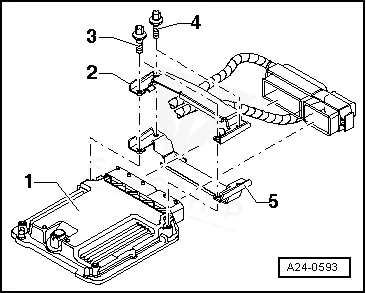
Work with the ignition off, and treat the module as static-sensitive: avoid touching the connector pins at any point.
| Operation | Configuration | Book Time |
|---|---|---|
| Engine Control Module Relearn | RS7 | 0.5 hr |
| Engine Control Module Relearn | S7 | 0.5 hr |
| Engine Control Module Relearn | A7 Quattro | 0.5 hr |
| Engine Control Module R&R | RS7 | 1.4 hr |
| Engine Control Module R&R | S7 | 1.4 hr |
| Engine Control Module R&R | A7 Quattro | 1.4 hr |
| Powertrain Control Module R&R | RS7 | 0.5 hr |
| Powertrain Control Module R&R | S7 | 0.5 hr |
After replacing the engine control module in your 2015 Audi A7, the factory procedure requires a relearn process to ensure the new unit communicates properly with the vehicle’s systems. This step typically adds 0.5 hours of labor and involves resetting parameters to match your specific vehicle. However, if you opt for a VIN-programmed replacement unit, these steps are already completed, saving you time and potential hassle. This pre-programming ensures the module is ready to integrate seamlessly with your Audi’s existing systems, reducing the risk of post-installation issues.
When the engine control module in your 2015 Audi A7 begins to fail, you may notice symptoms like intermittent stalling, rough idling, or difficulty starting the engine. Some owners report poor throttle response or unexplained misfires, while others experience shifting issues if the module’s communication with the transmission is disrupted. In many cases, the vehicle’s onboard diagnostics will log internal faults, such as an internal control module memory error, which can trigger the check engine light. If the module fails completely, your scan tool may struggle to communicate with the vehicle, leaving you with limited diagnostic options until the issue is resolved.
The 2015 Audi A7 may log specific trouble codes when the engine control module experiences internal faults. These codes often point to processor or memory issues within the module itself, rather than sensor or wiring problems elsewhere in the vehicle.
| Code | Meaning | Full Guide |
|---|---|---|
| P0603 | Keep-alive memory (KAM) error | Full P0603 guide → |
| P0605 | Internal ROM error | Full P0605 guide → |
| P060A | Module-internal fault | — |
| P060B | Module-internal fault | — |
| P0613 | Module-internal fault | Full P0613 guide → |
| P0667 | Module-internal fault | Full P0667 guide → |
Common signs include stalling, no-start conditions, or trouble codes like P0603 or P060A. If your scan tool can’t communicate with the vehicle, the ECM may be the issue. A professional diagnostic can confirm whether replacement is needed.
While the physical replacement is straightforward, the module’s location under the windshield plenum requires careful disassembly. Additionally, a factory relearn procedure is typically needed afterward, which may require specialized equipment or software.
In the 2015 Audi A7, the ECM (engine control module) focuses on engine management, while the PCM (powertrain control module) may handle additional functions like transmission control. Some vehicles integrate these roles into a single unit, but your Audi’s systems are often separate.
If your 2015 Audi A7 is showing signs of ECM failure, you have options. A repair may address minor issues, but if the module is beyond saving, a replacement is often the most reliable solution. Opting for a pre-programmed unit can streamline the process, eliminating the need for post-installation relearn procedures and getting you back on the road faster.
Flagship One stocks a refurbished, VIN-programmed PCM for the 2015 Audi A7 with a lifetime warranty, free shipping and no core charge. The full Audi A7 module lineup covers other engine configurations as well.
The engine control module in your 2015 Audi A7 plays a vital role in keeping your vehicle running smoothly. If you’re experiencing stalling, no-start conditions, or persistent trouble codes, addressing the ECM early can prevent further complications. Whether you choose a repair or replacement, understanding the process ensures you make the best decision for your vehicle’s long-term health.