
Last updated on August 25th, 2026 at 01:19 pm
The Engine Control Module (ECM) in your 2019 Hyundai Sonata Plug-In Hybrid manages fuel delivery, ignition timing, and hybrid system coordination. Failures may disrupt engine operation, trigger warning lights, or prevent the vehicle from starting.
If your 2019 Hyundai Sonata Plug-In Hybrid hesitates to start, stalls unexpectedly, or displays a check engine light, the Engine Control Module (ECM) may be at fault. This small but critical computer oversees engine performance and hybrid system integration. When it fails, drivability suffers, and diagnostic trouble codes appear. Understanding the ECM’s role, replacement process, and programming requirements helps you make informed repair decisions. This guide explains what to expect during replacement, common symptoms of failure, and how to protect your vehicle’s module from future issues.
The ECM in your 2019 Hyundai Sonata Plug-In Hybrid acts as the brain for engine and hybrid operations. It processes sensor data to optimize fuel injection, ignition timing, and power distribution between the gasoline engine and electric motor. A malfunctioning ECM may cause erratic behavior, such as rough idling, poor acceleration, or even a complete no-start condition. Since the module also communicates with the transmission control system, failures can indirectly affect shifting performance. If replacement becomes necessary, replacement engine computers for the Sonata Plug-In Hybrid ensure compatibility and proper functionality for your vehicle’s specific powertrain configuration.
2019 Hyundai Sonata Plug-In Hybrid
OEM programmed replacements — plug & play, no dealer visit.
Find yours by year, make & model →
Free shipping · Lifetime warranty
The ECM in your 2019 Hyundai Sonata Plug-In Hybrid is located next to the air cleaner assembly, making it relatively accessible for replacement. Factory procedures specify removing the module by disconnecting the electrical connector and unfastening the mounting bolts or nuts. Installation involves securing the new module with bolts or nuts torqued to 9.8 to 11.8 N·m. Labor estimates for removal and reinstallation typically run 0.5 hours, while a separate relearn procedure may add another 0.5 hours. A reset procedure, if needed, takes about 0.3 hours. Proper torque and secure connections are critical to prevent future issues.
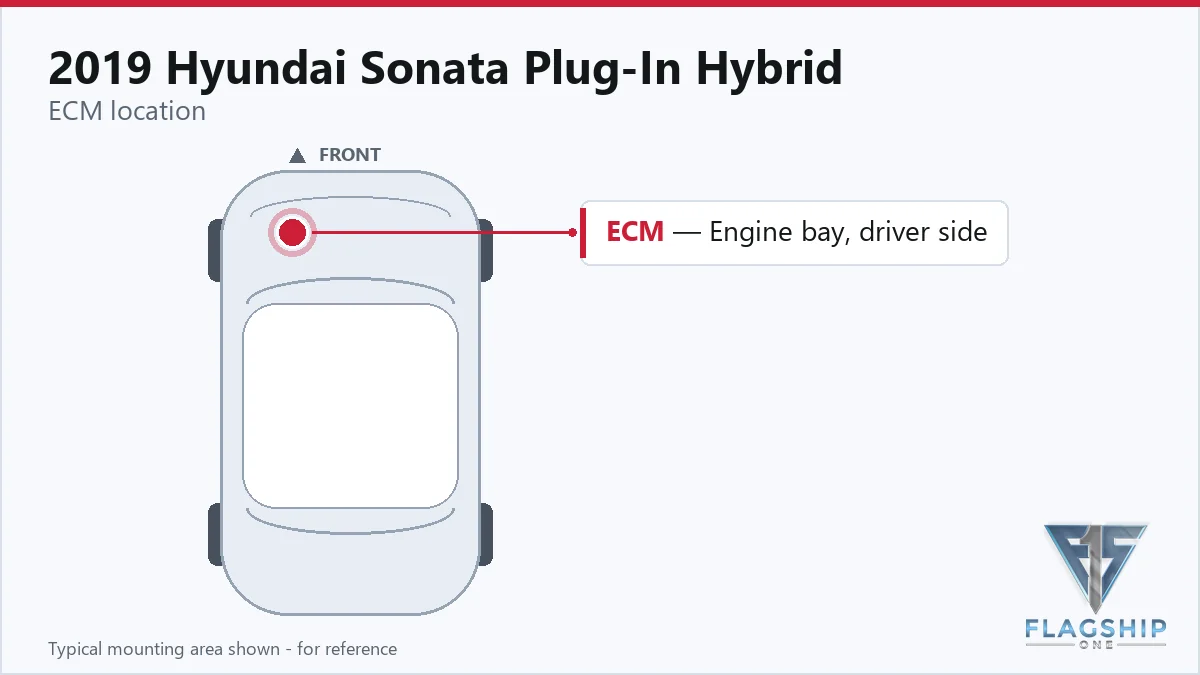
Work with the ignition off, and treat the module as static-sensitive: avoid touching the connector pins at any point.
| Operation | Configuration | Book Time |
|---|---|---|
| Engine Control Module R&R | All configurations | 0.5 hr |
| Engine Control Module Relearn | All configurations | 0.5 hr |
| Engine Control Module Reset | All configurations | 0.3 hr |
| Powertrain Control Module R&R | All configurations | 0.5 hr |
| Powertrain Control Module Relearn | All configurations | 0.5 hr |
After installing a new ECM in your 2019 Hyundai Sonata Plug-In Hybrid, the factory procedure requires programming the vehicle identification number (VIN) into the module. This step ensures the ECM communicates correctly with other onboard systems. However, a VIN-programmed replacement unit from Flagship One arrives ready for installation, eliminating the need for additional programming. This saves time and reduces the risk of errors during the setup process, allowing your vehicle to return to normal operation more quickly.
A failing ECM in your 2019 Hyundai Sonata Plug-In Hybrid may produce a range of symptoms. The vehicle might stall unexpectedly, hesitate during acceleration, or refuse to start altogether. You may notice the check engine light illuminated, often accompanied by codes related to internal module faults. One such code, internal control module ROM error, indicates a problem with the ECM’s read-only memory. Other signs include poor fuel economy, rough idling, or transmission shifting issues, as the ECM plays a role in coordinating these systems. If your scan tool fails to communicate with the module, it may also point to ECM failure.
The 2019 Hyundai Sonata Plug-In Hybrid’s ECM may generate specific trouble codes when internal faults occur. These codes help diagnose the source of drivability issues and guide repair decisions.
| Code | Meaning | Full Guide |
|---|---|---|
| P0605 | Internal ROM error | Full P0605 guide → |
Replacement typically requires 0.5 hours for removal and reinstallation. A relearn procedure may add another 0.5 hours, depending on the repair shop’s process. The exact time can vary based on technician experience and any additional diagnostics needed.
If the stalling is caused by an internal ECM fault, a replacement module may resolve the issue. However, other components like sensors or wiring could also contribute to the problem. A thorough diagnosis is recommended before replacing the ECM.
Yes, the factory procedure requires programming the VIN into the new ECM. Flagship One units arrive pre-programmed, so this step is already completed, saving time during installation.
If your 2019 Hyundai Sonata Plug-In Hybrid’s ECM has failed, you have options for replacement. A new OEM module may be available, but it often requires additional programming steps. Alternatively, a refurbished or remanufactured unit can provide a cost-effective solution without sacrificing reliability. Flagship One offers pre-programmed modules designed to restore your vehicle’s performance quickly and efficiently.
Flagship One stocks a refurbished, VIN-programmed PCM for the 2019 Hyundai Sonata Plug-In Hybrid with a lifetime warranty, free shipping and no core charge. The full Hyundai Sonata Plug-In Hybrid module lineup covers other engine configurations as well.
The ECM in your 2019 Hyundai Sonata Plug-In Hybrid is essential for smooth engine and hybrid system operation. If you’re experiencing drivability issues, a faulty module may be the cause. Understanding the replacement process, symptoms, and programming requirements helps you make the best repair decision. Consider a pre-programmed replacement unit to simplify the process and get your vehicle back on the road.