
Last updated on August 25th, 2026 at 01:12 pm
The Engine Control Module (ECM) in your 2016 Hyundai Sonata Plug-In Hybrid serves as the central computer managing the 2.0L engine and hybrid system integration. When this module fails, the vehicle may experience starting problems, erratic idle, and loss of hybrid functionality due to corrupted internal memory or hardware breakdown.
If your 2016 Hyundai Sonata Plug-In Hybrid is experiencing starting difficulties, unexpected stalling, or warning lights that refuse to clear, the Engine Control Module may be the culprit. This comprehensive guide walks you through understanding what the ECM does in your specific vehicle, recognizing failure symptoms, and navigating the replacement process with confidence. Whether you are a do-it-yourself mechanic or preparing for a professional repair, knowing the facts about this critical component helps you make informed decisions and avoid common pitfalls that lead to repeat repairs. The ECM serves as the brain of your 2.0L engine and hybrid coordination system, meaning its health directly impacts your vehicle’s drivability, fuel efficiency, and overall reliability. By the end of this guide, you will understand the replacement procedure, programming requirements, and why choosing a properly programmed replacement unit matters for your Sonata Plug-In Hybrid.
The Engine Control Module in your Sonnet Plug-In Hybrid engine computers represents the primary computing unit responsible for managing the 2.0L four-cylinder engine operating in conjunction with the hybrid electric system. This sophisticated computer monitors dozens of sensors throughout the powertrain, including coolant temperature, throttle position, oxygen sensors, crank position, and cam position inputs to calculate optimal fuel injection timing, ignition advance, and hybrid mode transitions. For the Sonata Plug-In Hybrid specifically, the ECM must also communicate seamlessly with the hybrid control module to manage the transition between pure electric propulsion, gas engine assist, and combined power delivery modes. The module processes this sensor data over 100 times per second, adjusting engine parameters in real time to meet driver demands while maintaining emissions compliance and maximizing fuel economy. When the internal processor or memory within the ECM becomes corrupted due to voltage spikes, thermal stress, or component aging, the module may enter a failsafe mode that prevents normal operation or causes intermittent electrical faults. Because this vehicle operates in a hybrid configuration with additional complexity over conventional models, ECM failure symptoms often manifest as degraded hybrid system performance, unexpected engine cycling, or complete refusal to start even when the high-voltage battery maintains proper charge.
2016 Hyundai Sonata Plug-In Hybrid
OEM programmed replacements — plug & play, no dealer visit.
Find yours by year, make & model →
Free shipping · Lifetime warranty
Replacing the ECM on your 2016 Hyundai Sonata Plug-In Hybrid requires accessing the module in the engine compartment, specifically positioned next to the air cleaner assembly where the factory routing places the unit for convenient service access. The removal and reinstallation procedure consumes approximately 0.5 hours of labor according to published book times, though this does not account for additional programming and relearn procedures that follow the physical replacement. After the old ECM is removed, the technician must install the replacement unit using the original mounting hardware, torquing all installation bolts and nuts to the factory specification of 9.8 to 11.8 N·m to ensure proper ground connections and vibration resistance. Overtightening beyond this range risks cracking the ECM housing or damaging threaded holes in the mounting bracket, while undertightening can cause micro-movement that leads to connector intermittent contact and future fault codes. The vehicle may require repositioning to gain adequate clearance for the module and associated wiring harnesses during the procedure, particularly when working around the air cleaner ductwork that shares the same general area.
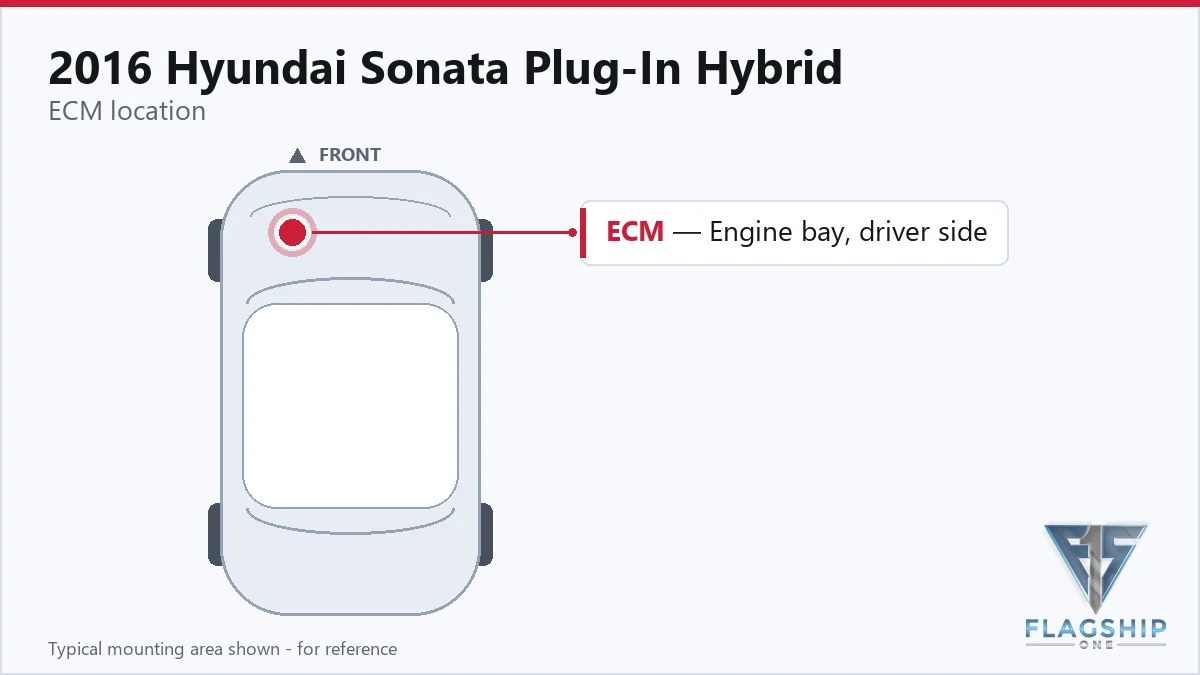
Work with the ignition off, and treat the module as static-sensitive: avoid touching the connector pins at any point.
| Operation | Configuration | Book Time |
|---|---|---|
| Engine Control Module R&R | All configurations | 0.5 hr |
| Engine Control Module Relearn | All configurations | 0.5 hr |
| Engine Control Module Reset | All configurations | 0.3 hr |
| Powertrain Control Module R&R | All configurations | 0.5 hr |
| Powertrain Control Module Relearn | All configurations | 0.5 hr |
Following the physical installation of a replacement ECM, the factory procedure mandates programming the vehicle identification number directly into the module memory before the engine will run properly. This VIN writing process, documented in Hyundai service bulletin 04-36-019 for ECM replacement procedures, ensures the replacement module recognizes your specific vehicle and prevents potential anti-theft system conflicts that would prevent ignition. After the VIN is written, the technician must perform a relearn procedure requiring approximately 0.5 hours to allow the new ECM to calibrate to your vehicle’s unique sensor characteristics and learned adaptive values stored in the powertrain control module. A reset procedure adding another 0.3 hours may be necessary to clear any stored fault codes and initialize the hybrid system communication protocols. Flagship One units arrive from the factory already programmed with your VIN, eliminating the need for this step when installing one of our replacement modules and reducing the overall time required to complete your repair.
Every VIN-programmed replacement unit from Flagship One arrives with these steps already completed.
When the Engine Control Module in your 2016 Hyundai Sonata Plug-In Hybrid begins to fail, the vehicle typically exhibits several recognizable symptoms that indicate the module requires attention. The most common presentation involves a no-start condition where the engine cranking motor operates normally but the engine refuses to fire, often accompanied by a check engine light that remains illuminated or flashes rapidly. Stalling during idle or low-speed driving represents another frequent complaint, particularly when the ECM loses synchronization with the hybrid system and cannot maintain proper air-fuel ratios during mode transitions. Diagnostic scan tools may show an inability to communicate with the ECM entirely, or display multiple unrelated trouble codes across various subsystems that point toward a central processing fault rather than individual sensor failures. The internal memory fault specifically indicates that the internal non-volatile memory within the module has experienced corruption, which may manifest as learned fuel trims resetting to default values, adaptive shifting behavior disappearing, or the vehicle reverting to default limp-mode operation. Additional symptoms can include rough idle, hesitation under acceleration, reduced fuel economy, and transmission shifting irregularities that feel harsh or delayed.
The 2016 Hyundai Sonata Plug-In Hybrid utilizes module-internal diagnostic trouble codes to help technicians identify when the Engine Control Module has detected an internal fault requiring replacement rather than simple sensor repair. These codes differ from conventional powertrain codes in that they originate from the module’s internal self-diagnostic routines rather than external sensor inputs.
| Code | Meaning | Full Guide |
|---|---|---|
| P0605 | Internal ROM error | Full P0605 guide → |
Hyundai has published service bulletin 04-36-019 addressing the VIN writing requirement during Engine Control Module and Powertrain Control Module replacements across multiple model years including those applicable to your Sonata Plug-In Hybrid. This bulletin establishes the factory procedure for programming the vehicle identification number into replacement modules and clarifies that proper VIN programming is essential for the anti-theft system to recognize the replacement unit. The bulletin also notes that failure to program the VIN correctly may result in a no-start condition or cause the immobilizer to prevent engine operation, necessitating repeat procedures to correct the oversight. Technicians following this bulletin must verify the programmed VIN matches the vehicle registration before releasing the car to the customer.
| Bulletin | Subject | What It Addresses |
|---|---|---|
| 04-36-019 | TSB • Fuel System • [04-36-019] 2005MY ECM AND PCM VIN WRITING DURING CONTROL MODULE REPLACEMEN | — |
You need an ECM programmed for your specific vehicle identification number. The module must match the 2.0L hybrid configuration and include the proper hybrid system integration logic. Units ordered without VIN programming will require dealer-level programming before installation.
The physical replacement is straightforward for those with mechanical experience, requiring access near the air cleaner assembly and proper torque to 9.8-11.8 N·m. However, the VIN programming and relearn procedures typically require dealer equipment or a professional tuning tool that most DIYers do not own.
If your scan tool cannot communicate with the ECM at all, or if you have trouble code P0605 indicating internal memory failure, the ECM itself is likely faulty. Problems isolated to the hybrid system typically still allow ECM communication and will set codes specific to the hybrid control modules.
The vehicle will likely not start, and the anti-theft system may immobilize the engine entirely. Some vehicles will run but display multiple fault codes related to security system conflicts. The cost of having the VIN programmed separately often exceeds the savings from buying an unprogrammed unit.
Quality remanufactured units that undergo proper testing and come with VIN programming can offer reliable service at a lower cost. The key is purchasing from a reputable supplier who tests the internal memory and includes the proper hybrid integration software for your vehicle.
When your 2016 Hyundai Sonata Plug-In Hybrid requires ECM replacement, you have two primary paths forward: a genuine new unit from the dealer at premium pricing, or a professionally remanufactured unit from Flagship One that arrives pre-programmed with your VIN and ready to install. Given the hybrid-specific programming requirements and the complexity of the 2.0L hybrid coordination system, the convenience of receiving a plug-and-play unit that eliminates dealer programming delays often makes remanufactured the practical choice for most owners. Consider your budget, timeline, and confidence in the installation process when making your decision.
Flagship One stocks a refurbished, VIN-programmed PCM for the 2016 Hyundai Sonata Plug-In Hybrid with a lifetime warranty, free shipping and no core charge. The full Hyundai Sonata Plug-In Hybrid module lineup covers other engine configurations as well.
Your 2016 Hyundai Sonata Plug-In Hybrid relies on a properly functioning Engine Control Module to coordinate the 2.0L engine with the hybrid system, making ECM health essential to reliable daily operation. Whether you pursue professional installation or tackle the replacement yourself, understanding the programming requirements, torque specifications, and symptom patterns empowers you to make sound repair decisions. If your ECM has failed, sourcing a properly programmed replacement unit gets you back on the road with minimal downtime and confidence in the repair.