
Last updated on August 25th, 2026 at 01:39 pm
The Powertrain Control Module on your 1994 Ford Taurus serves as the central computer managing engine timing, fuel delivery, and transaxle shift logic. When this unit fails, your vehicle may exhibit no-start conditions, erratic shifting, or illumination of the malfunction indicator lamp.
If your 1994 Ford Taurus with the 3.0L engine is experiencing hard-starting, stalling, or unexpected transmission behavior, the Powertrain Control Module often serves as the root cause. This comprehensive guide explains what the PCM does in your specific vehicle, how failures manifest, and the critical considerations that distinguish a successful repair from a costly mistake. You will learn exactly where the module mounts, what labor the job requires, and why matching the correct transaxle variant is not optional — it is mandatory to prevent catastrophic transmission damage. Whether you are diagnosing a no-start condition yourself or evaluating replacement options, the information here equips you to make informed decisions and avoid common pitfalls that plague this model year. The distinction between a proper replacement and a mismatched unit can mean the difference between a straightforward repair and a transmission rebuild.
The Powertrain Control Module on your 1994 Ford Taurus represents the primary electronic brain governing the 3.0L engine and its attached automatic transaxle. Unlike newer vehicles that separate engine and transmission control into distinct computers, the 1994 Taurus integrates these functions within a single unit often referred to as the PCM or EEC (Electronic Engine Control) processor. This module receives input from numerous sensors throughout the engine bay — including the coolant temperature sensor, throttle position sensor, and various knock sensors — then uses this data to calculate optimal fuel injector pulse width, ignition timing advance, and torque converter clutch engagement. The PCM also manages the idle air control valve to maintain stable idle speeds and coordinates with the ignition control module to govern spark delivery. Because this computer directly controls fuel delivery, timing, and shift patterns, any internal fault or corruption produces drivability symptoms that range from subtle stumble during acceleration to complete no-start conditions. The module stores adaptive fuel strategy learned over the life of the vehicle, which is why replacement without proper initialization often results in rough running until the computer recalibrates to your specific engine’s characteristics. Finding replacement engine computers for the 1994 Ford Taurus requires ensuring the replacement unit matches both the engine size and the exact transaxle application originally equipped on your vehicle.
Flagship One keeps Ford Taurus replacement engine computers in stock for exactly this failure pattern.
1994 Ford Taurus
OEM programmed ECM for your 1994 Ford Taurus — plug & play, no dealer visit.
Free shipping · Lifetime warranty
The Powertrain Control Module on the 1994 Ford Taurus 3.0L resides in the passenger side kick panel area, behind the interior trim panel near the right front door threshold. Access requires removing the lower kick panel trim piece, which is held in place with several push-pin fasteners and possibly a retaining screw. Once the panel is withdrawn, you will see the PCM mounted in a plastic bracket with an electrical connector secured by a locking tab. The replacement procedure involves disconnecting the negative battery terminal first — the factory caution explicitly requires the ignition switch to be OFF before any power disconnection to prevent module damage. After disconnecting the old module, transfer any mounting hardware to the replacement unit and reconnect the harness, ensuring the connector clicks fully into place. Reinstallation of the trim panel completes the physical work. Book time for the R&R operation is 0.4 hours for the removal and replacement itself, though this does not account for the additional relearn procedure required afterward. Plan accordingly if performing this repair yourself, allowing extra time to verify proper operation after the new module initializes.
| Operation | Configuration | Book Time |
|---|---|---|
| Powertrain Control Module R&R | All configurations | 0.4 hr |
| Powertrain Control Module Relearn | All configurations | 0.5 hr |
| Engine Control Module R&R | All configurations | 0.9 hr |
Following physical replacement of the PCM in your 1994 Ford Taurus, the factory procedure requires executing a relearn procedure to allow the new module to adapt to your specific engine and transaxle characteristics. This relearn process, which requires 0.5 hours of labor according to factory time guides, teaches the PCM your engine’s unique fuel trims and idle air control values. The process typically involves a series of idle cycles, accelerator pedal movements, and a test drive through various operating conditions so the computer can establish its adaptive memory. Without this step, the vehicle may run roughly, exhibit erratic shifting, or display persistent check engine illumination. The good news is that Flagship One units arrive pre-programmed with your specific VIN, which means many of these initialization steps are completed before the module ever reaches you. This VIN-programming significantly reduces the post-install procedure, often allowing the vehicle to start and run acceptably without requiring the full dealer relearn sequence. However, a short driving period is still recommended to allow the module to fully optimize its strategy for your particular engine.
Every VIN-programmed replacement unit from Flagship One arrives with these steps already completed.
When the Powertrain Control Module fails on a 1994 Ford Taurus 3.0L, the symptoms often manifest in ways that can be mistaken for other mechanical problems. The most dramatic presentation is a no-start condition where the engine cranking normally but receives no fuel or spark — the PCM simply fails to activate the fuel pump relay or the ignition system. Another common failure mode involves intermittent stalling, particularly at idle or under light load, where the module momentarily loses proper control of the idle air circuit or fuel delivery. Drivers may also notice the malfunction indicator lamp illuminating, though without OBD-II codes, this appears simply as an unexpected check engine light. Transmission symptoms frequently accompany PCM failure on this model because the module governs shift timing and torque converter lockup; harsh shifting, failure to upshift, or the transaxle getting stuck in gear all can trace back to a faulty computer. In some cases, the scan tool may fail to communicate with the PCM entirely, which points toward either a power supply issue or internal module failure. The vehicle might also display multiple unrelated trouble codes simultaneously if the PCM’s internal memory becomes corrupted. If your Taurus exhibits any combination of hard-starting, stalling, unexpected gear hunting, or a dead communication link to diagnostic equipment, the PCM warrants serious consideration as the culprit.
Factory service bulletin 95-10-02 addresses illumination of the malfunction indicator lamp on 1994 Ford Taurus models equipped with the distributorless ignition system. This bulletin concerns the Ignition Control Module rather than the primary PCM, but the two components interact closely in your vehicle’s ignition strategy. The bulletin describes revised connector retention clips and seals for the ICM connector to address intermittent MIL illumination caused by poor electrical connections. If your Taurus experiences repeated check engine light activation related to ignition system faults, inspecting and potentially replacing the ICM connector with the updated components may resolve the issue without PCM replacement. This bulletin reflects a known weak point in the ignition system architecture for this model year.
| Bulletin | Subject | What It Addresses |
|---|---|---|
| 95-10-02 | “MALFUNCTION INDICATOR LAMP” (MIL) ILLUMINATED – DISTRIBUTORLESS IGNITION SYSTEM (DIS) ONLY – I | — |
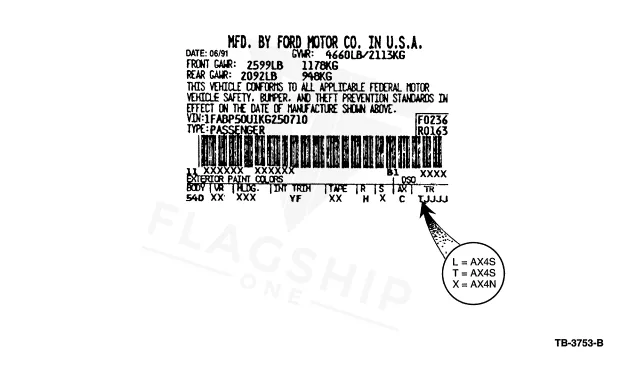
No. The PCM must match not only the engine displacement (3.0L) but also the exact transaxle type your vehicle left the factory with. The 1994 Taurus used either the AX4N or AX4S transaxle, and installing a PCM designed for the wrong variant will either cause erratic operation or transmit immediate damage to the transaxle.
Yes, mechanically skilled DIYers can perform the R&R in approximately 0.4 hours of book time. However, you must follow the factory caution to turn the ignition OFF before disconnecting the battery or module. After installation, plan for an additional 0.5 hours to allow the relearn procedure to complete, either through a dealer scan tool or by driving the vehicle through various operating conditions.
The new PCM contains default fuel and timing strategies that may not match your specific engine’s characteristics. The module requires a learning period to recalibrate its adaptive fuel tables. This is normal and typically resolves after 10-20 miles of varied driving. If roughness persists, verify that the replacement unit is correctly matched to your transaxle type.
On this model year, the terms are often used interchangeably, though technically the Powertrain Control Module integrates functions that would be separate in later vehicles. The 0.9 hour book time for Engine Control Module R&R likely refers to the same physical unit with the integrated transmission control functions.
The vehicle will experience erratic operation because the PCM’s transmission control strategy is incompatible with your hardware. Shifting will be unpredictable, and the torque converter clutch may engage at inappropriate times. This mismatch is easily avoided by confirming your vehicle’s original transaxle before ordering a replacement.
When your 1994 Ford Taurus 3.0L requires a PCM replacement, you face a choice between a genuine remanufactured unit from the dealer or a quality aftermarket replacement. Dealer units arrive VIN-programmed and ready to install but carry significant markup. Reputable suppliers like Flagship One offer VIN-programmed replacement modules that arrive ready to install, often saving hundreds of dollars while providing equivalent functionality. Given the critical nature of transaxle matching and the complexity of the relearn procedure, sourcing the correct unit from the start prevents costly comebacks. Evaluate your budget, warranty preferences, and whether the additional dealer programming fees justify the convenience of their unit versus a quality aftermarket alternative.
Flagship One stocks a refurbished, VIN-programmed PCM for the 1994 Ford Taurus with a lifetime warranty, free shipping and no core charge. The full Ford Taurus module lineup covers other engine configurations as well.
The Powertrain Control Module in your 1994 Ford Taurus 3.0L serves as the critical hub connecting engine management, transmission control, and vehicle diagnostics. While failure can leave you stranded, understanding the replacement process — from physical R&R to the required relearn procedure — empowers you to address the problem confidently. The most critical takeaway: verify transaxle compatibility before purchasing any replacement unit, because a mismatched PCM risks immediate and expensive transmission damage. Whether you choose dealer service or a quality VIN-programmed replacement from Flagship One, the information in this guide helps ensure your Taurus returns to reliable operation.