
Last updated on August 25th, 2026 at 01:52 pm
In the 2015 Mitsubishi Outlander, the Powertrain Control Module (PCM) and Engine Control Module (ECM) manage engine timing, fuel delivery, and transmission coordination. Failure of either unit can cause loss of power, stalling, or communication loss with diagnostic tools, often triggering related fault codes.
When a 2015 Mitsubishi Outlander experiences symptoms such as no‑start, rough idle, or unexpected gear shifts, the powertrain and engine control modules are often the culprits. Understanding how these computers operate, where they sit, and what steps are required after replacement can save you time and prevent costly missteps. This guide walks you through the function of the PCM and ECM in this model, describes the access path for removal, outlines the factory‑required programming and relearn actions, and offers practical advice to keep the new unit running smoothly. By the end, you should feel confident evaluating repair options, whether you choose a new factory‑programmed part or a refurbished alternative.
The Powertrain Control Module in the 2015 Mitsubishi Outlander interprets sensor data to control fuel injection, ignition timing, and transmission shift points, while the Engine Control Module focuses on engine‑specific parameters such as idle speed and emissions controls. Together, they ensure the vehicle meets performance and efficiency targets and maintain compliance with emission standards. Because the Outlander relies on precise coordination between engine and transmission, a malfunctioning PCM or ECM can lead to drivability issues, poor fuel economy, or failure to pass emissions testing. The vehicle’s diagnostic system monitors both units continuously, and any discrepancy triggers fault codes that guide technicians toward the root cause. Proper operation of these modules is essential for the Outlander’s overall reliability and driver confidence. replacement engine computers for the 2015 Mitsubishi Outlander are typically sourced from reputable suppliers who match the original specifications.
2015 Mitsubishi Outlander
OEM programmed replacements — plug & play, no dealer visit.
Find yours by year, make & model →
Free shipping · Lifetime warranty
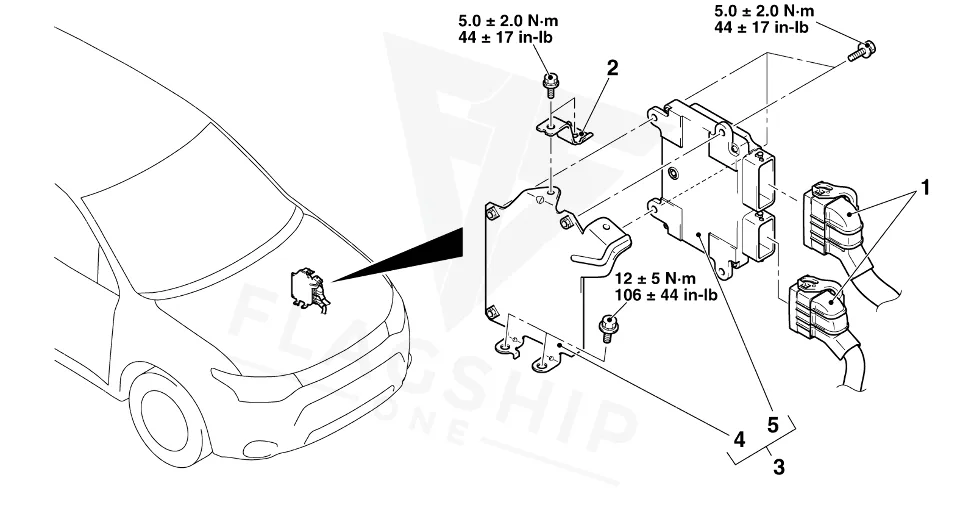
The factory removal procedure indicates that the control module sits adjacent to the air cleaner assembly. To access the PCM or ECM, you first remove the air cleaner assembly, which provides a clear path to the module mounting location. Once the assembly is out of the way, the module can be disconnected and unbolted. The labor book time for removing and reinstalling the PCM on the 2.4L engine version is listed as 0.5 hours, while the ECM removal and replacement time is also 0.5 hours. After the unit is physically replaced, the technician must perform a relearn or reset operation, each requiring an additional 0.5 hours of labor as specified in the factory guide.
| Operation | Configuration | Book Time |
|---|---|---|
| Powertrain Control Module R&R | 3.0L | 1.1 hr |
| Powertrain Control Module R&R | 2.4L | 0.5 hr |
| Powertrain Control Module Relearn | All configurations | 0.5 hr |
| Engine Control Module Reset | All configurations | 0.3 hr |
| Engine Control Module Relearn | All configurations | 0.5 hr |
| Engine Control Module R&R | All configurations | 1.1 hr |
After installing a new PCM or ECM in the 2015 Mitsubishi Outlander, the factory procedure calls for a VIN write operation and a series of relearn steps to synchronize the vehicle’s communication network. Flagship One supplies units that arrive already VIN‑programmed, eliminating the need for the technician to perform the VIN write manually. The remaining tasks include the PCM relearn, ECM reset, and ECM relearn, each of which typically takes about half an hour. a VIN-programmed replacement unit therefore reduces shop time and helps ensure the new computer integrates smoothly with the vehicle’s existing systems.
When the PCM or ECM in a 2015 Mitsubishi Outlander begins to fail, owners may notice the engine refusing to start, intermittent stalling at idle, or unexpected loss of power during acceleration. Transmission shifting can become harsh or erratic, and the check engine light often illuminates with codes related to sensor communication. A common diagnostic indication is a loss of communication with the scan tool, which can point to a failed module. In many cases, the fault code internal control module timing error appears, signaling that the control unit is not processing timing information correctly. These symptoms typically worsen under load or after the vehicle has been running for a while, prompting a need for prompt diagnosis and repair.
Common indicators include rough idle, delayed acceleration, erratic transmission shifts, and a persistent check engine light with related fault codes.
The ECM is accessible after removing the air cleaner assembly, but the subsequent reset and relearn procedures require diagnostic equipment and should be performed by a qualified technician.
Factory guidance advises against simultaneous replacement; you should replace one unit, register the necessary IDs, and then replace the next unit.
The labor book time for the PCM removal and reinstall on the 2.4L engine is listed as half an hour, plus additional time for relearn steps.
Flagship One units arrive VIN‑programmed, so the only required post‑install steps are the standard relearn and reset procedures outlined by the manufacturer.
When the PCM or ECM in your 2015 Mitsubishi Outlander fails, you can choose between a brand‑new factory‑programmed part or a professionally refurbished replacement. Both options restore the vehicle’s control functions, but a refurbished unit from Flagship One may offer cost savings while still meeting the required VIN programming and performance standards.
Flagship One stocks a refurbished, VIN-programmed PCM for the 2015 Mitsubishi Outlander with a lifetime warranty, free shipping and no core charge. The full Mitsubishi Outlander module lineup covers other engine configurations as well.
Replacing the PCM or ECM in a 2015 Mitsubishi Outlander restores essential engine and transmission control, ensuring reliable operation and compliance with emissions requirements. Consider your repair or refurbishment options carefully, and follow the factory reset and relearn steps to complete the job successfully.