
Last updated on August 25th, 2026 at 01:52 pm
The Powertrain Control Module (PCM) in the 2010 Mitsubishi Galant manages engine and transmission functions. Failures may trigger drivability issues, no-start conditions, or internal fault codes like P0606, often tied to electrical or software corruption.
If your 2010 Mitsubishi Galant has been stalling, refusing to start, or throwing cryptic engine codes, the Powertrain Control Module (PCM) may be the culprit. This small but critical computer oversees everything from fuel delivery to transmission shifts, and when it fails, your vehicle’s performance can suffer in frustrating ways. Replacing it isn’t just about swapping a part—it involves careful handling to avoid encryption issues and ensuring the new unit communicates properly with the rest of the vehicle’s systems. Understanding the process, from labor times to factory cautions, helps you make informed decisions and avoid unnecessary complications. Whether you’re a DIYer or working with a shop, knowing what to expect can save time, money, and headaches. This guide breaks down the essentials of PCM replacement for your Galant, including symptoms, installation steps, and how a pre-programmed unit can simplify the job.
The Powertrain Control Module (PCM) in the 2010 Mitsubishi Galant serves as the brain of the engine and transmission, coordinating fuel injection, ignition timing, and shift points to optimize performance and efficiency. Unlike earlier vehicles with separate engine and transmission controllers, the Galant’s PCM integrates both functions into a single unit, reducing complexity but increasing the stakes if it fails. A malfunctioning PCM may cause erratic idling, poor acceleration, or even prevent the engine from starting at all. Because it relies on input from sensors throughout the vehicle, the PCM also plays a key role in emissions compliance and fuel economy. When replacement becomes necessary, you’ll need replacement engine computers for the Galant that are compatible with your vehicle’s specific configuration. The PCM’s location and mounting design make it accessible, but its integration with other systems—like the ETACS-ECU—requires careful handling to avoid encryption mismatches or communication errors.
2010 Mitsubishi Galant
OEM programmed replacements — plug & play, no dealer visit.
Find yours by year, make & model →
Free shipping · Lifetime warranty
In the 2010 Mitsubishi Galant, the PCM is mounted in the engine bay, typically near the firewall or strut tower for protection from heat and moisture. Accessing it involves removing a few bolts or clips securing the protective cover, followed by disconnecting the wiring harness. The factory labor time for removing and reinstalling the PCM is 0.5 hours, which includes handling the connectors and ensuring proper seating. No specialized tools are required beyond basic hand tools, but care must be taken to avoid damaging the pins or connectors during disassembly. Once the old unit is removed, the new PCM is installed in the same location, with the wiring harness reconnected securely. The process is straightforward, but the factory caution about encryption codes means you’ll need to follow specific steps if other control modules are also being replaced.
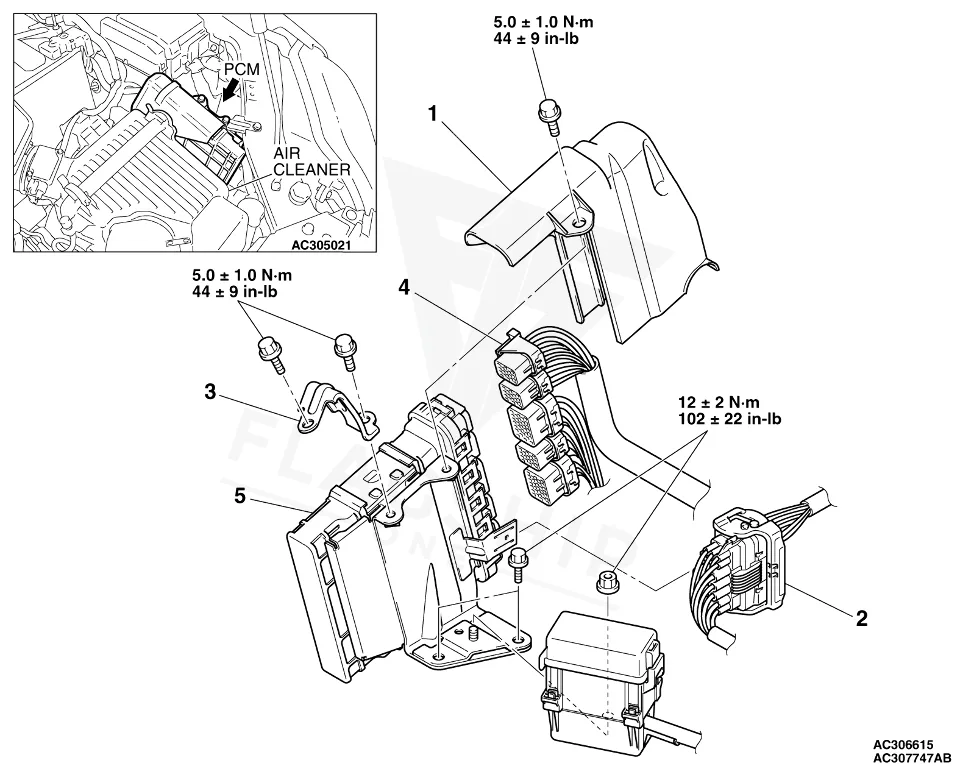
Work with the ignition off, and treat the module as static-sensitive: avoid touching the connector pins at any point.
| Operation | Configuration | Book Time |
|---|---|---|
| Powertrain Control Module R&R | All configurations | 0.5 hr |
| Engine Control Module Relearn | All configurations | 0.5 hr |
| Engine Control Module R&R | All configurations | 0.5 hr |
After installing a new PCM in your 2010 Mitsubishi Galant, the factory procedure requires an encrypted code registration to ensure the module communicates properly with the vehicle’s other systems, particularly the ETACS-ECU. This step is critical because the PCM and ETACS-ECU share encrypted data, and replacing both simultaneously can lead to communication failures. The registration process typically takes an additional 0.5 hours of labor, during which a scan tool is used to input the vehicle’s unique codes. However, if you opt for a VIN-programmed replacement unit, this step is already completed before the module arrives. Flagship One units are pre-configured to match your Galant’s specific VIN, eliminating the need for post-install programming and reducing the risk of encryption errors. This not only saves time but also ensures the new PCM integrates seamlessly with the rest of the vehicle’s electronics.
A failing PCM in the 2010 Mitsubishi Galant may produce a range of symptoms, some subtle and others impossible to ignore. One of the most common signs is a no-start condition, where the engine cranks but refuses to fire, often due to incorrect fuel or spark timing signals. Stalling at idle or during acceleration is another frequent issue, as the PCM struggles to maintain consistent engine operation. Drivers may also notice poor fuel economy, rough shifting, or the illumination of the check engine light. In some cases, the vehicle may enter a “limp mode,” limiting power to prevent further damage. Scan tool communication failures can also occur, making it difficult to retrieve or clear codes. If the PCM has an internal fault, you might see an internal processor error, which indicates the module’s self-check has failed. Other potential symptoms include erratic tachometer readings, delayed throttle response, or even intermittent electrical gremlins like flickering dashboard lights. Because the PCM controls so many systems, diagnosing its failure can be tricky—symptoms often overlap with those of sensor or wiring issues. However, if multiple systems seem affected simultaneously, the PCM is a likely suspect.
The 2010 Mitsubishi Galant’s PCM may store specific trouble codes when it detects internal faults or communication errors. These codes help narrow down the issue and guide repairs, though they should always be interpreted alongside other diagnostic steps.
| Code | Meaning | Full Guide |
|---|---|---|
| P0606 | Module processor failure | Full P0606 guide → |
Mitsubishi has issued cautions regarding the replacement of the PCM and ETACS-ECU in the 2010 Galant. The factory advises against replacing both modules simultaneously, as this can lead to encryption conflicts that prevent the vehicle from starting. Instead, one module should be replaced first, followed by the encrypted code registration process outlined in the service manual. This ensures the new module communicates properly with the remaining systems. While no additional bulletins specific to PCM failures were provided, following these guidelines is critical to avoiding unnecessary complications during replacement.
Random stalling in your Galant may stem from a faulty PCM, especially if the issue occurs alongside other symptoms like poor acceleration or no-start conditions. The PCM controls fuel delivery and ignition timing, so if it’s failing, the engine may cut out unexpectedly. A scan tool can help confirm whether the PCM is storing internal fault codes like P0606.
Replacing the PCM in your Galant is physically straightforward, as it involves removing a cover and disconnecting a wiring harness. However, the factory requires encrypted code registration after installation, which typically requires a scan tool. If you’re not comfortable with this step, a shop can handle it, though a pre-programmed unit simplifies the process.
Replacing both the PCM and ETACS-ECU simultaneously in your Galant can lead to encryption conflicts, preventing the vehicle from starting. Mitsubishi’s service manual advises replacing one module at a time, followed by registering the encrypted code to ensure proper communication between the two units.
Distinguishing between a bad PCM and a sensor issue in your Galant can be challenging, as both may produce similar symptoms. However, if multiple systems (like fuel delivery, ignition, and transmission) seem affected simultaneously, the PCM is more likely the culprit. A scan tool can help identify internal PCM faults, such as P0606, which point to module failure rather than a sensor issue.
A new PCM for your Galant will typically require programming to match your vehicle’s VIN and encrypted codes. However, if you purchase a pre-programmed unit, this step is already completed, allowing for a plug-and-play installation. This eliminates the need for post-install registration and reduces the risk of communication errors.
If your 2010 Mitsubishi Galant is experiencing PCM-related issues, you have options for repair or replacement. While a dealership may offer a new OEM unit, the cost and programming requirements can add up quickly. A refurbished or pre-programmed replacement unit provides a cost-effective alternative, especially when paired with the labor savings of a VIN-matched module. Whether you’re tackling the job yourself or working with a shop, understanding the process and factory cautions ensures a smoother repair and gets your Galant back on the road reliably.
Flagship One stocks a refurbished, VIN-programmed PCM for the 2010 Mitsubishi Galant with a lifetime warranty, free shipping and no core charge. The full Mitsubishi Galant module lineup covers other engine configurations as well.
Replacing the PCM in your 2010 Mitsubishi Galant doesn’t have to be a daunting task, especially when you’re armed with the right information. From recognizing the symptoms of failure to understanding the factory’s encryption requirements, each step plays a role in ensuring a successful repair. Whether you opt for a dealership solution or a pre-programmed replacement unit, the key is to follow the proper procedures to avoid complications. With the right approach, your Galant can regain its reliability and performance, keeping you on the road with confidence.