
Last updated on August 25th, 2026 at 01:55 pm
The powertrain control module (PCM) in your 1994 Mitsubishi Galant manages fuel delivery, ignition timing, and transmission behavior. Failures may cause erratic engine performance, stalling, or a complete no-start condition without warning.
If your 1994 Mitsubishi Galant suddenly refuses to start or stalls unpredictably, the powertrain control module (PCM) may be the culprit. This small computer coordinates fuel injection, spark timing, and transmission shifts to keep your engine running smoothly. Replacing it involves accessing a hidden location and performing a factory relearn procedure—unless you opt for a pre-programmed unit. Understanding the role of this module, where it’s located, and what to expect during replacement can help you make an informed decision without unnecessary delays or guesswork.
The PCM in your 1994 Mitsubishi Galant acts as the brain for engine and transmission operations. It continuously adjusts fuel mixture, ignition timing, and shift points based on sensor inputs like throttle position, engine speed, and coolant temperature. A failing module may disrupt these calculations, leading to poor performance or a vehicle that won’t run at all. Since this model predates OBD-II, there are no stored trouble codes to guide diagnostics, making replacement PCMs for the Galant a practical solution when symptoms point to electronic failure.
1994 Mitsubishi Galant
OEM programmed replacements — plug & play, no dealer visit.
Find yours by year, make & model →
Free shipping · Lifetime warranty
The PCM in the 1994 Mitsubishi Galant is mounted in a location shared with the Mirage and Diamante models. Accessing it requires removing interior panels or trim near the passenger-side footwell, depending on the exact mounting position. Replacement involves disconnecting the battery, unplugging the wiring harness, and removing the module’s mounting bolts. Labor time for removal and reinstallation is typically 0.9 hours, though some technicians may complete it in slightly less time. No specialized tools are required beyond basic hand tools, but care should be taken to avoid damaging connectors during disassembly.
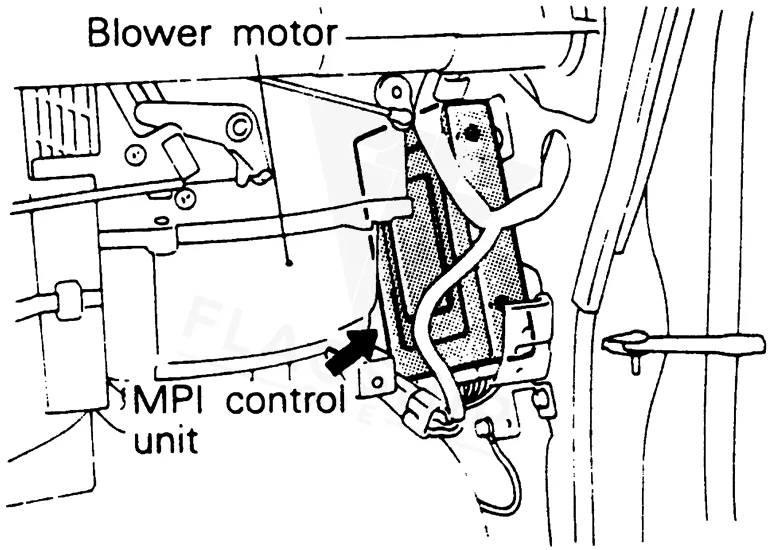
Work with the ignition off, and treat the module as static-sensitive: avoid touching the connector pins at any point.
| Operation | Configuration | Book Time |
|---|---|---|
| Engine Control Module R&R | All configurations | 0.7 hr |
| Powertrain Control Module R&R | All configurations | 0.9 hr |
| Powertrain Control Module Relearn | All configurations | 0.5 hr |
After installing a new PCM in your 1994 Mitsubishi Galant, the factory procedure requires a 0.5-hour relearn process to synchronize the module with the vehicle’s sensors and transmission. This step ensures proper engine performance and shift quality. However, a VIN-programmed replacement unit arrives pre-configured for your vehicle, eliminating the need for manual relearn procedures and saving you time during installation.
A failing PCM in the 1994 Mitsubishi Galant often causes symptoms like intermittent stalling, rough idle, or a complete no-start condition. You may also notice erratic transmission shifts or the engine running too rich or too lean. Since this model lacks OBD-II diagnostics, there are no stored trouble codes to confirm the issue. Instead, symptoms typically appear suddenly and may worsen over time, making prompt replacement a practical step if other potential causes have been ruled out.
Replacement is straightforward if you’re comfortable with basic mechanical work. The module is accessible after removing interior trim, and no special tools are required. However, you’ll need to perform a factory relearn procedure unless you use a pre-programmed unit.
Random stalling after a cold soak is a common symptom of PCM failure in this model. The module may struggle to maintain stable engine operation until it warms up, leading to intermittent no-start or stalling conditions.
Since this model lacks OBD-II diagnostics, you’ll need to rely on symptoms like stalling, misfires, or a no-start condition. If other potential causes (fuel pump, ignition system, sensors) have been ruled out, PCM failure is a likely culprit.
If your 1994 Mitsubishi Galant is experiencing PCM-related issues, you have two main options: attempt a repair or opt for a replacement unit. Given the age of the vehicle, a refurbished or new PCM is often the most practical solution, especially if you choose a pre-programmed module to avoid manual relearn procedures. This approach minimizes downtime and ensures reliable performance.
Flagship One stocks a refurbished, VIN-programmed PCM for the 1994 Mitsubishi Galant with a lifetime warranty, free shipping and no core charge. The full Mitsubishi Galant module lineup covers other engine configurations as well.
The 1994 Mitsubishi Galant relies on its PCM to manage critical engine and transmission functions. If you’re dealing with stalling, misfires, or a no-start condition, replacing the module with a pre-programmed unit can restore smooth operation quickly. Understanding the symptoms, location, and installation process helps you make an informed decision for your vehicle.